Posted by Krista J. Kesselring, 24 April 2023.
Being a rich heiress was dangerous when the law gave a man control of his wife’s property. Jane Puckering learned as much when Joseph Walsh had her abducted from Greenwich Park one fine afternoon in September 1649, then spirited her to Flanders to force her through a wedding ceremony. The outrage prompted new legislation from the republican authorities to preserve the ‘liberty and freedom’ that ought to be observed in contracts of marriage. Like their attempts to remodel other relationships of power, the revolutionaries’ efforts in respect to marriage proved fraught and fleeting, but interesting nonetheless—not least in light of attempts to eradicate child, early, and forced marriages in the present, such as the recent increase of the minimum age of marriage in England and Wales. This month’s post tells the tale of Jane Puckering’s abduction and its aftermath, and nods to a mystery embedded within it: Puckering’s abductor may have had help from the royalist secret agent (and royal mistress) Jane Whorwood. We know what Walsh hoped to gain; what Whorwood wanted is (to me, at least) unclear, but her presence points us toward added dimensions of the role of consent in early modern marriages.
Jane Puckering was nineteen at the time of her abduction, still under guardianship. The only surviving child of Sir Thomas Puckering (and a granddaughter of the Elizabethan Lord Keeper John Puckering), she stood to inherit lands worth at least £3000 per year upon her father’s death in 1637.[1] The estate made her a valuable prize, one Joseph Walsh decided to seize for himself.

Joseph’s brother William, Robert Thompson, and a few other men—all armed, all previously unknown to Jane—attacked while she was walking in the park with her cousin Magdalene Smith and two attendants. Violently fighting off Jane’s companions—holding a pistol to one, holding another down—the men then rode east with their captive. As they passed through Plumstead, several people saw them struggling with a woman fighting to escape. The blacksmith Robert Collard reported seeing three men riding at speed past his forge, one with ‘a little gentlewoman before him, tied to him with a silk garter or some such thing’. The man who carried her sang aloud to drown out her cries. Ursula Snape, who kept the Rose and Crown tavern, said much the same and added that the woman had beckoned for her help. Working in her husband’s hat shop, Dorothea Sprignoll heard a great shrieking and screaming; fearing that a child had been trodden by horses ‘or some such disaster’, she looked out to see instead a man who ‘carried in a violent manner a little gentlewoman before him’. When the party passed, Dorothea said that she and the others, talking amongst themselves of the horsemen, ‘did mistrust that they had stolen the gentlewoman somewhere’.[2] Indeed they had. At Erith, Joseph Walsh and other accomplices waited with a ship. They sailed for the continent.
Puckering’s friends immediately petitioned the Council of State for help. The councillors in turn wrote to their agents abroad about the ‘foul fact’ of the woman ‘lately stolen from Greenwich’. Cousin Magdalene and Margaret Walford, a servant who had tended Jane since birth, left to find the party in Flanders, accompanied by John Barton, an agent paid by Jane’s guardian. It became a matter of some international significance, requiring high diplomacy and vast expenditures. Barton recorded expenses in Brussels, Bruges, Flushing and more, with payments to interpreters, sea captains, and washerwomen, along with sizable ‘gratuities’ to anyone who might help the suit: he tallied his part of the costs of Jane’s redemption at £820. Walsh petitioned the Spanish king for assistance and seems to have had help from English Catholics and royalist expats, not least the Jesuit who performed the ceremony. Even so, Magdalene managed to have the governor of Ostend transfer Jane from Joseph’s keeping to the English convent in Nieuwpoort while the Bishop of Ypres dealt with a particularly contentious marriage case. About a year after her abduction, Jane was finally back in England and petitioning parliament to be free of her unwanted husband.[3]
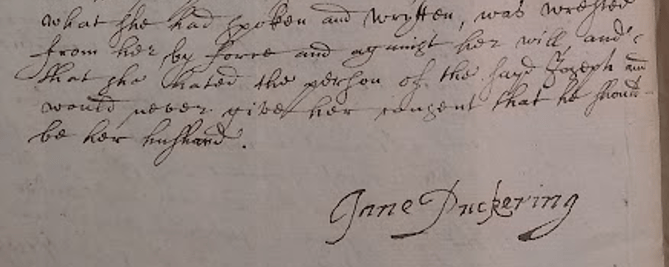
Before the Civil Wars, Jane could have turned to the church courts for an annulment, but in these revolutionary years, the church courts had disappeared along with the monarchy, the House of Lords, and so many other institutions of the old order. Members of parliament had discussed alternatives, with marriage business of the sort previously handled by the ecclesiastical courts taking up much of their own time instead. Jane’s predicament – and her insistent demands for a solution – prompted some movement. In January of 1651, parliament enacted a measure that authorized special commissions to investigate Jane’s claims and others of similar nature, no matter where the ‘foul facts’ occurred, and to ‘void the said pretended marriage[s]’ as needed.[4] A high-powered group of commissioners that included the senior justices, the MP and army commander Thomas Harrison, and others of their ilk soon set Jane free.
After she was safely released from her ostensible marriage, Jane laid a charge of abduction—a capital felony—against Joseph at the assizes in Kent in July 1651.[5] But Jane was not to see justice done nor to have a happy ending to her tale. Walsh had evaded capture and only appeared to plead not guilty after the danger was past. To avoid further abductions from unwanted bridegrooms, Jane had married a cousin shortly after her release; she died in childbirth within the year. The criminal prosecution seems to have effectively died with her.
Meanwhile, though, the parliamentary special commissions prompted by Puckering continued: files for at least eighteen such hearings to dissolve forced marriages survive in long-overlooked records.[6] Some complainants wrote of having been ‘distempered and distracted’ by intoxicants; others maintained that acts or threats of violence had left them ‘terrified, amazed, and affrighted’, with any words of purported consent being ‘wrest from them…against their free will and liking’. They invoked the promises of liberty and freedom that parliamentarians made in respect to contracts of marriage.
And parliament soon stepped up its attempts to remodel marriage to make it fit for a new, revolutionary age: the 1653 Marriages Act sought to transform this social institution by making it a wholly civil contract, not spiritual, to be done before a justice of the peace, not a priest. The act raised ages of consent to 14 for girls and 16 for boys (from 12 and 14 before), and required parental consent for marriages under 21 to be in any way binding. It also expanded the remit of criminal laws against forced marriage beyond the abductions of propertied women alone: it mandated new criminal punishments for those who ‘by violence or fraud shall steal and take away’ anyone with the intent to marry them. Any marriage obtained by violence or fraud would be null and void, subject simply to trial at the local county courts.[7] The authorities of these years infamously made adultery a hanging crime, but they pursued a wider range of changes, too, including ones that sought to protect the ideologically important work of ‘consent’ in the making of marriages and all the transfers of power and property that came with them.

Parliament’s changes to marriage law were significant, but short-lived. Upon the restoration of monarchy in 1660, the acts of 1651 and 1653 disappeared and the church courts resumed operations. But there is much about this story that remains of interest and might repay further study. For one, the two marriage acts asserted an unusual extraterritorial jurisdiction – something the territorially-bound common law had long found difficult, in dealing with duels, marriages, and other ‘foul facts’ committed beyond the seas. For another, Puckering’s stay with English nuns in exile offers interesting avenues to explore: to get Jane to say the required words during the marriage ceremony, Walsh threatened to kill her, to sell her as a slave, or to lock her away forever in a convent. Jane later noted that had she known that convent life could be so pleasant, she’d not have been so bowed by the threat: ‘if she had known there was such courteous usage to be found in a nunnery and an assurance of coming out again, it would not have been so terrible unto her’.[8] And then, of course, there are the hints of royalist intrigue that pepper the Puckering episode.
Peter Thelwall, the English agent in Brussels, reported to the Council of State on the interventions on Walsh’s behalf of Jesuits, a papal nuncio, and the Spanish ambassador.[9] Even more tantalizing are passing references in the depositions of Magdalene Smith and Margaret Walford before the English commission. Magdalene related confessions she said the plotters had made in the Flemish hearings into the marriage. Several of the abductors had apparently adopted fake names. Joseph Walsh was (unimaginatively) just ‘Mr Smith’, but his brother William was ‘the Emperor’, Robert Thompson was ‘Nobb’, and one female accomplice was addressed as ‘My Lady’: Jane Whorwood.[10] Anne Bassett and Susan Morse accompanied them, with Anne coldly urging Robert Walsh to take what was in his power to take when Puckering resisted and Susan providing respectable cover when securing lodgings. An Elizabeth Walsham played a role as well. But Jane Whorwood’s is the name best known to history: was this the Jane Whorwood, ‘she-intelligencer’, who smuggled, embezzled, and funneled funds to the royalists throughout the civil wars and schemed to free King Charles from his captivity at war’s end? The Jane Whorwood who exchanged coded letters with the king that referenced amorous encounters and ‘swiving’?[11] It seems so; perhaps the connection came in part through Whorwood’s experience with arranging secret shipping and transport. What Walsh expected to gain from forcing Puckering into marriage seems clear; quite what, if anything, Whorwood wanted is not. An adventurous researcher with access to Flemish archives might well learn more.
For now, though, this post ends with a final observation: both Puckering and Whorwood had marital difficulties that proved not just personally problematic but also publicly significant. Puckering’s petitions helped secure parliamentary legislation to protect the role of consent in the making of marriage by establishing a process to void unions secured through coercion. Whorwood’s troubles worked otherwise. Separated from her husband Brome, in 1659 she benefited from other innovations of the revolutionary years: she received from commissioners of the great seal an order that Brome pay her alimony of £300 per annum from the estates she had brought to the marriage. After the Restoration, though, Brome fought the decree. In a landmark case in Chancery, judges eventually decided that orders for alimony would once more need to be secured through the church courts. In the absence of such an order, Brome should not have to pay to support his wife outside the marital home. Their grounds? In the absence of a formal decree from the church, Brome would need to consent to the separation and support.[12] That the law bestowed a woman’s property upon her husband created particular dangers for rich heiresses, but it posed more prosaic problems for many more women – and suggests something of the ideological significance of ‘consent’ in the making (and breaking) of early modern marriages.
Images:
Cover image: ‘Discordia‘, by Crispijn de Passe the Elder, c.1589, © The Trustees of the British Museum.
Greenwich Park, c. 1680, by Johannes Vorstermans, via Wikimedia Commons.
Jane Puckering’s signature, from The National Archives, Court of Delegates, DEL 3/5.
The image of English women sailing abroad to become nuns comes from ‘The Painted Life of Mary Ward’ (?1680-1717), via Wikimedia Commons.
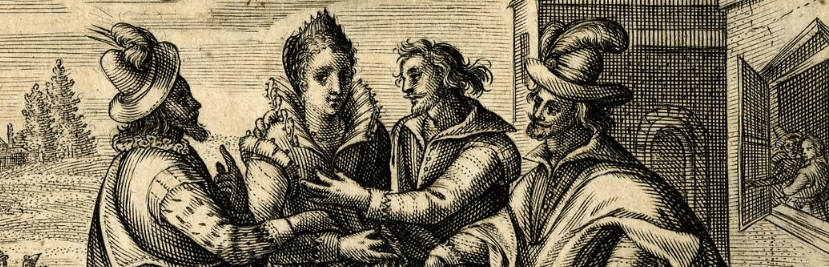
Final image, from the ‘Hortus Voluptarum‘, by Crispijn de Passe the Elder, c. 1599, © The Trustees of the British Museum.
Notes:
[1] The Earl of Strafforde’s Letters and Dispatches, ed. William Knowles (London, 1739), 2:72. For her father, see Andrew Thrush, ‘Puckering, Sir Thomas, 1st Bt. (1591-1637, of The Priory, Warwick’, The History of Parliament: the House of Commons, 1604-1629, ed. Andrew Thrush and John P. Ferris, 2010.
[2] The National Archives, Kew [TNA], Court of Delegates, DEL 3/5, ff. 21d-24.
[3] In addition to the papers in the Court of Delegates’ files [DEL], many references can be found in the State Papers (e.g., SP 25/94, ff. 489, 517; SP 25/63/2, f. 189; SP 25/64, ff. 363, 447; SP 25/65, f. 109) and in Secretary Thurloe’s papers, in Bodleian Library, Rawl. MS A.2 (note that the latter were not included in the published edition of Thurloe’s papers.) The Shakespeare Birthplace Trust holds ‘Mr Barton’s accompt for moneys expended in soliciting and effecting Mistress Jane Puckering’s liberty, &c’, DR 37/3/31; note, too, the fees to the convent (£261), and the cost of a birdcage to bring back Jane Puckering’s newly acquired pet.
[4] ‘January 1651: An Act Enabling the Lords Commissioners for Custody of the Great Seal of England, to issue Commissions of Delegates in Cases of Pretended Marriages‘, in Acts and Ordinances of the Interregnum, 1642-1660, ed. C H Firth and R S Rait (London, 1911), pp. 496-497. British History Online. For the passage of the Act, see also the Commons Journals, 6:491, 1 Nov. 1650, the reading of Jane Puckering’s petition and introduction of the bill; 6:503-4; 6:515; 6:522-3.
[5] For the criminal charges, see A Perfect Diurnall, issue 84 (14-21 July 1651), 1167-9 and TNA, KB 29/300, Michaelmas 1651: http://aalt.law.uh.edu/AALT7/Com/KB29no300/aKB29no300fronts/IMG_0119.htm.
Interestingly, the newsbook account suggests that the special commission to annul the marriage had prompted some controversy – the reporter notes that Puckering pursued the criminal charges in part to vindicate both the sentence and the commissioners and indicates that Walsh had published a denunciation of the commission in the form of a petition to parliament. (Unfortunately, I’ve not been able to find any such petition.)
[6] Eighteen special commissions to annul allegedly forced marriages are identified in the repertory books now filed amongst the papers of the High Court of Delegates, in TNA, DEL 8/71. Some cause papers survive in DEL 2/92. Relevant examinations and depositions are in DEL 3/5, 7, with some relevant personal answers in DEL 3/17 and sentences in DEL 5/15, 16. The bulk of the depositions on the Puckering case are in DEL 3/5. See G.I.O. Duncan, The High Court of Delegates (Cambridge, 1971) for an overview of the court and a brief discussion (pp. 46-9) of these interregnum-era commissions. Note that the nineteenth-century parliamentary survey of records of the Delegates omits these years altogether, its drafters having deemed legitimate authority to have been in abeyance.
[7] ‘August 1653: An Act touching Marriages and the Registring thereof; and also touching Births and Burials‘, in Acts and Ordinances of the Interregnum, 1642-1660, ed. C H Firth and R S Rait (London, 1911), pp. 715-718. British History Online. On the wider story of marriage law reform in these years, see e.g., Christopher Durston, The Family in the English Revolution (Oxford, 1989) and K.J. Kesselring and Tim Stretton, Marriage, Separation and Divorce in England, 1500-1700 (Oxford, 2022).
[8] TNA, DEL 3/5, f. 38.
[9] Bodleian Library, Rawl. MS A.2. p. 19.
[10] TNA, DEL 3/5, ff. 3-3d; see also f. 18d.
[11] For a brief overview of Whorwood’s career, see https://www.english-heritage.org.uk/visit/places/carisbrooke-castle/history/jane-whorwood/. For a longer examination, see John Fox, The King’s Smuggler: Jane Whorwood, Secret Agent to Charles I (Stroud, 2011) and Nadine Akkerman, Invisible Agents: Women and Espionage in Seventeenth-Century Britain (Oxford, 2018). For detailed treatment of the evidence for Whorwood’s relationship with the king, see Sarah Poynting, ‘Deciphering the King: Charles I’s Letters to Jane Whorwood’, The Seventeenth Century 21 (2006): 128-40.
[12] Whorewood v Whorewood (1675), 22 English Reports 785; for earlier efforts, see Whorwood v Whorwood (1662), 21 English Reports 556. The conflict is discussed in Kesselring and Stretton, Marriage, Separation and Divorce in England, 146-51.
Discover more from Legal History Miscellany
Subscribe to get the latest posts sent to your email.
 Legal History Miscellany