Posted by Sara M. Butler, 20 Feb. 2025.
Despite the anti-immigrant rhetoric that gushes forth from the mouths of right-leaning politicians and pervades our news and social media, it is hard to deny that the Anglo-American world was founded on immigration. In the US, where most families can recount by memory their origin stories, be it from Ireland, Italy, Nigeria, or Mexico, the evidence of our immigrant past is present everywhere, from our diets (just how purely “American” are pizza and chop suey?) to the names of the towns in which we live (Ohio has towns named Lebanon, Lima, and London).
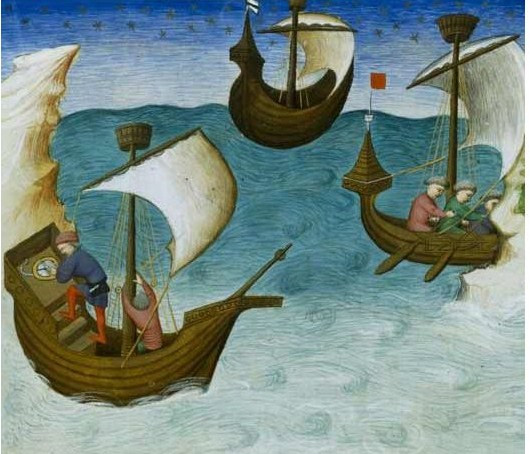
But even those pilgrims on the Mayflower who came to America in order to establish a Puritan state were not “pure-blood” Englishmen and women, because quite frankly such a thing has never existed. As any medievalist would be happy to explain, England’s early history was all about the movement and mixing of peoples. Research over the last twenty years has quashed all the old scholarly standbys that would have preserved a pure “Anglo-Saxon” bloodline. Once, historians believed that when the Angles and the Saxons (Germanic peoples) came to England, they did so as an invading force and the Britons (Celtic peoples) living there were either massacred, driven into exile, or turned into slaves living in an apartheid-like state. None of this is accurate. It was not just the Angles and the Saxons who came to England, but also Jutes and Frisians; they did not invade, they settled; they largely intermarried with the Britons or lived side by side. Nor did the various peoples perpetuate a separation of living by ethnicity (East Saxons in Essex; West Saxons in Wessex) – this has more to do with historians trying to understand naming practices than anything else.[1]
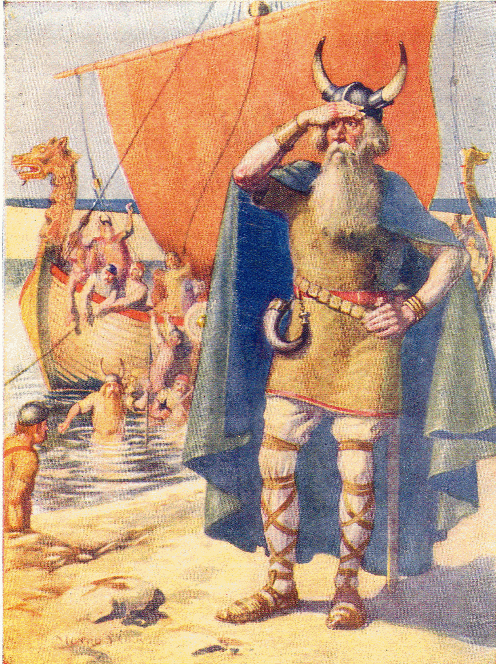
Historians of Norse migration have a similar story to tell of the “Viking” invasion of England beginning in the ninth century. It was not a few Danish soldiers who showed up and ruled, but large-scale migration of Danes, Norwegians and the occasional Swede who were soldier-farmers looking for good arable land with their wives. They moved to England in multiple waves over the course of several hundred years.[2] Remember King Cnut, who was simultaneously king of England, Denmark, and Norway? Oh, and what about the Norman Conquest of 1066? All those French-speaking north men! And yes, there were battles during this period: but they were rarely as ethnically divided as historians had once thought.
The result? Being English means sharing a mixed heritage and speaking an equally mixed language. Even English common law – can we get more English? – derives from the laws of the various peoples who came together in this early period. The English word “law” is the perfect example: it is a loan-word from the Old Norse (ON) lagu. England’s legal vocabulary is a cultural mishmash that attests to the historical mixing of legal traditions: outlaw (útlagr, ON), plaintiff (pleintif, Old French [OF]), witness (vitni, ON), manslaughter (mansliht, Old English [OE]), appeal (appele, OF), ransack (rannsaka, ON), tort (tort, OF), sheriff (scīrgerēfa, OE) – and this isn’t even taking into account the thousands of Latin terms and phrases that generate sales every year for Russ VerSteeg’s Essential Latin for Lawyers, now in its 2nd edition.

The presence of loan-words once again is evidence of immigration rather than invasion. The early Middle Ages functioned on the idea that you bring your law with you (what is known as “the principle of the personality of law”). You were to be judged according to the laws of your native land, rather than those of the land you happened to be visiting. This approach is particularly evident in the Wantage Code (also known as III Æthelred), a royal code put forward by Æthelred II (d.1016), meant for those areas under English rule where the population was chiefly Scandinavian or of mixed heritage. The code itself represents a fusion of West Saxon and Scandinavian legal practices. As Jake Stattel writes: “if this was a top-down assertion of royal legal authority, the apparent concern and sensitivity for local custom would not be present.”[3]
All of this cultural mixing produced a legal vocabulary that verges on the weird and the wonderful (alliterative word-pairs – that’s an OE tradition!). The goal of this post is to appreciate just how rich medieval England’s legal language was because of this cultural contact. Here are some delightful terms – most of which have since fallen out of fashion – that bear witness to England’s diverse heritage.
HAMSOKEN
I encountered hamsoken (hamsocn) for the first time while reading Pollock and Maitland’s magisterial two-volume set on The History of English Law before the Time of Edward I. My first thought: what is this strange sounding offense and why haven’t they translated it from the Old English? Well, first, it’s not Old English, it’s Old Norse. And the authors didn’t translate it because we don’t actually have a word in the English language that means quite the same thing. Hamsoken is an assault upon a person within his (or her) own home “with intent to kill, rob or beat those within.”[4] Why did such a useful term die out? Rebecca Colman argues that the term was most appropriate for an era in which some people were “devoted to armed raiding.” (Ah, perhaps we should be happy that it has fallen out of use.) Nonetheless, it is a great term to highlight continuity of law between regions: the same crime is spoken of in the early laws of Jutland and Sweden (hemsokn) and Norway (heimsókn).[5] In Scotland, hamesukkin was a crime with cultural valence well into the early twentieth century.[6]
SAKE AND SOKE AND TOLL AND TEAM AND INFANGTHIEF AND UTFANGTHIEF
As I’ve already said, the English had a great appreciation for alliterative word-pairs, also known as “legal doublets” (think: “aid and abet,” “lathe and land,” “part and parcel”). This particular legal formula collects three of them at once! Early English royal charters regularly granted the king’s thegns (that is, lords) “sake and soke and toll and team and infangthief and utfangthief.” Effectively, the charters were recognizing the bundle of privileges that “went with the land and could be transferred with the land.”[7] But what exactly were those privileges?
Sake and Soke (sacu ond sōcn) come from a lord’s right to administer justice and, more importantly, collect the profits of justice that went with that right. The alliterative formula was Old Norse: sac comes from sekr which means “accused, charged, guilty” and soke from soc meaning “jurisdiction or suit.”[8] By the late Middle Ages, this phrase had been replaced with the Old French oyer and terminer (to hear and to determine).
Toll and Team (also, thol and theam) is a phrase with a mixed heritage. Toll comes from the Latin toloneum by way of Old Frisian, and it means a “toll, or tax”; team (tæme) is Old English and it refers to a suit for the recovery of goods.[9] Together the phrase recognizes a lord’s right to tax the sale of goods on an estate and any legal procedures associated with that sale.
Infangthief and Utfangthief are good Old English terms that refer to a lord’s jurisdiction to punish crime. Infangthief (infangene-þēof) speaks to a lord’s right to punish the “thief seized within” his lands, utfangthief (ūtfangene-þēof) to punish the “thief seized without” (that is, outside) his lands, providing that thief belonged to his territory. Utfangthief was the first part of this formula to disappear with the centralization of authority into the hands of the English monarchy. By the time of Henry I (1100-35), both had become royal rights (iura regalia).
FRANKPLEDGE
Frankpledge is a Norman term (frauncplege) that began making appearances after the conquest. It means “free pledge,” and refers to the oath imposed on free men in each village, in which they swore to police the area and be responsible for the criminal misbehaviors of their neighbors and kin. Typically, Norman terms superseded Old English ones; but in this situation, frankpledge coexisted with and was eventually displaced by the Old English “tithing” (teothing).
LOVE DAYS
Admittedly, “love days” were not the hippie love-fest that I had originally imagined. “Love” from the Old Norse lufu refers to arbitration, and is meant to stand in contrast to formal legal proceedings. The Wantage Code expresses it best when it speaks of lufe oððe lage (“love or law”), that is, “would you prefer arbitration, or a formal trial?”[10] Days dedicated to love, that is, the resolving of disputes through arbitration, first appeared with the Norse. While the sagas may give the impression that disputes were resolved with revenge killings, in real life the Norse favored peaceful settlements whenever possible. Love days were particularly critical for English borderlands where cross-border crime necessitated unique and expedient solutions to maintain peace. The term appears also in Latin (dies amoris) and in French (jour d’amour – the rhyming makes it my personal favorite).
THWART-UT-NAY
Thwart-ut-nay (also, thwertnik) derives from Old Norse’s þvert, meaning “thoroughly or completely” and nei meaning “no.” Combined together it is an accused’s doubly emphatic rejection of all criminal allegations. Despite its Norse origins, the phrase came to England through Scotland, where it appeared first in the twelfth-century laws of the Scottish Burghs (Leges Quatuor Burgorum), sticking out from the Latin like a sore thumb: responderit et dixerit thwertnay (“he answered and said thwertnay”).[11] Then in the thirteenth century, it slowly made its way into the courts of Cheshire and Leicestershire, in use only for the elite. As R. Stewart-Brown has argued, “suitors had to pay money for the privilege of defending themselves by thwertnic,” which justices interpreted as a flat denial, while poorer defendants were required to deny the allegations “word for word.” [12]
Let’s end with just one more loan-word: alehouse (ealahuse, ON). It may not be a legal term, but it was certainly a site of both law-breaking and peace-making.
Endnotes
[1] For a highly readable summary of the historiography, see Guy Halsall’s The Worlds of Arthur: Facts and Fictions of the Dark Ages (Oxford, 2014).
[2] Jake A. Stattel, “Legal Culture in the Danelaw: A Study of III Æthelred,” Anglo-Saxon England 48 (2019), 166.
[3] Stattel, “Legal Culture,” 170.
[4] William J. Whittaker, ed., The Mirror of Justices (London, 1895), 29.
[5] Rebecca V. Colman, “Hamsocn: Its Meaning and Significance in Early English Law,” The American Journal of Legal History 25.2 (1981), 105 and 99.
[6] Headword “Hamesucken,” Dictionaries of the Scots Language (University of Glasgow).
[7] Helen Cam, “The Evolution of the Mediaeval English Franchise,” Speculum 32.3 (1957), 433.
[8] Charlotte Neff, “Scandinavian Elements in the Wantage Code of Æthelred II,” The Journal of Legal History 10.3 (1989), 293.
[9] Headword, “toll” I.c and “team” III.8a, Oxford English Dictionary.
[10] Neff, “Scandinavian Elements,” 288.
[11] Acts of Parliament of Scotland (1844), vol. i, 371. See “Thuertnay, Thwertnay, Twertnay,” in Dictionaries of the Scots Language.
[12] R. Stewart-Brown, “Thwert-ut-nay and the Custom of ‘Thwertnic’ in Cheshire,” The English Historical Review 40.157 (1925), 15.
Discover more from Legal History Miscellany
Subscribe to get the latest posts sent to your email.
 Legal History Miscellany

