Posted by Sara M. Butler, 14 Aug. 2025.
There is no medieval record more enjoyable to peruse than visitation returns. Although visitations developed over the course of the ninth century, it was not a regular process with recognizable features (and written records!) until the end of the thirteenth century. By 1300, the visitation had become an investigation into the morality and abuses of a district’s clergy as well as its laity by an ordinary, that is, a high ecclesiastic, usually working on behalf of the bishop or whoever has jurisdiction. Those who found themselves reported to the ordinary were ratted out by their neighbors, a group of “trustworthy men” drawn from the community whose job it was to testify to the wickedness and neglect of their fellow Christians and local clergy. As a result, the written returns are chock full of sex, negligence, blasphemy, bastardy, dilapidation, and even the occasional bit of violence.[1]
But how did people feel about their dirty laundry being aired so publicly?
Laymen were not content with this intrusion into their personal lives. They performed their displeasure by refusing to cooperate: high rates of contumacy – failure to appear when summoned before the court – tell a story of resistance, but one that usually ended in compliance as the church only permitted a wayward Christian to be contumacious for so long. Excommunication, and if necessary, caption and imprisonment by royal authorities were generally enough to coerce most Christians into returning to the fold. Clergymen were no happier than the laity about visitations and the humiliation they entailed . As Ian Forrest explains, having one’s sins outed by a group of one’s own parishioners “must have seemed like an inversion of the hard-won and jealously protected status of the clerical order.”[2]
Failed visitations are further evidence of resistance. We find out about those through the records of Chancery. When a visitation did not go as planned, it was often to the chancellor they complained. The chancellor was both a servant of the king and a prelate – his dual appointment made him ideally suited to offer a speedy remedy, whereas an appeal to the pope might take years to resolve.
Here are three vignettes of visitations gone awry:
An Aggrieved Vicar and his Riotous Men at Cromer Parish Church

Occasionally, a clergyman and his parish teamed up together to avert the visitation. A Chancery petition from John Mackworth, archdeacon of Norfolk (1408 to bef. 1412), recounts a failed attempt at visitation at Cromer Parish Church in the early years of the fifteenth century. On a Wednesday in the week of Easter, Mackworth arrived for the visitation, only to be met by the church’s disgruntled vicar, Richard Bysshop. He was accompanied by a large group of men “arrayed for war,” assembled both inside and outside of the church, who proceeded to assault Mackworth and his clerks. Mackworth tells us that they just barely escaped with their lives (a formulaic bit of hyperbole). The assault prevented the archdeacon and his clerks from carrying out the visitation “in contempt of Holy Church” and to their “great damage.” Mackworth’s appeal to the chancellor, Thomas Arundel, who also just happened to be the archbishop of Canterbury, was in hopes of seeing Bysshop reprimanded for his leadership in this offense.[3]
Because only petitions survive for records of Chancery, we cannot know whether Bysshop was in fact punished for his actions. Margaret Bowker, Mackworth’s biographer for the Oxford Dictionary of National Biography, believes this was a transformative experience for Mackworth, in which he learned the value of coercion. As dean of Lincoln (1412-1452) he engaged in multiple disputes with the canons in his chapter. To pressure them into agreement, he regularly attended chapter with a small army of retainers whose main purpose was “to sit in chapter and intimidate resident canons.”[4]
How to Suppress the Truth: A Prior turns on his Canons
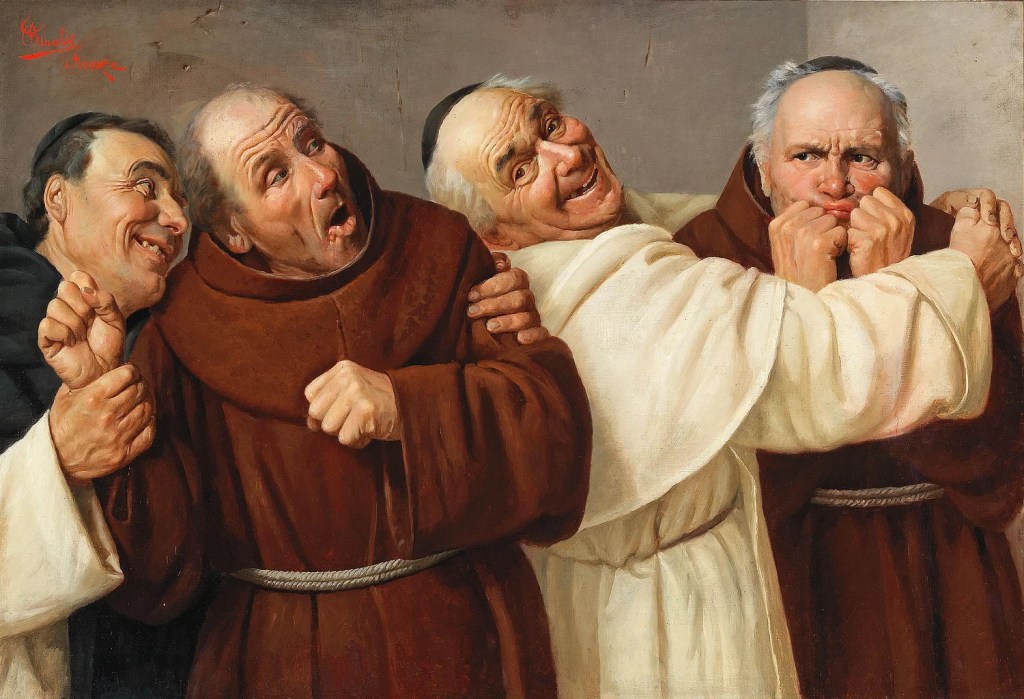
Visitations of monastic communities were particularly divisive. The subordination of monks to the bishop for spiritual correction was widely resented. Regular clergy (monks, canons) saw the secular clergy (priests, bishops) as inferior in faith and discipline, tainted by the sins that dominate the world outside the cloister. Accordingly, monastic orders sought exemption from diocesan oversight whenever possible. By the thirteenth century, the orders of Cluny, Cîteaux, and Prémontré had succeeded in this mission; their visitations were carried out internally. All new orders similarly enjoyed exemption. Benedictines and Augustinians, however, continued to endure annual diocesan visitations. Records of visitation make it clear exactly why they so resented the intervention of the secular clergy. As Martin Heale explains, in some English communities, “the fundamentals of the monastic life [were] barely present.” For example, the visitation at Dorchester in 1441 revealed that “canons frequented taverns, engaged in hunting and hawking and regularly admitted women into the cloister.” Abbots or priors, in particular, worried that their positions of authority might be jeopardized by the unveiling of a spiritually corrupt or unruly convent.[5]

A petition to the chancellor by William Hoton and Miles Bery, two canons from the Augustinian priory of Cartmel (in southern Cumbria), demonstrates just how contentious visitation might be within the monastic community itself. The monastery was within the jurisdiction of the archdeaconry of Richmond where Christopher Urswick was archdeacon (1494-1500).
[Aside: Urswick has been immortalized as a minor character in William Shakespeare’s Richard III. Before he was archdeacon, he was chaplain and confessor to Lady Margaret Beaufort and eventually also to Henry VII, whom he accompanied to Bosworth Field in 1485. He was also a pluralist. While he was archdeacon of Richmond, he was also dean of Windsor (1496-1505).[6]]
As Hoton and Bery tell us, Urswick received “credible information” about the “incontinent living” of William Hale, prior at Cartmel, and his “perjury, simony, and manifest and notary dilapidation.” Accordingly, Urswick sent Edward Cooper, his clerk and commissioner, to the priory to perform a visitation. Fearing that his brethren might tell Cooper about his “outrageous and unlawful living and disposition,” the prior “without any cause … cruelly and with great force, accompanied with many lay persons” seized William Hoton and put him in prison. (Was Hoton the source of that “credible information”?) His incarceration had the intended effect on the rest of the community: they stayed quiet, assuming that otherwise they might also end up in prison.
After Cooper’s departure, Hoton and Bery left the monastery to go to London. They were hoping to find Urswick and speak to him about the prior’s sinful living and mismanagement of the convent. Once again, Hale was one step ahead of them. Out of his “extreme malice,” he sent word to the mayor of London that Hoton and Bery were apostates, fleeing the monastic life. Local authorities arrested and imprisoned the two. To make matters worse, Hale pleaded diverse “feigned plaints of debt” in the city court against them, totaling £1050, a sum that Hoton and Bery had no hope of repaying, ensuring that even if they agreed to return to their order, they could not be released from prison.[7]
The petition by Hoton and Bery purportedly was written from their prison cell in the city of London. At this time, the chancellor, John Morton, was also the archbishop of Canterbury, and a cardinal. Presumably, he saw their plight as enough of a cause célèbre to make sure that it reached Urswick’s ears. Sometime after, Urswick had Hale deprived of office and the revenues of the priory sequestered on the grounds of Hale’s “excesses.” Hale appealed to the pope. He denied Urswick’s allegations, claiming that the evidence against him had been fabricated. The findings of the papal inquiry have not survived. We do know that William Hale was still prior in 1501 when he demanded that the chancellor, in his guise as archbishop of Canterbury, compel the return of the two errant canons. By 1504, Hale had been replaced by none other than Miles Bery.[8]
Visitations were not just about correction and reform; they were also a demonstration of power. In this instance, the archdeacon was reminding the prior exactly who was in charge. While the prior might feel like a king in his community, he reported to the archdeacon, who had it within his power to remove him from his seat of authority if he chose to do so.
Visiting as a Show of Power: La Charité-sur-Loire and its (former) English Dependencies
William Brecknock’s petition to the chancellor – this time the bishop of Rochester, John Alcock — highlights another show of power, but in a much more insidious way. Brecknock introduces himself as the prior of St Andrew, a Cluniac monastery in Northampton. He explains that he had recently been appointed by the prior of La Charité-sur-Loire, Philibert de Maraffin, as his vicar-general, with power to rule and govern all the priories and dependencies of La Charité in England. That list would include Cluniac houses at Bermondsey (Surrey), Wenlock (Shrops.), Pontefract (Yorks.), and Daventry (Northants.), in addition to St Andrew. Intent on seeing the “correction and reformation” of these houses, sometime in the year 1475, Brecknock visited the Abbey of St Savior in Bermondsey. With letters patent in hand, he arrived at the monastery, having heard of the “great ruin and decay as well of the said monastery as of religion within the same.” John Marlowe, the abbot of Bermondsey was cited to appear before Brecknock in the chapterhouse that day, but he “contemptuously despised to obey.” Being “of forward disposition,” Marlowe absented himself.

Not to be deterred by the abbot’s contumacy, Brecknock reappeared the following day. He walked into the body of the conventual church, only to be met by Marlowe and Master John Cooke, doctor of law. The two had concocted a plan between them: they had gathered a multitude of lay people. Riotously and with force, they apprehended Brecknock, drawing him away from his entourage of doctors (of law), notaries and other learned counsel, and carried him off to a secret hold, where they imprisoned him. At the time he wrote his petition, they were still keeping him there, and as Brecknock informed the chancellor, they intended to “murder him or otherwise mischief him, contrary to the law and all good conscience.”[9]

What was really going on here? William Brecknock’s petition, as self-righteous and full of self-pity as it, is not telling the whole story. Brecknock’s appointment was a power grab by the prior of La Charité to restore Bermondsey to the order’s control. In 1380, Richard Dunton, Bermondsey’s first English prior (it did not become an abbey until 1399), had taken steps to “naturalize” the priory. Fearing that a new outbreak of war with France might lead once again to the confiscation of the priory as “alien property,” as it had in the period 1337 to 1360, Dunton paid a fine of 200 marks for denization, wrenching the priory out of La Charité’s hands. In some respects, Bermondsey was following in the footsteps of Daventry Priory, which had been independent of La Charité since 1221. Wenlock Priory gained its independence through a charter of denization in 1394; St Andrew in 1405. Pontefract secured a papal bull in 1441 to elect their prior in independence. The loss of these dependencies to La Charité was significant. Henry VIII’s survey of 1535 found Bermondsey had clear revenues of £474 14s 14 ¾ d, and a gross income of £548 2s 5 ¾ d. Wenlock was also well endowed, with temporalities worth £333 16s 10 ¾ d, spiritualities of £100 4s 3d, and a net income of £401 7s. 0 ¼ d. St Andrew was less comfortable. The value of the priory, “after the many outgoings and pensions had been paid,” was £263 7s 1 ¼ d.[10] Of course, La Charité wanted these dependencies back!
Brecknock’s visitation, then, was a charade. La Charité had no lawful right to visit; Brecknock’s appointment as prior of St Andrew was also pretended (that is another story altogether!). If their performance had been successful – if John Marlowe, the newly elected abbot, had not recognized the pseudo-visitation for what it was – would Bermondsey have once again become a dependency of La Charité?
[1] Ian Forrest and Christopher Whittick, eds.and trans., The Visitation of Hereford Diocese in 1397 (Canterbury and York Society, vol. 111, 2021); read Ian Forrest’s brilliant and thought-provoking Trustworthy Men: How Inequality and Faith made the Medieval Church (Princeton University Press, 2018).
[2] On the process, see F.D. Logan, Excommunication and the Secular Arm in Medieval England (Pontifical Institute of Mediaeval Studies, 1968); Ian Forrest, “The Transformation of Visitation in Thirteenth-Century England,” Past & Present 221 (2013), 22.
[3] Macworth v. Bysshop, TNA C 1/16/52 (1408-12). [The National Archives, Chancery files]
[4] Margaret Bowker, “Mackworth [Macworth], John (c. 1375-1450),” Oxford Dictionary of National Biography (26 May, 2005).
[5] C.R. Cheney, Episcopal Visitation of Monasteries in the Thirteenth Century (Manchester University Press, 1931), 38; Martin Heale, Monasticism in Late Medieval England, c.1300–1535 (Manchester University Press, 2013), 25.
[6] The Bede Roll of the Fraternity of St. Nicholas, ed. N.W. James, V.A. James (London, 2004), 264-75.
[7] Hoton v. The Mayor of London, TNA C 1/206/63 (1493-1500). Please note: spelling has been modernized for quotations drawn from Chancery petitions.
[8] “Houses of Austin Canons: The Priory of Cartmel,” in A History of the County of Lancaster: Volume 2, ed. William Farrer, J. Brownbill (London, 1908), 143-48. A list of priors appears on the Lancashire Online Parish Clerks website for “The Priory Church of St Mary and St Michael, Cartmel in the County of Lancashire,” https://www.lan-opc.org.uk/Cartmel/priory/index.html, accessed 13 Aug. 2025. Here, Miles “Bery” is written as “Burre.”
[9] The Prior of St Andrew Northampton v. The Abbot of Bermondsey, TNA C 1/47/58 (1483-85).
[10] John Caley, Monasticon Anglicanum: A History of the Abbies and Other Monasteries, Hospitals, Friaries, and Cathedral and Collegiate Churches, with their Dependencies, in England and Wales, 6 vols.(1846), vol. 5, 92 and 98; “Daventry, Priory of,” New Catholic Encyclopedia, vol. 4 (McGraw-Hill, 1967), 656; “Houses of Cluniac Monks: Abbey, later Priory, of Wenlock,” in A History of the County of Shropshire: Volume 2, ed. A.T. Gaydon and R.B. Pugh (London, 1973), 42 and 44; “Houses of Cluniac Monks: The Priory of St Andrew, Northampton,” in A History of the County of Northampton: Volume 2, ed. R.M. Serjeantson and W.R.D. Adkins (London, 1906), 107-108; Rose Graham, “The English Province of the Order of Cluny in the Fifteenth Century,” Transactions of the Royal Historical Society 7 (1924), 113.
Discover more from Legal History Miscellany
Subscribe to get the latest posts sent to your email.
 Legal History Miscellany