By Cassie Watson; posted 27 March 2026.
What did a cheese thief in Victorian Lancashire have in common with a pitman in County Durham, a bigamist in the Rhondda Valley, or an eighteenth-century Welsh labourer? They were all repeat offenders who earned themselves a memorable nickname: Dick the Devil. I came across the last-mentioned of these ne’er-do-wells, Richard Williams of Llanelian-yn-Rhos in the historic county of Denbighshire, over a decade ago in the voluminous files of the Court of Great Sessions, and now use him as a seminar case study of a particularly incorrigible persistent offender. His nineteenth-century successors appear to have been considerably less violent, but offer equally interesting insights into contemporary socio-legal attitudes to crime and punishment.
“A very wicked and dangerous person”: Richard Williams, 1730s
In early August 1732 six frightened and exasperated villagers were examined by magistrates, concerning offences committed a year or more earlier by one Richard Williams, a foul-mouthed, violent bully.[1] Hannah and Edward Thomas described how Williams had invaded their home at Eglwys-bach on 14 February 1732: he swore at them, threatened to rob their employer (a widow), brandished “a large sharp pointed knife,” and made the most extraordinary threats and claims, including that “women were fitt for nothing but to be killed or layn with.” He advanced on Hannah and threatened to kill her, upon which she fainted.[2] He then tried to stab her husband, a cooper, before the latter — after a desperate struggle — managed to push him out and lock the door.[3] A possible, but by no means adequate, clue to Williams’s propensity to threaten sexual violence to nearly every woman he encountered was noted by Hannah: “He swore his wife had been dead a month and that he had a license in his pocket to lye with all women he met with.”[4]
Next, a neighbouring couple, John and Anne Owen, related what had happened to them around August 1731, when Williams forced John Owen, a miller, to accompany him to a ferry crossing, then stole both his sword and his trousers. Owen gave up his breeches in exchange for Williams’s tattered pair (“not worth two pence”) because he was “bodily afraid of him,” and Anne was then abandoned for six months when her husband “quitted his house and family and did not return till he heard he the said Richard was seized and put into gaol.”[5]
True to his word, Williams tried to rape Ellinor Parry of Llansanffraid Glan Conwy about Michaelmas of 1731: he knocked her down with a staff “and swore he would ravish her.” A neighbour intervened, upon which Williams “went off and swore he would shoote him.”[6] Mary Hughes, a widow living at Llysfaen, had suffered a similar encounter with Williams a year before Parry, and was “forced to quitt her house and lye at a neighbour’s house for fear of him.”[7] Similarly, Martha Evans, a married woman from Llandrillo-yn-Rhôs, was assaulted in her own home by Williams, who beat her so badly that she was “in such fear of him that she would rather contribute towards his maintenance in gaol than that he should have his liberty.”[8]
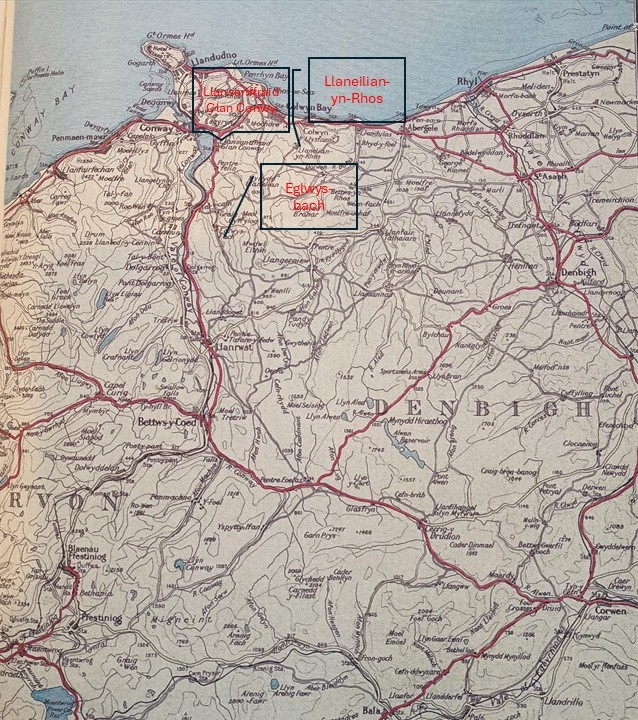
Seven months later John and Anne Owen, Edward Thomas, Ellinor Parry, and David Richards of Llansantffraid were again giving depositions against Richard Williams, then a prisoner in the county gaol at Ruthin, providing considerable detail about his long-term campaign of violence, intimidation, and crime.[9] Williams (“a night walker and without any visible way of living for severall years”)[10] had been locked up since before Christmas 1732 and knew whom he had to thank for it: he swore revenge against them all, Edward Thomas in particular. It is clear that every witness was terrified of him, that Williams felt he was above the law (“tho he was taken, he vallued Transportation not at all, because he could soon return from the West Indies”),[11] and that the intervening months had given the victims time to compile a detailed list of all his bad deeds. These included crimes of violence (robbery, attempted rape, wounding, assault and battery, and even suspected murder); making threats (to kill, commit arson and rob); enlisting then deserting the army multiple times; cursing; forcing people to do things they did not want to do (leaving their homes in fear, doing favours for him, giving him their belongings, and feeding him); inciting others to commit crimes (horse theft, poaching); invading people’s homes. Williams was an irredeemable habitual criminal before the Victorians invented the term: “this present imprisonment was the eleventh he had undergone in his lifetime.”[12]
The timing of both sets of depositions is significant, as they show that neighbours tried twice to prosecute Williams at the Court of Great Sessions, in summer 1732 and spring 1733, for a crime serious enough to get rid of him. Perhaps his periodic absences in the army and gaol had allowed them to tolerate him for years, before some kind of tipping point was reached. Maybe his behaviour had escalated, due to his wife’s death (January 1732) or some other factor. He was quarrelsome and disrupted the smooth functioning of society; his reputation was such that it was rumoured his mere presence caused a woman to die of fear.[13] His actions went far beyond “transgressions of ‘neighbourliness’” and the victims were not engaging in “vexatious litigation.”[14]
Representative of a Dangerous Class: Richard O’Brien, 1870s
The press reported no cases of wrongdoing by anyone nicknamed Dick the Devil until the late 1870s, when coal miner Richard Robinson was sentenced to one month’s hard labour at the Durham quarter sessions, for wounding a cow and attempting to wound a man.[15]
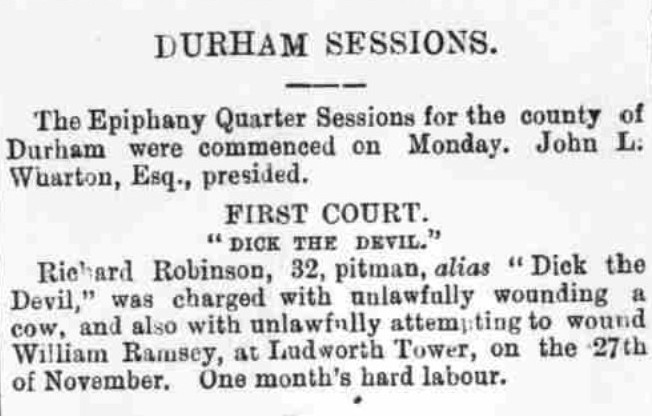
But this individual’s criminal career was insignificant in comparison to that of Richard O’Brien, who attracted considerable public attention two years later when he and his gang were sentenced to ten years’ penal servitude at the Liverpool quarter sessions:
“CONVICTION OF DESPERATE THIEVES. VIOLENT BEHAVIOUR IN THE DOCK. At the Liverpool sessions on Friday, three men, named O’Brien, McNally, and Smith, well-known to be members of a gang of desperate thieves, headed by a man known as Dick the Devil, were sentenced to ten years’ penal servitude. Prisoners had been found guilty of stealing cheese from carters by means of terror. Before leaving the dock O’Brien seized one of the warders and tried to strangle him.”[16]
Home Office records show that a fourth man was acquitted, that O’Brien, McNally, and Smith were labourers in their 20s with previous convictions, and that they had stolen not cheese but a coat, a pair of boots, and 50 pounds of butter.[17] But it is the Indian press that provides the clearest indication of just what a prolific offender Richard O’Brien, 26, really was: the Madras Weekly Mail used his case to highlight the unfairness of a judge in the High Court of Madras, Mr Justice James Kernan, QC (1819–1900), who had threatened to give Indian thieves a life sentence for even the smallest repeat offence. The newspaper had learned of O’Brien’s latest arraignment months before the conviction described above, and commented on it:
“His name is Richard O’Brien; but in recognition of his versatile talents he has acquired among his admirers, victims, and the police, the nickname of ‘Dick the Devil.’ He was last month brought up before a Liverpool Court, and it appeared that he had been arraigned before it not twice, or even thrice, but forty-seven times, the last being in 1873 when, for wounding a person, he was sentenced to five years’ penal servitude. He worked out the sentence, and was lately released, but among the earliest uses that he made of his liberty was that of committing a highway robbery.”[18]
The newspaper believed that O’Brien would be sentenced to a mere three months for this latest offence, whereas in Madras he would be classed as a habitual offender and given a long sentence of penal servitude: “In England the law seems to hope for the best; in India it does not hope at all, but assumes that every petty thief is a Dick the Devil in the bud.” That this was not ultimately so for Richard O’Brien was, dare I say, probably to the general benefit of his community.
Conclusion
Later press reports of men known as Dick the Devil give little indication that they really deserved the moniker. In 1889 Richard Hughes, a labourer from Blaenrhondda in Glamorgan, was sentenced to three months’ imprisonment with hard labour for deserting his pregnant wife (for a second time) and marrying another woman.[19] In 1905 another Welshman, Richard Evans, a cabdriver at Aberdare who was clearly no stranger to the inside of a police cell, lamented the fact that people shouted out ‘Dick the Devil’ at him in the street and accused him of stealing a watch. The stipendiary magistrate, with no little sarcasm, told him he could bring a prosecution at the assizes if he had £150 to pay for it, and then fined him 5s. and costs for being drunk and disorderly.[20] By this date, it seems, the moniker Dick the Devil had become more comical than devilish.
And what of Richard Williams, the original Dick the Devil? He was convicted for stealing the breeches, but there is no record of his sentence and I do not know his ultimate fate. He does not appear in the National Library of Wales Crime and Punishment database after 1733, leading me to hope that his long-suffering neighbours finally managed to get some peace.
Images
Main image: The Drunkard’s Children, plate V. Coloured etching by George Cruikshank, 1848. Source: Wellcome Collection. Public domain.
John Bartholomew, Bartholomew’s 1900 Touring Atlas and Gazetteer of the British Isles, new edition (London: HarperCollinsPublishers Ltd., 1998), Map 37. Author’s photograph.
Stockton Herald, South Durham and Cleveland Advertiser, 8 January 1876, 6. British Newspaper Archive, public domain.
References
[1] National Library of Wales (hereafter NLW), GS 4/45/3/4, Richard Williams, Denbighshire, examinations taken 8 August 1732.
[2] Ibid., examination of Hannah Thomas.
[3] Ibid., examination of Edward Thomas.
[4] Ibid., examination of Hannah Thomas.
[5] Ibid., examinations of John Owen and Anne Owen.
[6] Ibid., examination of Ellinor Parry.
[7] Ibid., examination of Mary Hughes.
[8] Ibid., examination of Martha Evans.
[9] NLW GS 4/45/4/23-27, Richard Williams, Denbighshire, examinations taken 1 March 1733.
[10] Ibid., examination of Edward Thomas.
[11] Ibid.
[12] Ibid.
[13] Ibid., examination of Anne Owen.
[14] Sharon Howard, Law and Disorder in Early Modern Wales: Crime and Authority in the Denbighshire Courts, c. 1660–1730 (Cardiff: University of Wales Press, 2008), 187-206 (quotations on pp. 187, 204). Howard mentions Dick the Devil (prosecuted for assault) at p.191 n.12; the reference number suggests a date in 1730 but this file does not appear in the online database.
[15] Stockton Herald, South Durham and Cleveland Advertiser, 8 January 1876, 6.
[16] Cardiff Times, 30 November 1878, 8. This article appeared, verbatim, in English, Welsh, Scottish and Irish newspapers on the same date.
[17] The National Archives, HO 140/42, A Calendar of Prisoners Who Have Taken Their Trial at the General Quarter Sessions of the Peace for the Year 1878; Borough of Liverpool, 26 November 1878, 12. Retrieved from Findmypast.
[18] Madras Weekly Mail, 4 September 1878, 9-10. O’Brien’s criminal career could be studied using the methodology developed by Godfrey, Cox and Farrall to build a composite of the lives of serious offenders. See Barry S. Godfrey, David J. Cox and Stephen D. Farrall, Serious Offenders: A Historical Study of Habitual Criminals (Oxford: Oxford University Press, 2010), chapter 2.
[19] South Wales Daily News, 17 September 1889, 3.
[20] The Cardiff Times, 2 December 1905, 9.
Discover more from Legal History Miscellany
Subscribe to get the latest posts sent to your email.
 Legal History Miscellany