Posted by Krista J. Kesselring, 16 January 2023.
In 1619, the Yorkshire gentleman John Nelson complained that Gillian Collier and a group of other women had torn down the fences he’d erected to turn once common lands into private property. Not only that, he warned, but ‘upon their phantastical imaginations, conceived amongst themselves’, Collier and her companions had maintained ‘that women were lawless and not subject to the laws of the realm as men are, but might in such cases offend without dread or punishment of law’.[1] Significantly, Nelson took this complaint to Star Chamber.
My last post focused on the popular belief in a lawless period between the death of Queen Elizabeth I and the coronation of her successor, a belief embraced by ‘plebeian constitutionalists’ who declared themselves temporarily freed from law’s restraints to do as they wished. This month’s post highlights similar claims, made throughout the late sixteenth and early seventeenth centuries, that married women deemed themselves somehow immune to law’s sanctions. Women led some of the period’s many agrarian protests, asserting customary rights to common lands – and reportedly asserted themselves to be ‘lawless’ when doing so.
They had some basis for such a belief. Upon marriage, a woman became subject to the common law doctrine of coverture, in which her husband’s legal personhood ‘covered’ her own. One effect was a diminished responsibility for her actions at law. The law put a wife under the power of her husband (‘sub potestate viri’) and thus made her subject to his coercion in ways that complicated her criminal liability. Pragmatically, too, a wife lost ownership or control over any property to her husband, so how then could she pay financial penalties for wrongdoing?[2]
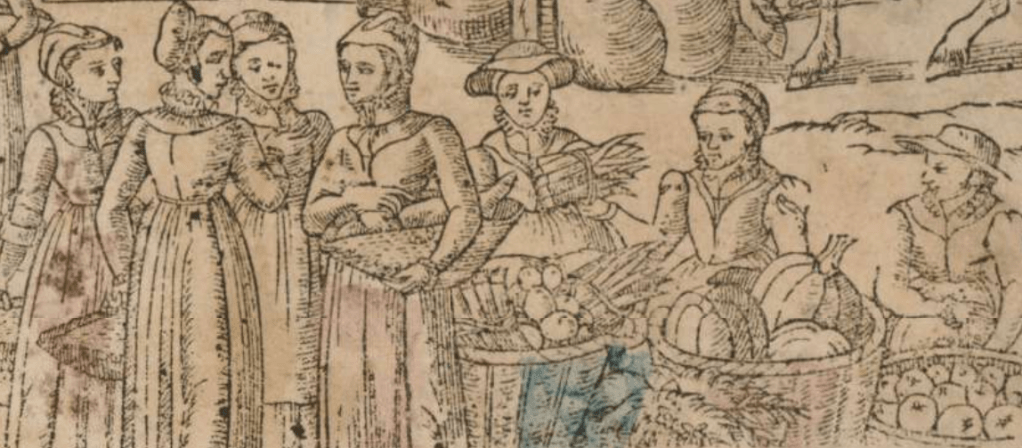
In 1581, the legal writer William Lambarde appended a caveat to his description of the common and statute law on riots: if women or children assembled ‘for their own cause’ and without the instigation of a ‘man of discretion’, then this was ‘no unlawful assembly punishable by these statutes’.[3] And some women evidently sought to use their subordinated status strategically, to the advantage of themselves, their families, and neighbours, in assembling to destroy the enclosures that privatized the common lands on which they depended.[4]
But enter the Court of Star Chamber—a discretionary, prerogative court, not bound by common law, effectively new to the sixteenth century and operating in years of great change and contestation. Lambarde continued his discussion with a note ‘that not many years since, women were punished in the Star Chamber, and that worthily, for that (having put off their seemly shamefastness, and apparelling themselves in the attire of men) they assembled in great number and riotously pulled down an enclosure’.[5]
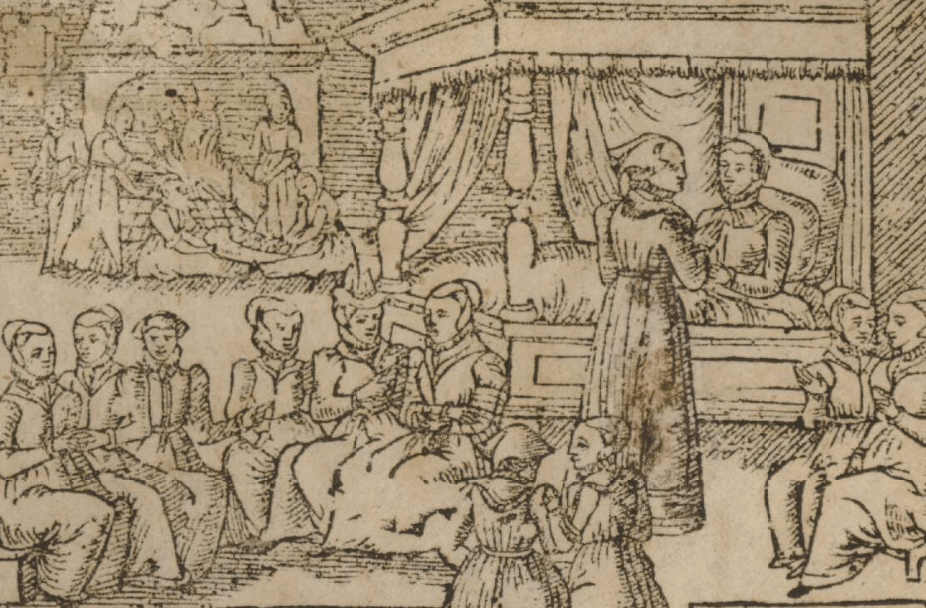
To which episode, exactly, Lambarde referred isn’t yet clear. Perhaps he had in mind the 1567 case in which Roger Alford complained that a group of women—Joan Kitche, Lucy Barnard, Alice Tribeck, and others—had destroyed a ditch that infringed upon their commons at Hitcham and Woburn manors. Alford said the women had plotted their action while gathered at a friend’s childbed; he suggested, too, that some of the husbands had joined the fray while disguised in women’s clothing. The women acknowledged having filled up Alford’s new ditch, which had barred their families’ cattle from pasture that had been common from time immemorial. They continued to assert their right to the commons and defended their action as having been (implausibly) quiet and orderly. Should that defense not suffice, they insisted that they had acted entirely on their own and without the knowledge or consent of their husbands. They also sought to excuse themselves by saying that as women, they had ‘no knowledge or understanding of the law’—though their opponent maintained that they had taken counsel from a man known as ‘Over the Lawyer’ on how to proceed without coming into the law’s danger. William Over reportedly told families contemplating direct action against the offending enclosures that ‘women were lawless and might better do it’. Acting upon such advice might have complicated action against the women at common law, but what of Star Chamber? There, judges punished the women indirectly. They finally accepted that no men had directly participated in the riot, but insisted that the husbands had nonetheless to pay the fines imposed on the wives.[6]
Accounts of women’s assemblies to tear down enclosures—and of their purported claims of legal immunity—repeatedly came before the judges in Star Chamber in the decades that followed. Aggrieved enclosers brought complaints from Devon and Dorset, from Norfolk, from Lancashire, and elsewhere. And Star Chamber’s judges sought very hard to disabuse women of any notion of being ‘lawless’.
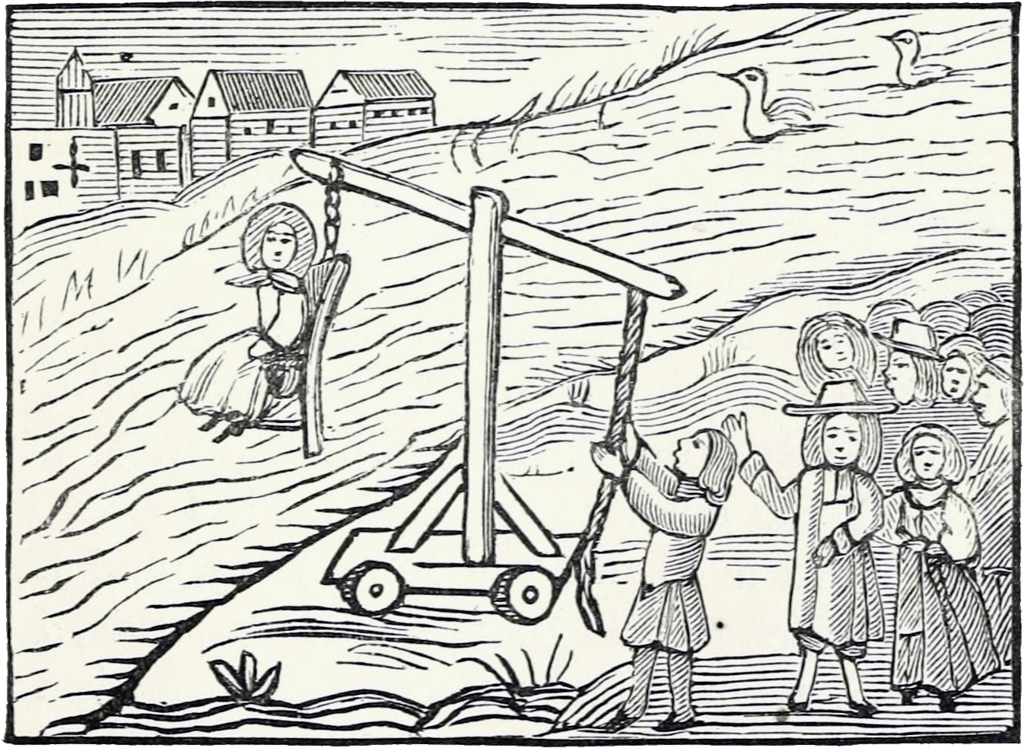
In a case Edward Kidderminster brought to the court in 1599, women clearly led the way in the assault on his enclosure, tearing up and burning hedges, attacking his shepherd and servants (‘besmutting’ their faces with grease), driving off his sheep with dogs and cudgels, and pelting the bailiff who came to stop them with rotten eggs. In this incident, it seems that some of the husbands had joined their wives while dressed in women’s apparel; the court ordered the men to be pilloried while wearing the women’s clothing they’d worn during the riot, the wives to be put on cucking-stools and ducked, and fines to be imposed upon both.[7]
A 1605 case showed Star Chamber’s judges determined once more to refute the notion that married women could not be held legally accountable for riotous behaviour. This suit centered on the destruction of an enclosure at the manor of Harrow, Middlesex, by a group of women, both single and married, who insisted they had acted without any of the husbands’ knowledge. The complainant said that one of the fourteen women he named in the suit, Anne Page, had ‘vauntingly and braggingly’ asserted that she would have the offending hedge ‘pulled down by women, and that there was no law for women, or words to that effect’. The judges expressed some thin commiseration for the women’s cause—according to a contemporary report, ‘it was agreed by the court that it is not good to make enclosures of commons, for this causes great offence, but it is warranted by the law’. What was not warranted, the judges said, was a troupe of disorderly women destroying property. Judges ordered fines for both the single and married women, while also decreeing that ‘if women offend in trespass, riot, or otherwise, and an action is brought against them and their husband, they [the husbands] shall pay the fines and damages, notwithstanding the trespass or offence is committed without the privity of the husbands.’[8] Another report on the case suggested that the judges had some of the women imprisoned in the Fleet, too, as ‘the court mislik[ed] that offences of this nature should be committed by persons of their sex upon pretense and hope that they should not be punished by the law for the same.’[9]
True, one needs to be wary of accepting the plaintiffs’ claims that the women who destroyed their enclosures had boastfully, boldly claimed a lawless status in quite the ways they said—this was a strategy to delegitimize the protesters’ actions. When the women’s own formal responses survive, they usually claimed weakness and ignorance—but this, too, was a strategy. Witnesses’ depositions sometimes support the depiction of women embracing claims to lawlessness, and the women caught up in these cases had certainly banded together in often violent protests to destroy enclosures. As John Walter notes in his discussion of such cases, women ‘drew on contemporary constructions of their gendered identity both to justify their presence in protest and to attempt to escape the punishment that their open challenge to authority might otherwise bring’. As he continues, ‘disorderly women’ could ‘invert commonly accepted ideas of women’s frailty to claim for themselves a license to protest’.[10]
Yet (as Walter would likely agree), what the women wanted wasn’t so much a ‘license to protest’ as to retain their access to the commons. And in both matters Star Chamber stymied their efforts. Just as with the claims to common lands, the question of married women’s responsibility at law was contested and changeable. Whatever immunities they had at common law proved weak in Star Chamber. When we look beyond the thick files of pleadings in Star Chamber’s archive and turn to its records of judgements, we find evidence not just of women’s collective action but also of a court taking advantage of its flexible relationship with the common law to restrict ‘lawlessness’.
There is much of interest in these moments of ‘lawless’ agency—not least the question of what to make of the knowing, mocking, subversive, or playful nods to the gendering of power and protest through the cross-dressing of men and women. Surely it’s significant, too, that while these women weren’t protesting about ‘women’s issues’ or for women’s rights as such, they were drawing upon and reiterating claims based on their status as women (or at least as married women). Arguably, we see in these cases signs of people developing a consciousness of women as a group whose subordination wasn’t just natural or divinely mandated but partly the product of contestable and changeable laws.[11] Maybe it’s not too much of a stretch to see these invocations of a collective identity in the midst of collective action—whether made by themselves or their foes—as a precursor to women’s more self-consciously political activity in the revolutionary years of the 1640s and 50s.
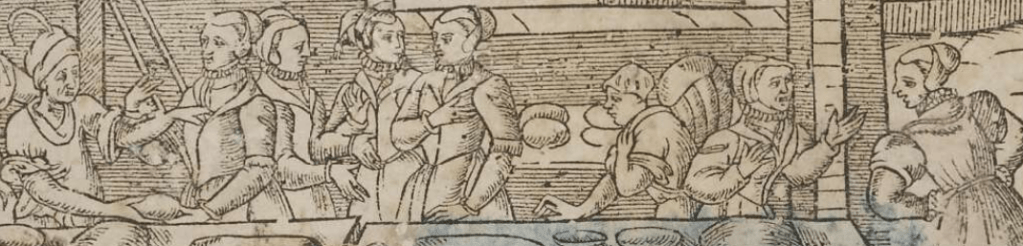
Images: Save for the image of the cucking stool taken from Wikimedia Commons, the images are derived from ‘Tittle Tattle, or the Several Branches of Gossipping‘, a c.1750 impression of a 16th century satirical broadside, © The Trustees of the British Museum and shared on a CC BY-NC-SA 4.0 license.
Notes:
[1] The National Archives (Kew) [hereafter TNA], STAC 8/223/7, Nelson v Collier (1619).
[2] On coverture, see, e.g., Tim Stretton and K.J. Kesselring, eds., Married Women and the Law: Coverture in England and the Common Law World (Montreal, 2013); for married women’s criminal responsibility under common law coverture, see the chapter by Marisha Caswell, or her longer treatment of the subject (though focused on later years) in ‘Married Women, Crime, and Questions of Liability in England, 1640-1760’, PhD dissertation, Queen’s University, 2012. For another area in which married women sought to use their coverture to avoid legal sanctions – in avoiding fines for recusancy – see Karen Peddle, ‘In the Name of the Father: The Elizabethan Response to Recusancy by Married Catholic Women, 1559-1586’, Feminist Legal Studies 15.3 (2007), 307-28. As Peddle notes, authorities did find ways around coverture’s ostensible barrier to fining recusant women – but significantly, one might note, they did so via the Ecclesiastical Court of High Commission, another prerogative court akin to Star Chamber.
[3] William Lambarde, Eirenarcha, or, Of the Office of the Justices of the Peace (London, 1581), p. 179.
[4] The classic work is Natalie Zemon Davis, ‘Women on Top’, in Society and Culture in Early Modern France (Stanford, 1975). On such uses in England, see John Walter, ‘”Law-Mindedness”: Crowds, Courts, and Popular Knowledge of the Law in Early Modern England’, in Law, Lawyers and Litigants in Early Modern England: Essays in Memory of Christopher W. Brooks, ed. Michael Lobban, Joanne Begiato, and Adrian Green (Cambridge, 2019), 164-84; Walter, ‘Faces in the Crowd: Gender and Age in the Early Modern English Crowd’, The Family in Early Modern England, ed. Helen Berry and Elizabeth Foyster (Cambridge, 2007), 96-125; and R.A. Houlbrooke, ‘Women’s Social Life and Common Action in England from the Fifteenth Century to the Eve of the Civil War’, Continuity and Change 1.2 (1986), 171-86. See, too, Shannon McSheffrey’s suggestion that women appeared far less frequently in such protests in the later middle ages than they did by the late sixteenth century, which raises the intriguing possibility of something new in the frequency of women’s appearances in (even leadership of) late sixteenth and early seventeenth century riots—perhaps the accelerating rate of enclosure—that warrants further consideration.
[5] Lambarde, Eirenarcha, 179. On women and collective action in suits heard in Star Chamber, see also, e.g., Andy Wood, ‘Subordination, Solidarity, and the Limits of Popular Agency in a Yorkshire Valley, c. 1596-1615’, Past and Present 193 (2006), 41-72, at 63-6 and Bronach Kane and Fiona Williamson, ed., Women, Agency and the Law 1300-1700 (London, 2013), chapters by Deborah Youngs and Nicola Whyte. On enclosure protests as tried in Star Chamber, see, e.g., Briony McDonagh, ‘Making and Breaking Property: Negotiating Enclosure and Common Rights in Sixteenth-Century England’, History Workshop Journal 76 (2013), 32-56 and Roger Manning, Village Revolts: Social Protest and Popular Disturbances in England, 1509-1640 (Oxford, 1988).
[6] See TNA, STAC 5/A2/34, STAC 5/A14/10, STAC 5/A16/34, Alford v Goodwin (1567). Discussed in Houlbrooke, ‘Common Action’, pp. 179, 183. See the fine list in E 159/361, transcribed by Robert Palmer, which specifies that the husbands paid the fines for their wives: http://www.uh.edu/waalt/index.php/SCF_1570
[7] TNA, STAC 5/K6/24 and STAC 5/K5/23, Kidderminster v Hale (1599); John Hawarde, Les Reportes del Cases in Camera Stellata, 1593-1609, ed. W.P. Baildon (London, 1894), p. 130; William Hudson, ‘A Treatise on the Court of Star Chamber’, in Collectanea Juridica, ed. F. Hargrave (2 vols., London, 1792), ii, p. 83; fines list, E 159/417: http://www.uh.edu/waalt/index.php/SCF_1599; and pardon, C 66/1577, mm. 37-8.
[8] TNA, STAC 8/244/18, Page v Page; Hawarde, Reportes, p. 247 (emphasis added). The fines list indicates that some husbands and wives were fined together, though at moderated amounts: E 159/429: http://aalt.law.uh.edu/AALT6/J1/E159no429/aE159no429fronts/IMG_1369.htm
[9] Harvard Law Library, MS 1101, p. 104d: 13 Nov, 3 Jas, John Page v Henry and Ann Page et al.
[10] Walter, ‘Faces’, 111, 114.
[11] On the broader histories of women and social or political action in these years, see, e.g., Susan Amussen and David Underdown, Gender, Culture and Politics in England, 1560-1640: Turning the World Upside Down (London, 2017) and Ann Hughes, Gender and the English Revolution (London, 2012). See also Gerda Lerner’s classic, The Creation of Feminist Consciousness from the Middle Ages to Eighteen-Seventy (Oxford, 1993), esp. p. 14.
Discover more from Legal History Miscellany
Subscribe to get the latest posts sent to your email.
 Legal History Miscellany