Guest post by Andrew Vidali, 28 June 2023.
Keeping the peace inside a society plagued by enmities and violence is a goal that any ruling class in pre-modern Europe set for itself: living in peace with one’s neighbour was not only a Christian precept, but also a political objective, functional to maintaining social order.[1] This task was normally carried out informally and a wide range of authority figures helped to mediate peace.[2]
This post focuses on an experiment attempted nearly simultaneously on the Venetian mainland and in the Papal States to create new officeholders whose task was to maintain community peace. In other words, the ruling classes of these territories created official peacemakers, making them a very interesting case study to understand the relations between violence, society, and the State.
City magistracies designed to foster reconciliation existed elsewhere in Italy in the sixteenth and seventeenth centuries. Bologna’s authorities established two bodies for this purpose: the ‘Peace Office’ (Assunteria delle paci), which contributed to city peace in the mid-seventeenth century, at a time when noble feuds seemed to have reached new heights.[3] Before that, they created the ‘Congregation for Harmony’ (Congregazione della Concordia) in the second half of the sixteenth century. This was a judiciary with arbitration function that worked in conjunction with a confraternity.[4] But what of similar offices in other territories?
The Papal States: Pacifici
In addition to Bologna, other city peacemakers were established in the Papal States, in particular in the Romagna territories as well as in Marche and Umbria. For instance, Forlì had the ‘Sacred number of ninety peacekeepers’ (Sacro numero dei novanta pacifici); in Cesena there were the ‘Eighty peacekeepers’ (Ottanta pacifici); in Rimini the ‘Eighty lovers of peace, defenders, and keepers of the city’ (Ottanta amatori della pace, defensori e conservatori della città); in Ascoli the ‘Two hundred men to peace keeping’ (Duecento uomini per la conservazione della pace); in Ancona the ‘Deputies to peacemaking’ (Deputati a fare le paci); and, finally, in Norcia, the ‘Forty keepers of peace and justice’ (Quaranta conservatori de la pace et iustitia). Similar bodies may have existed in other smaller cities in the Papal States.[5]
A surge in institutionalization is noticeable in Romagna in the 1540s, which gives the impression of coordinated action by representatives of the central authority, i.e., the Apostolic delegation in Romagna, and suggests reciprocal influences between these towns. Here, but also in other smaller towns, the so-called Peacekeepers (Pacifici) spread.
The frontrunner in Romagna appears to be Forlì, where the governor Giovanni Guidiccioni created the ‘Ninety peacekeepers’ in 1540, an example soon followed by other Romagna communities.[6] Similar bodies arose in Faenza in 1541, in Cesena in 1544, and in Ravenna by 1551. In Rimini, the ‘Eighty defenders’, who shared the same traits as other Peacekeepers, were established in 1547.
Chronologically, the first peacemakers from the whole of the Papal States were possibly those from Norcia, in Umbria, where the ‘Forty keepers of peace’ were established in 1532. As far as Ascoli is concerned, Pope Paul III approved a reform of the ‘Two hundred men for peace keeping’ in 1546, which means that this body had almost certainly been created earlier. Finally, between 1561 and 1562, the first six ‘Deputies to peacemaking’ from Ancona were appointed.
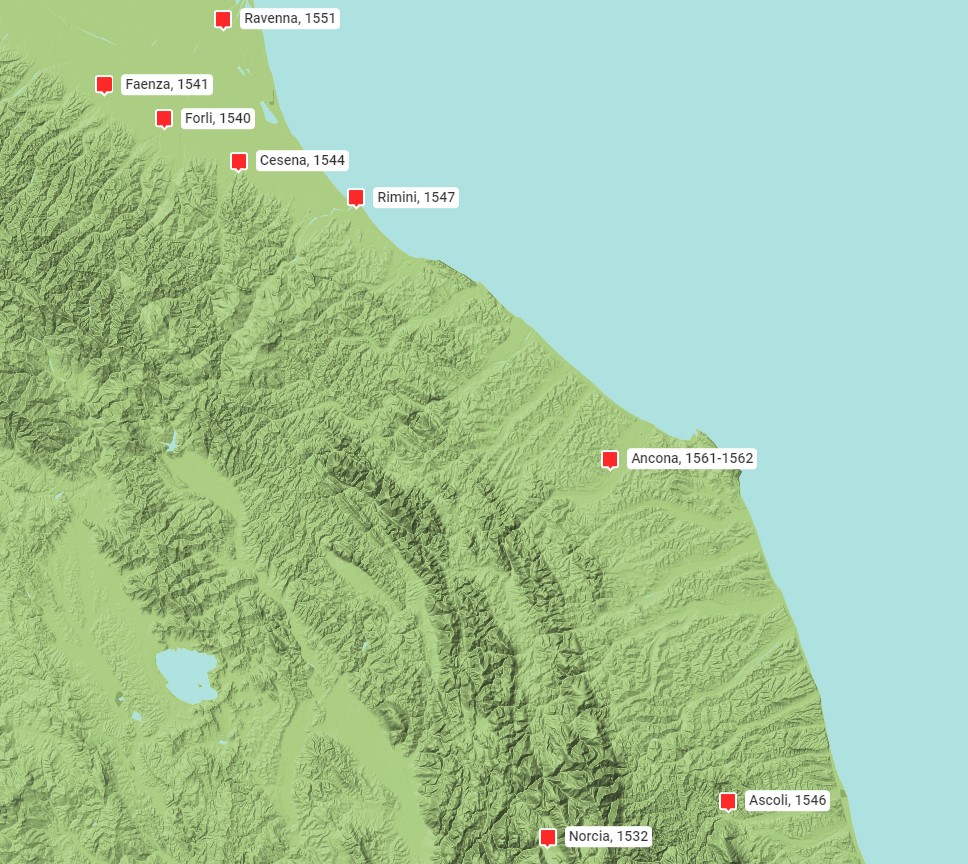
If we focus on Peacekeepers established in Romagna we can see a peculiar physiognomy. They usually included between eighty to one hundred members. Their duties were formally codified in specific charters, ordinances, and statutes. The primary role of such bodies was still to settle quarrels within the community, but they were also tasked with suppressing riots and preventing factional clashes, and it was for this reason that their members had the right to bear arms. They also had the responsibility to garrison the city’s politically sensitive areas, not only squares and the palaces of power, but also the city gates. In a nutshell, the Peacekeepers in Romagna not only acted as peace-brokers where necessary, but also as watchmen.[7]
The Venetian Mainland: Signori alla Pace
Uncovering city peacemakers from the Venetian mainland is a much more challenging task as they produced few records. Evidence of their existence can be found instead either in local council records or in a more indirect way, for instance, thanks to chronicles and diaries. As for the offices we know of, the first are probably those of Verona, where three ‘Makers and keepers of peace’ (Compositori e conservatori della Pace) were established in 1531, and increased to four in 1547.[8]
In 1543, the ‘Lords over Peace and Weddings’ (Signori sopra la Pace e i Matrimoni) were established in Udine, and after some refinements, an embassy was dispatched to Venice a year later to seek confirmation from the Signoria.[9] More followed later in Padua, Bergamo, Belluno, and Salò over the 1560s, as well as Feltre in the first half of the 17th century, groups of city peacemakers that for simplicity’s sake can be referred to as ‘Peace Lords’ (Signori alla Pace).
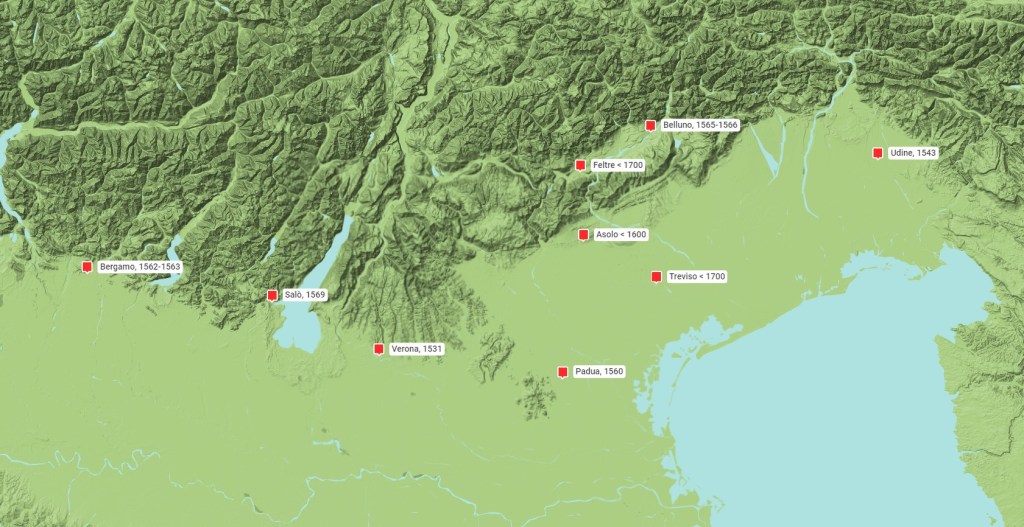
The Peace Lords did not get the same kind of regulation as the Peacekeepers. Local civic councils set up the former without providing them with statutes or founding charters, which is why they enjoyed a greater degree of flexibility, but at the same time their activities were probably more informal. They very likely had no proper archives either, which is almost certainly one of the reasons why these bodies have remained under the radar.
A further distinction is a consequence of the nature of Venetian peacemakers. They usually came from the civic councils’ ranks and were very few in number, so they were often prominent figures within local society. In contrast, within the Papal Peacekeepers a limited number of members had an honorary title reflecting their high social status, with the rest probably being citizens or ordinary inhabitants. However, in some cities the very first members had a good share of individuals with honorary titles, as was the case in Forlì.[10] Such social status probably helped Venetian Peace Lords to appear as mediators within the community, but they could only rely on their influence, whereas the Peacekeepers had a much more formalized power.
It is unclear whether Peace Lords were created from scratch, or if they were a revival of previous communal bodies, as happened in some Romagna communities, such as Faenza. What we can infer is, at any rate, that local urban nobility expressed efforts to reaffirm their hold on local political life through the creation of Peace Lords, sometimes in conjunction with local governors sent from Venice, eager to facilitate the reconciliation of their subjects.[11]
A late 17th-century peacemaker in Padua: Giovanni de Lazara
What motivated people to be appointed as a Peace Lord or to become a member of the Peacekeepers? They very likely shared the values of social peace and public order with other members of the local elite and also with the central powers. Beyond that, they would have probably benefited from the prestige and honour associated with office-holding and a role that opened plenty of opportunities for patronage, as successful mediators had the chance to forge such ties with the settled parties.
There could be reasons of personal gain in the choice made by individuals such as Giovanni de Lazara, a Paduan nobleman with the title of knight and feudal estates in the countryside, who served as peacemaker in the city of Padua many times between 1671 and 1680.[12] In the chronicle of political life in Padua that he wrote, Giovanni presented himself as a faction leader, empowered by his work as a peacemaker, a task that he carried out even beyond his institutional role.[13]
An example of Giovanni de Lazara’s work as Peace Lord in Padua will show what kind of activities these figures carried out. In 1679, de Lazara was elected to this office. On 12 August, a verbal quarrel occurred in the Palazzo della Ragione, where justice was administered. A civil case discussed before the judges led to an exchange of insults between two people belonging to the medium and upper echelons of local society, Marco Antonio Braga and Doctor Crivellari. The case’s intricacy lit up the spirits and Braga walked away accusing Crivellari of being insolent. The latter responded by calling him an insolent too, but also a reckless and disgraceful person, to which Braga further responded by accusing him of being disgraceful, reckless, and a drunkard.
The following day, Giovanni took action by approaching both men and offering his services. The Peace Lord first reported to Crivellari a message from Braga, affirming that the altercation that had occurred the day before stemmed from the heat of the moment and there was no intention to insult him, along with a request to restore friendly relations. Crivellari replied that he accepted de Lazara as a peace broker and consented to the proposal, a reply which was eventually forwarded to Braga. The episode, although rather trivial at first sight, actually bore the seeds of a bitter conflict. From this, we understand why Giovanni noted that, on account of his service, “peace was preserved”.[14]
Conclusion
How should we understand the trend of institutionalisation of local peacemakers in the Venetian mainland and Papal States over the course of the sixteenth century? We may speculate that the structural differences responded to specific problems: the numbers of Peacekeepers and their function as watchmen in the urban areas of Romagna, Marche, and Umbria perhaps mirrors the aim, also made explicit in the founding decrees, of fighting internal factionalism within the Papal State.
This happened in a moment when the central authority was reorganising itself and attempting to negotiate power with the peripheries. Something similar also happened in the Venetian Mainland, where the social dimension of Peace Lords may instead reflect the need to reduce as much as possible the outbreak of conflicts between noble families that fuelled noble banditry, a problem that in the Republic of Venice in the second half of the sixteenth century was becoming increasingly problematic.[15]
The existence of city peacemakers on the Venetian mainland and in the Papal States raises a number of questions: how effective were they in actually keeping the peace in the urban area? And what about the surrounding rural areas? What was their relationship with central authorities and their representatives on the periphery? And finally, what were the inner and more nuanced differences among the many peacemakers in the Venetian and Papal territories?
Bio:
Andrew Vidali is currently a Marie Curie Research Fellow in the Department of History at the University of York. He works primarily on the interrelationships between criminal justice, violence, banditry, and the law in early modern northern Italy. His other research interests include the political, legal, social, and religious history of the Republic of Venice and its mainland and maritime empire.
Acknowledgements: This project has received funding from the European Union’s Horizon 2020 research and innovation programme under the Marie Skłodowska-Curie grant agreement No. 101023687 , ‘ViolenControl – Violence and its Control in Early Modern Venice.”
Notes:
[1] The most recent book investigating the intrinsic relations between peace, violence, and the state is Stuart Carroll, Enmity and Violence in Early Modern Europe (Cambridge, 2023).
[2] Lucien Faggion, “Violence, Rites and Social Regulation in the Venetian Terra Firma in the Sixteenth Century”, in Aspects of Violence in Renaissance Europe, ed. Jonathan Davies (New York, 2013), 185-204; idem, “Social mediation in the Venetian regional state: The notary, the uncle, the priest (C. 1560-1590)”, Acta Histriae 22, II (2014), 291-304; Michelangelo Marcarelli, “Il terzo nei riti di mediazione e di pace nel Friuli del Cinquecento”, Acta Histriae 22, II (2014), 225-240; a focus on Jesuits and their role as peacemakers in Paolo Broggio, “I gesuiti come pacificatori in Età moderna: dalle guerre di frontiera nel Nuovo Mondo americano alle lotte fazionarie nell’Europa mediterranea”, Rivista di Storia e Letteratura Religiosa, 39, II (2003), 249-289.
[3] Ottavia Niccoli, Perdonare. Idee, pratiche, rituali in Italia tra Cinque e Seicento (Rome-Bari, 2007), 113-123; on 17th century Bolognese noble feuds see Giancarlo Angelozzi, Cesarina Casanova, La nobiltà disciplinata. Violenza nobiliare, procedure di giustizia e scienza cavalleresca a Bologna nel XVII secolo (Bologna, 2003), and more recently, Colin Rose, A Renaissance of Violence. Homicide in Early Modern Italy (Cambridge, 2019), 181-222.
[4] Paolo Broggio, Governare l’odio. Pace e giustizia criminale nell’Italia moderna (secoli XVI-XVII) (Rome, 2021), 185-197.
[5] Evidence of the existence of other Pacifici bodies in smaller Romagna communities, such as Bertinoro, Brisighella, Faenza, Riolo, and Verucchio, is in Archivi Storici in Emilia-Romagna. Guida generale degli archivi storici comunali, ed. Giuseppe Rabotti (Bologna, 1991), 246, 677, 708-709, 751, 901.
[6] As suggested by Vito La Mantia, Storia della Legislazione Italiana, vol. 1, Roma e Stato Romano (Rome-Turin- Florence, 1884), 379.
[7] The Rimini records mention the first difensori tasked with guarding weapons and their storage, walls, and city gates: see Archivio di Stato di Rimini, Archivio Storico Comunale – preunitario, series AP, reg. 1993, fol. 5 v.; another example in Capitoli, et Leggi delli Novanta Pacifici di Ravenna, Girolamo Rossi (ed.) (Bologna, 1620), 22-23.
[8] Archivio di Stato di Verona, Antico archivio del comune, Atti dei Consigli del comune, reg. 74, fol. 74 v.-75 r.; reg. 80, fol. 93 r.-v.
[9] Biblioteca civica “V. Joppi” di Udine, Sezione Manoscritti e Rari, Archivum Civitatis Utini, Annales, reg. 51, fol. 82 v.-83 r., 204 v.-205 r., 221 r.-v.
[10] Footnotes 14 and 15 also include reference to the first Signori alla Pace appointed in the cities from the Venetian mainland. The first conservatori from Rimini can be found in Archivio di Stato di Rimini, Archivio Storico Comunale – preunitario, serie AP, reg. 1993, fol. 2 v.-3 v.; the first Pacifici from Forlì are listed in Ordini, leggi, concessioni, e privilegii del Magistrato dei Novanta Pacifici della città di Forlì (Cesena, 1719), 223-224.
[11] The motion passed in Verona’s civic council in 1531 had been proposed by rettori, see Archivio di Stato di Verona, Antico archivio del Comune di Verona, Atti del Consiglio, reg. 74, fol. 74 v.-75 r.; the establishment of the Signori alla Pace in Udine and Bergamo was the result of the shared concerns of the city’s governors and key representatives, see Biblioteca civica “V. Joppi” di Udine, Sezione Manoscritti e Rari, Archivum Civitatis Utini, Annales, reg. 51, c. 82 v.-83 r.; Archivio storico comunale di Bergamo, Sezione Antico Regime (secc. XV-XVIII), Comune di Bergamo, Azioni dei Consigli, reg. 29, cc. 80 r.-81 r.; the rettore most involved in this process was perhaps that of Belluno, Alvise Gritti, see Archivio storico del Comune di Belluno, Comunità Cividàl Belluno, Deliberazioni (1565-1576), Libro R, reg. 14, fol. 11 r.
[12] On Giovanni de Lazara’s political activity, see Valentina Casarotto, Giovanni de Lazara (1621/1690). Collezionista numismatico nella Padova del Seicento. Le collezioni antiquarie, l’epistolario, la biblioteca (Trieste, 2015), 27-29.
[13] Evidence of the peacemaker activity of Giovanni de Lazara can be found in Biblioteca Comunale di Lendinara, Archivio Malmignati, Famiglia De Lazara, reg. A-333, A-334.
[14] Biblioteca Comunale di Lendinara, Archivio Malmignati, Famiglia De Lazara, reg. A-333, “1679 13 Agosto. Aggiustamento di Briga tra il signor Dottor […] Crivellari et il signor Marco Antonio Braga”.
[15] On Papal statehood in the early modern age from a long-term perspective see Angela De Benedictis, Repubblica per contratto. Bologna: una città europea nello Stato della Chiesa (Bologna, 1995), and Irene Fosi, Papal Justice. Subjects and Courts in the Papal State, 1500-1750 (Washington D.C., 2011). On banditry in the early modern Republic of Venice, see Peter Laven, “Banditry and lawlessness on the Venetian Terraferma in the later Cinquecento”, in Crime, Society and the Law in Renaissance Italy, ed. Trevor Dean and Kate J. P. Lowe (Cambridge, 2009), and Cristina Gioia, “Aristocratic Bandits and Outlaws: Stories of Violence and Blood Vendetta on the Border of the Venetian Republic (16th-17th Century)”, in Imagining Frontiers, Contesting Identities, ed. Lud’a Klusáková and Steven G. Ellis (Pisa, 2007), 93-107.
Discover more from Legal History Miscellany
Subscribe to get the latest posts sent to your email.
 Legal History Miscellany