Posted by Krista J. Kesselring, 12 January 2024.

Agnes Waterhouse is often identified as the first person to have been executed as a witch in Elizabethan England. Many websites and popular histories say as much. Her name even appears in Judy Chicago’s famous feminist history installation, The Dinner Party. The accompanying material on the Brooklyn Museum’s website explains the reason for her inclusion:
“Agnes Waterhouse was put on trial in Chelmsford, England, in 1566 for using witchcraft to cause illness; her eighteen-year-old daughter Joan was accused of the same crime. Joan testified against her in order to save herself and Agnes was hanged, becoming the first woman executed for witchcraft in England.”
She wasn’t, though she was the first for whom a contemporary news pamphlet survives, which presumably explains her residual fame.[1]
What about Elizabeth Lowys, also often said to have been the first?[2] A cunning woman and healer tried in July 1564 for killing a child by occult means, she was also hanged in Chelmsford, Essex, but in March 1565. Her biographer, Joyce Gibson, qualified her claim for Lowys’s priority, noting that Lowys was “the first person hanged as a witch in Essex under the Act against Conjurations, Enchantments and Witchcraft, enacted by parliament in March 1563…Her case could well have been the first in England.”[3] James Sharpe offered another, similar qualification: “on the strength of surviving documentation” we might say that Lowys was the first person to be executed under the Elizabethan Act.[4] As Sharpe’s comment implies, we just don’t have enough records to identify the first with certainty. Lowys was the first in the court records from Essex, but Essex is one of only a handful of counties for which most (but not all) of the pertinent criminal court records survive for the years immediately following the passage of the 1563 Act. Too much has been lost to know for sure who warrants the dubious honour of being first, despite the claims of many general interest sites and books.
Nuances often disappear when summarizing complex histories. (I’ve surveyed the history of European witchcraft in 50-minute lectures to undergraduate students — I know all about losing subtleties along the way!) But why the persistent interest in identifying “the first,” especially as it just can’t be done? Being the first woman executed for the felony of witchcraft is hardly a first worth celebrating, a moment of breaking barriers or overcoming odds in some inspiring fashion. Identifying a first might be good for pub trivia or for a quirky bit of local history. As a ploy to pique interest, “the first” ranks along with the “never before told history” (which has, very often, been often told before). But perhaps it’s a product of our fondness for narratives, and every story needs a starting point. Maybe it’s a function of how our memories work. In this case, it might be a way to put a human face or at least a name to an otherwise nameless and innumerable group of people killed for a crime many of us would now not deem real. And if a first forges a path, then finding it might help plot the path’s direction. As Francis Young suggested of the judge who tried Agnes Waterhouse: “By convicting her he created a precedent and defined the parameters within which the ‘Witchcraft Act’ would be understood by lawyers and judges and thereby inaugurated England’s era of witch-hunting.”[5] As it turns out, Waterhouse wasn’t the first, but looking at the earliest possible cases may well give us a bit more insight into the beginnings of the Elizabethan witch trials.
In this spirit, then, let’s look at a case that was likely a bit earlier even than that of Elizabeth Lowys, a case that may get us a little nearer to the passage of the 1563 Act, in more ways than one: Agnes Mills (or Mylles), a widow from Wiltshire, was executed at Fisherton Anger for having killed the infant William Baynton by means of witchcraft in April 1564. Mills purportedly acted at the instigation of both the devil and Dorothy Baynton, wife of the infant’s uncle, next in line as heir to Sir Edward Baynton and his wife Agnes. This was witchcraft-for-hire, and detected by another witch-for-hire (or a cunning woman, if one prefers), a Somerset widow named Jane Marsh. The bereaved parents had gone to local justices of the peace and the Bishop of Salisbury with their suspicions. Someone then told the visiting assize justices about Marsh, a woman “of such skill and knowledge that she could detect persons who used witchcraft.” On their invitation, Marsh travelled to Salisbury and promptly identified both the procurer and the witch as the agents of the infant’s destruction. Dorothy Baynton remained free, but Mills confessed and was hanged.
We don’t know the precise date of the execution. Assize court records don’t survive for Wiltshire in these years; we know of this case only because it came up in a complaint the infant’s parents made to the court of Chancery in May 1565.[6] Upon pressure from Dorothy Baynton and at the order of the Bishop of Salisbury, Marsh had been imprisoned shortly after making the accusations that had led to Mills’s death. After “about half a year” in gaol Marsh retracted her tale to regain her freedom. When called to answer in Chancery upon the parents’ complaint, Marsh reverted to her original story, that the murder was done by Agnes Mills at Dorothy Baynton’s instigation.
So, was Mills the first person executed under the 1563 “Witchcraft Act”? Even if she did die a few months before Lowys, as seems likely from the evidence, we still don’t know if Mills was “the first” – far too many records have long since disappeared to make such a claim tenable. But the case is interesting and significant in all sorts of ways, regardless. It gets us out of Essex and the Home Counties, the area from which we derive most of our evidence of Elizabethan witchcraft trials. It shows us witchcraft as work, in both its maleficent and cunning forms, and both the reputation and risk that might come with the latter.[7] The case also conveys the enabling role of elite participants. The Bayntons were wealthy and the senior assize court judge, Richard Weston, had been Attorney General under Queen Mary, for example. And, significantly, the bishop involved in this episode was none other than John Jewel, a key apologist for the Elizabethan religious settlement and the man once thought to have been the prime mover behind the 1563 Witchcraft Act.

The church historian John Strype long ago pointed to Jewel as the Act’s instigator, citing a sermon he gave before the Queen at court.[8] Certainly, Jewel had called for legal action against what he saw as a growing threat, one worsened by the recent reversion to “superstition” under the Catholic Queen Mary. Perhaps drawing on continental beliefs he’d encountered while in exile in Mary’s reign, he warned of witches and conjurors both “good” and bad: even those who seemed to help could do so only by colluding with devils. He counselled the Queen that:
“This kind of people (I mean witches and sorcerers) within these few last years are marvellously increased within this Your Grace’s realm. These eyes have seen more evident and manifest marks of their wickedness. Your Grace’s subjects pine away even unto death, their colour fadeth, their flesh rotteth, their speech is benumbed, their senses are bereft. Wherefore, your poor subjects’ most humble petition unto Your Highness is, that the laws touching such malefactors may be put in due execution. For the shoal of them is great, their doings horrible, their malice intolerable, the examples most miserable. And I pray God they never practise further than upon the subject.”[9]
Did Jewel’s admonitions suffice to secure the transformative 1563 Act? No. Work by Norman Jones and others has shown that the puritanical pressure for a measure against witchcraft only managed to take effect when nudged along by anti-Catholicism and fears of popish plots that invoked magical methods to kill the Queen.[10] In this retelling, the impetus for the Act came more so from fears of Catholic conjurors and learned sorcerers than from concerns about village witches. But anyone who has assumed a years’ long gap between the Act and the first trials and thus posited a disjunction between the aims of legislators and those of the people who put the law to work might take pause from this case: Bishop Jewel returned to Salisbury from his time in parliament and within the year helped to prosecute one supposed witch and incarcerate the cunning woman who provided evidence against her. Multiple motives could co-exist. John Jewel may not have been the prime mover behind the 1563 Act, but he quickly helped put it to use in a way that made Agnes Mills at least one of the very first people to be executed under its provisions.
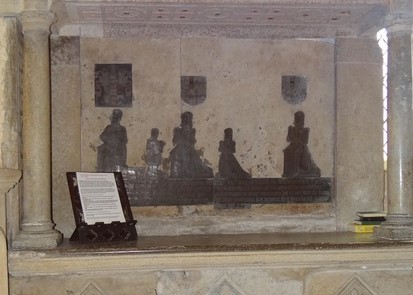
Images: Feature Image and (1), from The Examination and Confession of Certaine Wytches at Chensforde in the Countie of Essex (London, 1566); (2) the Baynton family memorial at the Church of St. Nicholas, Wiltshire, courtesy of Duncan and Mandy Ball; (3) portrait of John Jewel by an unknown artist, c. 1560s, courtesy of The National Portrait Gallery.
Notes:
[1] For the trial and execution of Agnes Waterhouse, see The Examination and Confession of Certaine Wytches at Chensforde in the Countie of Essex (London, 1566), reprinted in Marion Gibson, Early Modern Witches: Witchcraft Cases in Contemporary Writing (London, 2000). For the 1563 Act, see 5 Eliz. I, c. 16. A statute of 1542 (33 Hen. VIII, c. 8) had previously made witchcraft a felony but it was repealed within five years and little is known of its operation. An attempt to pass a new law in 1559 failed.
[2] See, e.g., Alan R. Young, “Elizabeth Lowys: Witch and Social Victim, 1564,” History Today, 22 (December 1972) and (as of 11 January 2024), her Wikipedia page.
[3] Joyce Gibson, Hanged for Witchcraft: Elizabeth Lowys and Her Successors (Canberra, 1988), 3 (emphasis added). The qualifications subsequently disappear, though. (See, e.g., p. 141.)
[4] J.A. Sharpe, review of Gibson’s Hanged for Witchcraft, in the English Historical Review 106.441 (1991), 994 (emphasis added).
[5] Francis Young, Magic as a Political Crime in Medieval and Early Modern England: A History of Sorcery and Treason (London, 2018), 110.
[6] The National Archives, Kew, C 3/8/113, also excerpted in E. M. Thompson, “The Murder of William Baynton by Reputed Witchcraft,” in Wiltshire Notes and Queries, 7 (1893), 72-4. Martin Ingram reports that a few witchcraft prosecutions came before Wiltshire’s church courts each year; a search through the relevant records might well tell us whether Mills had come under suspicion previously (and whether she had worked in medicine, as did Waterhouse and Lowys), but unfortunately I don’t currently have access to these archives. One hopes that the surviving church court records might allow someone to reconstruct Mills’s story much as Gibson has done for the Lowys case. On the Wiltshire church courts, see Ingram, Church Courts, Sex and Marriage in England, 1570-1640 (Cambridge, 1987), 96-7.
[7] On service magic, see, e.g., Owen Davies, Cunning-folk: Popular Magic in English History (London, 2003); Tabitha Stanmore, Love Spells and Lost Treasure: Service Magic in England from the Later Middle Ages to the Early Modern Era (Cambridge, 2022); and Taylor Aucoin, ‘The Magiconomy of Early Modern England‘, Forms of Labour blog, 4 November 2020.
[8] John Strype, Annals of the Reformation and Establishment of Religion (Oxford, 1729), I.i., p.11. See also Wallace Notestein, A History of Witchcraft in England from 1558 to 1718 (Washington, D.C., 1911), 24-5.
[9] The Works of John Jewel, Bishop of Salisbury, ed. John Ayre (Cambridge, 1847, Parker Society, 3 vols.), II. p. 1028. Also often quoted, a passage from a letter Jewel sent to Peter Martyr Vermigli in which he complained that having done a visitation of the western counties, he had found that “the number of witches and sorceresses had every where become enormous.” The Zurich Letters, ed. Hastings Robinson (Cambridge, 1842, Parker Society, 2 vols.), I. p. 44-5.
[10] Norman Jones, “Defining Superstitions: Treasonous Catholics and the Act Against Witchcraft of 1563,” in State, Sovereigns and Society in Early Modern England, ed. Charles Carlton et al (Stroud, 1998), 187-203; Michael Devine, “Treasonous Catholic Magic and the 1563 Witchcraft Legislation: The English State’s Response to Catholic Conjuring in the Early Years of Elizabeth I’s Reign,” in Supernatural and Secular Power in Early Modern England, ed. Victoria Bladen and Marcus Harmes (Farnham, 2015), 67-91; and Lewis Brennen, “Witchcraft and Politics in Early Modern England, c. 1558-1604,” University of Southampton PhD dissertation, 2021. (My thanks to Dr. Brennen for sharing a copy of his dissertation with me.)
Discover more from Legal History Miscellany
Subscribe to get the latest posts sent to your email.
 Legal History Miscellany