Posted by Sara M. Butler, 8 February 2024.

Geoffrey Chaucer’s The Canterbury Tales offers an idyllic vision of pilgrimage. A motley crew of characters – when else are we going to see a prioress, a reeve and a plowman spending quality time together? – exchanging fantastical stories at the Tabard Inn en route to Canterbury cathedral to pay their respects at the shrine of Saint Thomas Becket, in the hopes of finding some inner peace and spiritual renewal. Going on pilgrimage was a normal experience in the late Middle Ages. And unlike today where employers often make sure that no one enjoys time off without feeling at least some guilt about all the work they are missing, the medieval world actually encouraged people to go on pilgrimage. Indeed, legal protections existed to make the whole process easier for pilgrims traveling long distances. Pilgrims were granted immunity from depredation and imprisonment, and their households and possessions were to be protected until their safe return. Perhaps even more usefully, once a pilgrim had taken their vows, they were also immune from criminal or civil lawsuits.[1] While traveling, they were exempt from paying taxes and tolls, and their distinctive attire marking their pilgrim status ensured that they would be recipients of charitable giving in the communities through which they traversed, including free meals and lodging, as sheltering the pilgrim and feeding the hungry are two of the seven corporal works of mercy.
Despite the rosy image depicted by both Chaucer and the canonists, the legal record suggests that medieval men and women were not as respectful as one might suppose of the protected status of pilgrims. Those who embarked on a pilgrimage were in a vulnerable state. Veneration at a saint’s shrine was only part of the package deal. Pilgrimage was intended also to be a form of suffering in imitatio Christi (in imitation of Christ), thus pilgrims undertook their long, exhausting journeys barefoot. As a “penitent pauper for Christ,” they were also expected to relinquish any weapons.[2] The only possible means of protection available to them was a wooden walking stick, blessed by the bishop and conferred upon the pilgrim during a formal ceremony – of course, one wonders how appropriate it would have been to whack a brigand with such a holy item? Needless to say, for thugs and highwaymen who made their living preying on travelers, pilgrims were the ideal victims.
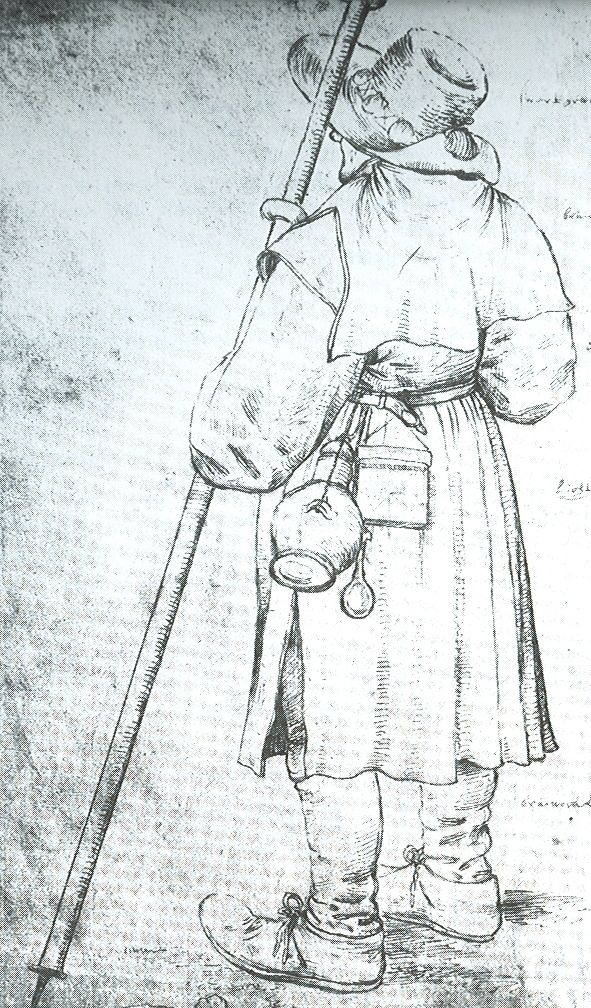
Oddly enough, the records suggest that it was not highwaymen that pilgrims had to worry about, but rather their own neighbors. The publicity of a religious ceremony, with the bishop no less, effectively advertised one’s upcoming journey. This was particularly bad news for those engaged in disputes with other locals. John Vivian of Cornwall’s story, recorded in a petition to the House of Commons in 1473, makes it clear that a pilgrimage was exactly what his nemesis, Thomas Trethewy of Reskymer (county Cornwall), had been waiting for.
On 11 Aug. 1472, Vivian, a self-described gentleman, and his wife, his son, his nephew, and a multitude of servants were on pilgrimage to the chapel of Saint James at Tregowris when they were attacked by a group of men acting upon the command of Thomas Trethewy and his wife Elizabeth. He tells us that the men were “arraied in maner of werre, with Bowes and Arrowes, Swerdes and Bokelers, Gleyves and Billes, and other ablementes of werre, contrarie to the lawes and peas of oure said Sovereigne Lord the Kyng” (the specific phrasing here was a legal formula, intended to underscore the felonious nature of the crime). They had lain in wait for Vivian and his family in the highway hoping “to murder and sle hym, his wife, children and servauntes, then and there.” Spying the men, and knowing them to be “maliciously desposed,” Vivian and his entourage turned tail and fled, only to be pursued and then assaulted. His nephew, John Morthure, was murdered; his servant, Piers Davy, was “maimed, hurte and woonded.” But that was not the end. Vivian laments that the harassment had continued since that tragic day. At the behest of Trethewy, up to forty persons “dayly and nyghtly have lay in awayte, and made their espies thorough the said Counte, that if he myght take your said Besecher, his wyfe, childern and servauntes, thay shuld dye.” Accordingly, Vivian and his family did not dare return home “for fere of deth.” Trethewy and his wife informed Vivian that the threats and violence would cease only once he turned over his goods and chattels, as well as the revenues from his lands. Vivian’s refusal to do so led Trethewy eventually to help himself: on the Sunday after Saint Bartholomew (24 Aug.), twenty-eight “riotous persones,” once again “arraied in maner of werre” attacked Vivian’s property at Trelowarren and carried away goods and chattels to the value of 40 marks, leaving Vivian “ympoverysshed” with “noon power to punysshe the said riotte and murdre, accordyng to the common lawe.”[3]
Vivian’s petition did not go unanswered. After failing to appear in King’s Bench and being found guilty by default, Trethewy sought to have Vivian’s bill voided. Among other things, in his counter-petition, Trethewey clarified that he was in fact the county coroner (although, clearly, not one with high moral standards).[4] Perhaps more importantly, the two were neighbors. Trethewy had recently married the widow of Reskymer near Helston. Vivian’s manor at Trelowarren was nearby. It is not clear what led to this siege: a boundary dispute? Pasturage rights? Tin collection? But clearly, when Trethewey became aware of the Vivian family pilgrimage – knowing that they would be walking, barefoot, and weaponless – it was simply too good an opportunity to pass up.

More commonly, pilgrims complained that royal officials failed to respect the immunities and protections granted to pilgrims by canon law. In his petition to the chancellor, John Foster, a skinner of London, lodged a complaint against the sheriff of Kent for imprisonment while on pilgrimage to Canterbury, a clear violation of the pilgrim’s immunity from incarceration. Admittedly, Foster’s story doesn’t quite add up. Protesting a little too heartily, he tells us that when everything went wrong, he was simply minding his own business. He was “goyng on pilgremage to Cannterbury not thynkyng any harme to any creature but forto doo his pilgremage godly and goodly as his intent was God knoweth,” when a strange man came up and launched into a quarrel with him, speaking in “unfittyng and sedicious langage.” Yet, because the “strange man” was known in Kent and Foster was not, it was Foster who was arrested and cast into prison, where he remained at the time of the writing of the petition.[5]
Something about Foster’s story does not ring true. Why would a strange man come up and start shouting at him without cause or provocation? And if he did absolutely nothing, how is it that he was the one who ended up in jail? One can’t help but wonder: did Foster think his “immunity from imprisonment” meant that he could do whatever he wanted – even engage in violent or criminal behavior – without having to worry about the consequences?
Or, is it possible that Foster was somehow the victim of a scam run by locals? A false plaint of trespass was a traveler’s worst nightmare. Not only would it lead to arrest and imprisonment, but the odds of having a fair trial, when the traveler was a stranger to the community and the plaintiff was well known, were not good. Richard Winter of London, a barber, also voiced this concern in his petition to the chancellor. He recounts how he was on pilgrimage to visit the shrine of “the goode vicar of Norwyche” – that is Richard Caister, Margery Kempe’s former confessor, who was never in fact canonized, but whose burial site became a popular destination for pilgrims in the fifteenth century nonetheless – when “for malice,” two locals, Richard Monesle and Richard Pilly, had him arrested for failing to have a surety of the peace. Writing from prison, he, too, claimed that because he “ys strange and unknowen” to the inhabitants of Norwich, his innocence was meaningless.[6]
A false plaint of trespass, arrest, imprisonment, and a fear of the impossibility of a fair trial all add up to the perfect blackmail: surely, a prisoner in this situation would be inclined to pay to have the plaintiff drop the charges, thereby securing his release from prison? In this respect, the medieval con artist may well have appreciated the recognizability of a pilgrim’s garb: his short tunic and broad brimmed hat boldly announced his alien status, helping the swindler to identify his next victim. And while pilgrims were supposed to act the role of the poor penitent, it was rare that they were in fact penniless.
I would argue that Michael Denys of Exeter was one of these scoundrels, deliberately exploiting the vulnerability and outsider status of pilgrims in order to make some money. There are two surviving complaints against him for manufacturing false plaints of detinue to have pilgrims imprisoned. In the first, one can only assume that Denys met John Jerard of Netherbury (co. Dorset) and his companions on their way to St Michael’s Mount in Cornwall. After they left Exeter, Denys sued a plaint of detinue of chattels against Jerard and his two companions, Thomas Combe of Netherbury and John Danyell, before the mayor and bailiff of Exeter. When the three pilgrims failed to answer the summons, the officials assumed they were evading the law. A stop at Exeter upon their return trip saw all three arrested and imprisoned, even though they claimed that they had never withheld chattels from Denys.[7]
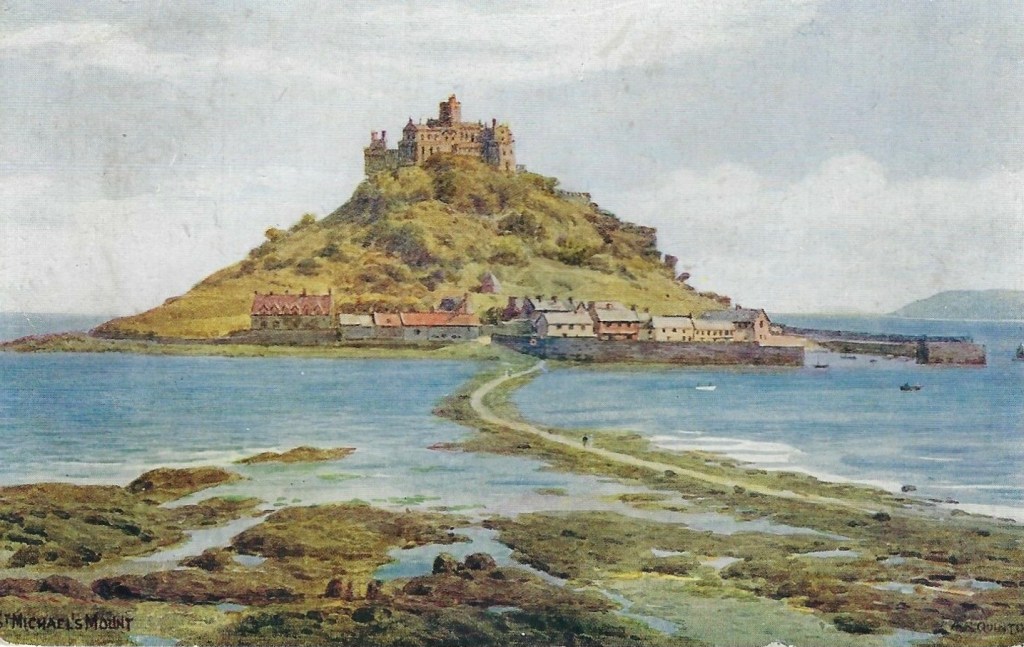
Connected with Mont St-Michel, purportedly both regions had sightings of the Archangel Michael in the 5th century.
The second took place a few years later. Denys was accused of using the same tactic against William Purchas, a mercer of London. Purchas reported that he was headed to Plymouth via Exeter, hoping to catch a ship to visit the shrine of Saint James at Compostella, when “of pure malice and untrouth,” Denys affirmed a plaint of detinue of goods and chattels as well as another unnamed plaint of trespass against Purchas. The astonished pilgrim, denying any wrongdoing, also ended up petitioning the chancellor from Exeter’s prison.[8]
Both Jerard and Denys turned to the chancellor for help because there was simply no resolution at common law for the scoundrel who wielded the law as a weapon against strangers. But how many others paid their way out of prison, or took their chances with a jury trial?
At the very least, a subsequent surviving petition makes it clear that Purchas had his revenge. Upon his return to London, he lodged a plaint against Denys for assault and imprisonment; Denys, who is described in the abovesaid complaint as “of London but born in Exeter,” had presumably recently moved to London. Purchas’s complaint had him arrested and imprisoned. The tables turned, now Denys, as “foreyn” and an “inhabitant in Devonshire,” fearing the “favour might and power” of Purchas, a respectable mercer in his own hometown, had no choice but to turn to the chancellor for rescue.[9]
What can we learn from these cases? Despite all the protections afforded by canon law, and the general good cooperation between church and crown in the maintenance of a Christian society, not everyone respected pilgrimage as a holy endeavor. Clearly, to some criminally-minded folks, pilgrimage was just an opportunity waiting to be exploited.
Images
Pilgrims leaving Canterbury, taken from Lydgate’s Siege of Thebes, Royal 18 D II f.148, 1455-1462. Public Domain. Wikimedia Commons.
Pieter Bruegel the Elder, Pilgrims and Pilgrim (Rotterdam, 1550). Public Domain. Wikipedia.
“Becket’s crown” chapel at Canterbury. Photo by DAVID ILIFF. License: CC BY-SA 3.0. Wikipedia.
Postcard, St Michael’s Mount, by Alfred Robert Quinton (c. 1920). Public Domain. Wikipedia.
[1] Jessalynn Bird, “Canon Law Regarding Pilgrims,” Encyclopedia of Medieval Pilgrimage (Brill, 2012). Brill Online Reference Works.
[2] Brenda Gardenour, “Barefootedness,” Encyclopedia of Medieval Pilgrimage.
[3] Rotuli Parliamentorum; ut et Petitiones, et Placita in Parliamento, vol. 6 (Record Commission, 1738), 54a-b.
[4] Rotuli Parliamentorum, 52b-53b. For a summary of the legal actions in this case, see: “Edward IV: October 1472,” in Parliament Rolls of Medieval England, ed. Chris Given-Wilson, Paul Brand, Seymour Phillips, Mark Ormrod, Geoffrey Martin, Anne Curry and Rosemary Horrox (Woodbridge, 2005), British History Online http://www.british-history.ac.uk/no-series/parliament-rolls-medieval/october-1472 [accessed 16 January 2024].
[5] T[he] N[ational] A[rchives] C[hancery] 1/1/143 (1467-1473), Foster v. The Sheriff of Kent.
[6] TNA C 1/74/48 (1386-1486), Winter v. Monesle. And yes, every individual in this case, including the saint, is named Richard.
[7] TNA C 1/11/422 (1467-1470), Jerrard v. Denys.
[8] TNA C 1/64/167 (1475-1480), Purchas v. The Mayor of Exeter.
[9] TNA C 1/64/1123 (1479), Denys v. The Mayor of London.
Discover more from Legal History Miscellany
Subscribe to get the latest posts sent to your email.
 Legal History Miscellany

#/media/Bestand:Pelgrim_met_lepel_,_tekening_van_Pieter_Breughel_D.O._1525_-_1569.jpg)


Do like the phrases used : ‘ablementes of ware’ !
LikeLiked by 1 person