Posted by Krista J. Kesselring, 22 April 2026.
Who owns what lies within the ground beneath our feet? Who determines when and how it can be extracted, to what ends, and on what basis?
Where I write, subsurface or mineral rights are currently in the news. The provincial government of Nova Scotia has recently lifted longstanding bans on uranium mining and fracking for onshore gas, citing the need to add to Canada’s supply of critical minerals and to develop natural resources in the face of economic challenges worsened by America’s trade war with its neighbours. My own university has entered into an agreement with the province to help effect its subsurface energy investment program, receiving a grant of $30 million with the expectation that it deliver the bulk of the funds to private developers as incentives for exploratory drilling. Mi’kmaw leaders, environmentalists, and others have expressed deep concerns about these developments, ranging from a failure to consult appropriately with Indigenous groups to fears of significant ecological harms. Beneath all the debates lurks the legal claim that here, at least, most mineral rights are reserved to the Crown. How, one might wonder, did this come to be?
Today, rights to what lies beneath the surface of the land differ across common law jurisdictions, but it’s striking how often one particular sixteenth-century case gets cited as a starting point or way marker in the varying paths these laws have taken: the Case of Mines (1568).[1] On this Earth Day, then, I offer a brief introduction to this remarkable and remarkably significant Elizabethan case, a dispute with contemporary analogues as well as legacies.
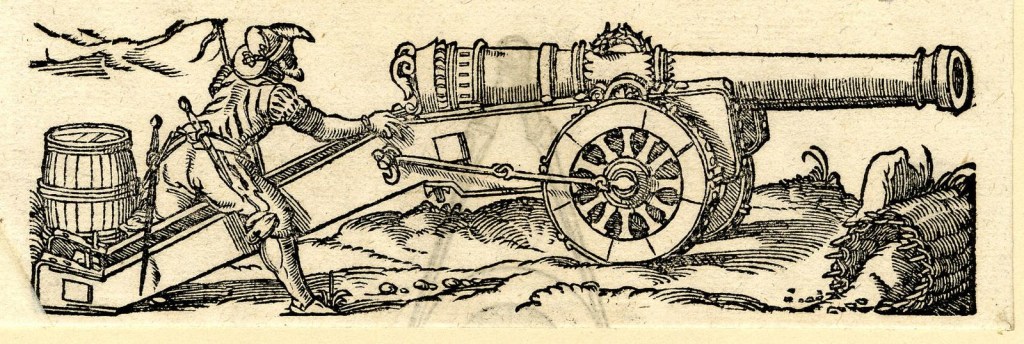
Modern mentions of the Case of Mines sometimes err in assuming that the Crown’s objective had been to secure gold or silver: the most immediate aim was copper. What Queen Elizabeth and her councillors wanted in the 1560s dispute was the copper needed for the most advanced weaponry of the era: artillery and other arms made from bronze and brass, alloys of tin and copper and zinc and copper respectively. But to get to the copper—a ‘base’ metal—Queen Elizabeth’s agents first had to firm up and extend a longstanding notion that the Crown had some sort of claim to the ‘royal metals’ of gold and silver.
They also needed technological help. The queen’s chief councillor, William Cecil, put his prodigious creativity and energies to use to defend his Protestant queen and country from their Catholic foes. As noted in a previous post, he sought to strengthen the navy by promoting the fisheries with legislation in 1563. Other efforts included licensing a novel copper production partnership in 1564 that became the Company of Mines Royal.[2] The Crown would receive 1/20th, later 1/15th, of any copper produced and first dibs on buying the remainder at market price.[3] Cecil and the other privy councillors who personally invested in the venture presumably hoped to enrich themselves as well as the queen’s treasury, but they also wanted to ensure a domestic supply of the metal needed to defend the realm. To do this, they turned to the Germans, considered the best in Europe at finding, working, and smelting copper ore. The Bavarian master miner Daniel Hechstetter directed a group of foreign labourers, hundreds strong, who set to work in Cumberland and soon struck pay dirt at Newlands, near Keswick.
But problems quickly surfaced, with both the people who lived on the land where the Newlands mine operated and the man who claimed ownership of it: Thomas Percy, earl of Northumberland. Tensions with locals prompted Thomas Thurland, the English director of the mining venture, to get permission to punish anyone who disturbed the mineral works. He and Hechstetter requested licenses to override objections to their felling of trees far and wide to fuel their furnaces. Thurland also warned that local magistrates would need ‘to quiet and appease the people for such detriment as may grow to any of their grounds by smoke in the smelting’.[4] Whether reacting to the damage to their lands and livelihoods from the noxious gases produced by smelting or to another trigger, in October 1566, groups of men some twenty to fifty strong attacked the German miners, killing one of them.[5] Days later, the earl of Northumberland had his men block the mining altogether. Asserting his own rights to the ore, he said he had received from the previous queen a grant of the entire estate on which the mine operated. Letters, writs, and injunctions travelled back and forth between the earl, Queen Elizabeth and her councillors, and the directors of the copper mining project.
Thurland urged Cecil to resolve the matter of title not just to this mine but also to the ore he and his partners might find anywhere in any of the counties in which the queen had granted them permission to dig. He wrote to the queen’s councillors (and his fellow investors) to say that the Germans might leave without firmer assurances of profit, having expressed surprise that the queen of England had less power than their own princes. Thurland urged Elizabeth to call her judges together to demand ‘why she should not by her prerogative have as good right to gold, silver, and copper ores as the Emperor, King Philip, and all other princes have within their dominions’. The queen might quite readily assert her royal prerogative to gold and silver, he thought, though he acknowledged that the right to base metals would be trickier. He then laid out a novel and ultimately winning argument: metallurgists said that copper was always mixed with traces of gold and silver, so surely it too should be deemed the queen’s property?[6]
Elizabeth took the dispute to her Court of Exchequer Chamber in November 1567. The queen’s law officers charged the earl of Northumberland with trespass, in a case heard not by the usual panel of four Exchequer judges but by all twelve of the high court justices specially convened.
The queen’s solicitor general, Richard Onslow, described the case as turning on three questions:
- Did mines of gold and silver on the land of subjects belong to the Crown by virtue of the royal prerogative?
- If yes, then did the royal prerogative extend to copper mines on private land if they contained traces of gold and silver?
- If such mines did belong to the Crown, could a monarch grant them away or sever them from the Crown?
To the first question, Onslow responded with a firm yes, offering three chief reasons based on excellency, necessity, and convenience:
1. Given the excellency of gold and silver, ‘the common law appropriated them to the king, who is the most excellent person in the realm’. Admitting that the medieval legal text Prerogativa Regis did not clearly support the royal claim to gold and silver wherever it might be, Onslow drew a parallel to ‘royal fish’, the Crown’s rights to whales and sturgeon as the most excellent fishes of the sea, a right that the Prerogativa Regis did endorse. ‘Because gold and silver are the most excellent things which the soil contains, the law has appointed them (as in reason it ought) to the person who is most excellent and that is the king [, a]nd so does it likewise in regard to the water as well as the earth’.
2. Given the necessity of gold and silver to pay for the defence of the king’s subjects, the law had appropriated mines for such metals to the king: ‘inasmuch as God has created mines within this realm, as a natural provision of treasure for the defence of the realm, it is reasonable that he who has the government and care of the people, whom he cannot defend without treasure, should have the treasure wherewith to defend them.’
3. Given that subjects needed to be able to trade goods to supply their wants, it was a convenience to do so with a well regulated coinage: ‘the body of the realm would receive no benefit or advantage if the subject should have the gold and silver found in mines in his land; but on the other hand by appropriating it to the king, it tends to the universal benefit of all the subjects in making their king able to…put the print and value upon it and … they are thereby enabled to carry on mutual commerce with one another and to buy and sell as they have occasion, and to traffic at their pleasure.’[7]
The queen’s attorney general, Gilbert Gerard, added a fourth reason for the Crown to have rights over gold and silver found on land held by another, noting that it would be an ‘inconvenience’ if any subject surpassed the king in wealth: ‘for a subject who is superior to the king in substance and treasure will seldom obey’.[8]
The queen’s counsel then adduced a variety of precedents that might be read to support the notion that the Crown rightly controlled mines of gold and silver even on a subject’s land. Gerard sought to counter any notion that the royal prerogative could not impinge on a subject’s freehold or inheritance. Along the way he offered a potentially alarming interpretation of Magna Carta, arguing that anything it restrained the king from doing had been lawful before its sealing and thus that any limits it imposed on a king’s ability—e.g., to cut the trees on others’ lands—had to be interpreted narrowly.[9]
Somewhat surprisingly, the earl of Northumberland’s counsel seems to have conceded the first point quite quickly—‘surprisingly’ as a judicial opinion issued as recently as 1555 had deemed otherwise, concluding that a mine of gold or silver if newly found in the soil of a subject would belong to the subject, like mines of base metals. Gold and silver belonged to the Crown only when it was treasure trove.[10] But the 1555 opinion, recorded in Justice Dyer’s manuscript notebooks, received no mention whatsoever in the record of the 1568 hearing.
Instead, counsel moved on to the second question, whether the queen’s prerogative in mines of gold and silver would extend to copper and other base metals, too. Here, Thurland’s argument came to the fore, and Northumberland’s counsel admitted that some gold or silver might well exist within the copper mine. The earl’s side tried to argue that the amount and value of silver was so far outweighed by the copper as to be irrelevant but had no assays of their own on which to rely; as Eric Ash has shown, the Crown’s control of German expertise on this question hampered the earl.[11] While three of the twelve judges eventually concluded that not all copper mines with ‘metals royal’ present automatically belonged to the Crown—they thought the relative value should matter—the others professed themselves convinced: ‘the gold and the silver being more worthy shall draw to it to the copper, which is less worthy…So that the queen being possessor of the one shall be possessor of the other’.[12]
Having thus agreed that base metal mines with precious metals present would be covered by the royal prerogative, the judges moved on to the third query. They all agreed that the Crown could bestow its rights on others, but only with very clear and specific wording, which had not appeared in Queen Mary’s grant to the earl.
We know of the arguments and decisions in this case in unusual detail as one contemporary, Edmund Plowden, left an extensive 60-page report of it. Plowden clearly understood its significance, legally and politically. He detailed not just the legal arguments and lists of precedents but also observed that after the hearing, the justices met several times privately to deliberate. Moreover, when they did finally offer the reasons for their judgement, he was not present, ‘for there were none present but themselves and the counsel who had argued for the queen’.[13] Unusual indeed. Plowden reported the rationales based on subsequent conversations with some of the judges, and followed the account with his own commentary, clearly inclined to think some of its elements concerning.
The Case of Mines had various postscripts beyond Plowden’s. Within little more than a year of the judgement, the earl of Northumberland joined with fellow Catholics to rise in rebellion against the queen. Faith served as the unifying element among the rebels, but Northumberland’s decision to rise was presumably eased by having so recently been deemed guilty of trespass, ordered to pay damages, and denied any part of the wealth being extracted from a mine on his property. He later died a traitor’s death in York.[14]
Queen Elizabeth won not just this particular dispute but also a significant expansion in the royal prerogative. In the immediate aftermath of the 1568 decision, the Company of Mines Royal received its charter of incorporation; its extraction of copper ore accelerated. In coming years, other disputes tried to assert a stronger distinction between ‘mines royal’ and those dominated by baser metals. It was only in the aftermath of the Revolution of 1688 that parliamentary statutes effectively reined in the expansive second part of the 1568 judgement, insisting that ‘no mine of copper, tin, iron, or lead shall hereafter be adjudged, reputed or taken to be a Royal Mine, although gold or silver may be extracted out of the same’.[15]
Digging even just a bit below the surface of the Case of Mines reveals veins of various valuable sorts – the legal and technological innovations of the Elizabethan era, intended both to create wealth for some and to defend the realm, in ways that encountered contemporary resistance and accelerated new types of environmental harms. I find the analogies made with ‘royal fish’ particularly striking, as that medieval precedent was soon made to support ever more expansive Crown claims to the foreshore and to the resources of the sea. But there’s much more of interest here, suggesting that further excavation of this early history of resource rights might well repay the effort as we work to find better ways to relate to the earth’s ‘most excellent things’.

Images:
Cannon, by Jost Amman, illustration in Leonhardt Fronsperger, Kriegßbuch (Frankfurt, 1573), via Wikimedia Commons.
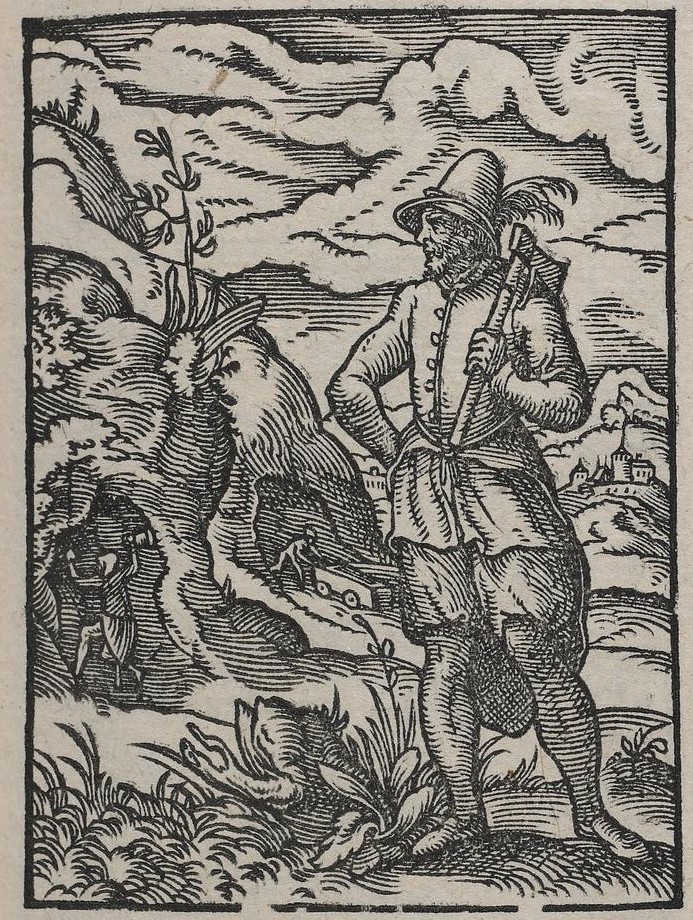
Miners, by Jost Amman, illustration in Hartmann Schopper, Panoplia Omnium Illiberalium Mechanicarum (Frankfurt, 1568), via Wikimedia Commons.
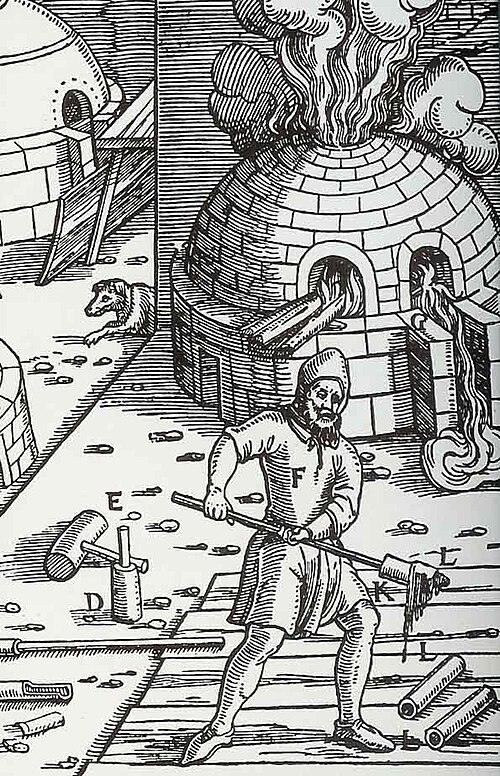
Prospecting (cover image) and smelting from Georgius Agricola, De Re Metallica (Basel, 1556), via Wikimedia Commons.
View from the cairn on Dale Head down the Newlands valley (2008), by Mick Knapton, shared under a Creative Commons license via Wikimedia Commons.
Notes:
[1] For the case itself, see Edmund Plowden’s report, R v Northumberland (1568), 75 English Reports 472, from a translation of Plowden’s Les Commentaries, ou, Les Reportes (1571).
For references to the case in modern overviews of mining law, see, e.g., Tobias Lewin, “The History of Government Property in Minerals in the United States,” St. Louis Law Review 16 (1931), 245-52; Owen J. Morgan, “The Crown’s Rights to Gold and Silver in New Zealand,” Australian Journal of Legal History 1.1 (1995), 51-74; David V. Williams, “Gold, The Case of Mines (1568) and the Waitangi Tribunal,” Australian Journal of Legal History 11 (2003), 157-75; Anthony Scott, The Evolution of Resource Property Rights (Oxford University Press, 2008), ch. 5.
What follows is indebted to the excellent overviews of the case in M.B. Donald, Elizabethan Copper: The History of the Company of Mines Royal (Pergamon Press, 1955), ch. 6, and Eric H. Ash, “Queen v. Northumberland, and the Control of Technical Expertise,” History of Science 39 (2001), 215-40. See also Ash, Power, Knowledge, and Expertise in Elizabethan England (Johns Hopkins University Press, 2004), ch. 1.
[2] A second corporation, the Company of Mineral and Battery Works, was granted mining rights in parts of England not covered by the patent for the Company of Mines Royal: Select Charters of Trading Companies, A.D. 1530-1707, ed. Cecil T. Carr (London, 1913), 4-20.
[3] Donald, Elizabethan Copper, 99.
[4] The National Archives, Kew [TNA], SP 12/40, f. 11, Thomas Thurland’s remembrances touching mining operations at Keswick, 8 June 1566. See also SP 12/36, f. 190.
[5] Donald, Elizabethan Copper, 124.
[6] TNA, SP 12/42, no. 33, Thurland to Leicester and Cecil, 16 March 1567.
[7] Case of Mines, 75 English Reports 480-1.
[8] Case of Mines, 75 English Reports 481.
[9] Case of Mines, 75 English Reports 491.
[10] J.H. Baker, ed. Reports from the Lost Notebooks of Sir James Dyer, Selden Society, 1994, vol. 109, p. liv and p. 14, pl. 26.
[11] Ash, Power, Knowledge, and Expertise, ch. 1.
[12] Case of Mines, 75 English Reports 492.
[13] Case of Mines, 75 English Reports 510.
[14] For the rising, see K.J. Kesselring, The Northern Rebellion of 1569: Faith, Politics, and Protest in Elizabethan England (Palgrave Macmillan, 2007).
[15] 1 William and Mary, c. 30 (1688), Mines Royal Act, emphasis added; clarified in 5 William and Mary, c. 6 (1694).
Discover more from Legal History Miscellany
Subscribe to get the latest posts sent to your email.


.jpg)
_(BM_1904,0206.103.50).jpg)
I enjoyed this, something to get one’s teeth into (so to speak).
LikeLiked by 1 person
Thanks for this thorough and interesting write-up. One minor observation: the 1555 ‘case’ was actually an extra-judicial request for the advice by the lords of Queen Mary’s council directed initially to the chief justice of the Common Bench, Robert Brooke, on the subject. Because it was during the vacation between Michaelmas and Hilary terms, Brooke summoned such law serjeants as happened to be in town (including Dyer, then a queen’s serjeant) and they privately discussed the question before rendering their opinion. The sudden and ad hoc nature of the deliberation and resolution is apparent from the fact that Dyer appended to his contemporaneous note of this meeting a further note of several seemingly contrary authorities that he only later came across.
LikeLiked by 1 person
Thanks for this additional information – much appreciated.
LikeLike