Posted by Krista J. Kesselring, 20 July 2023.
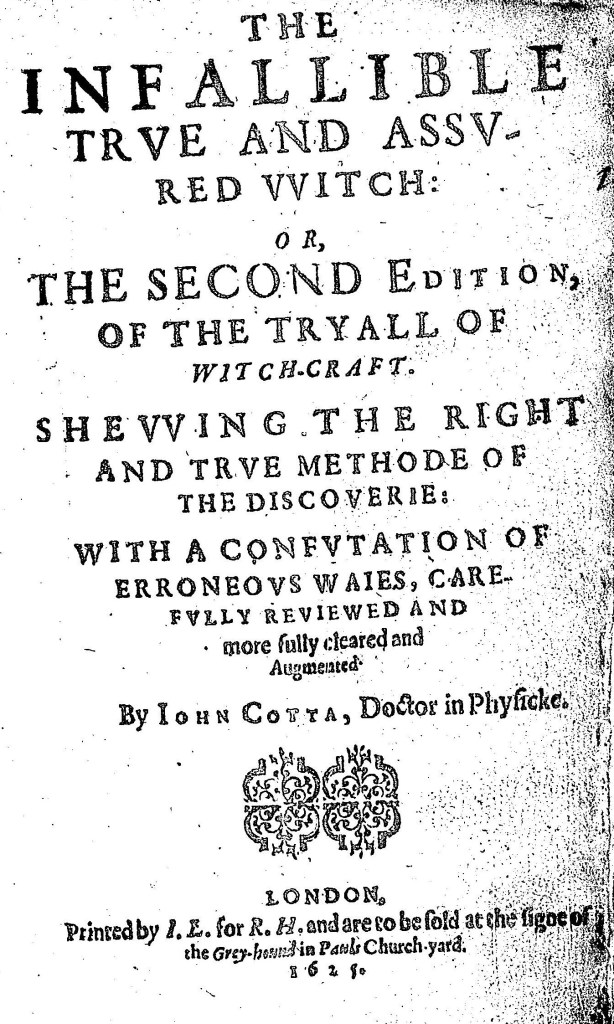
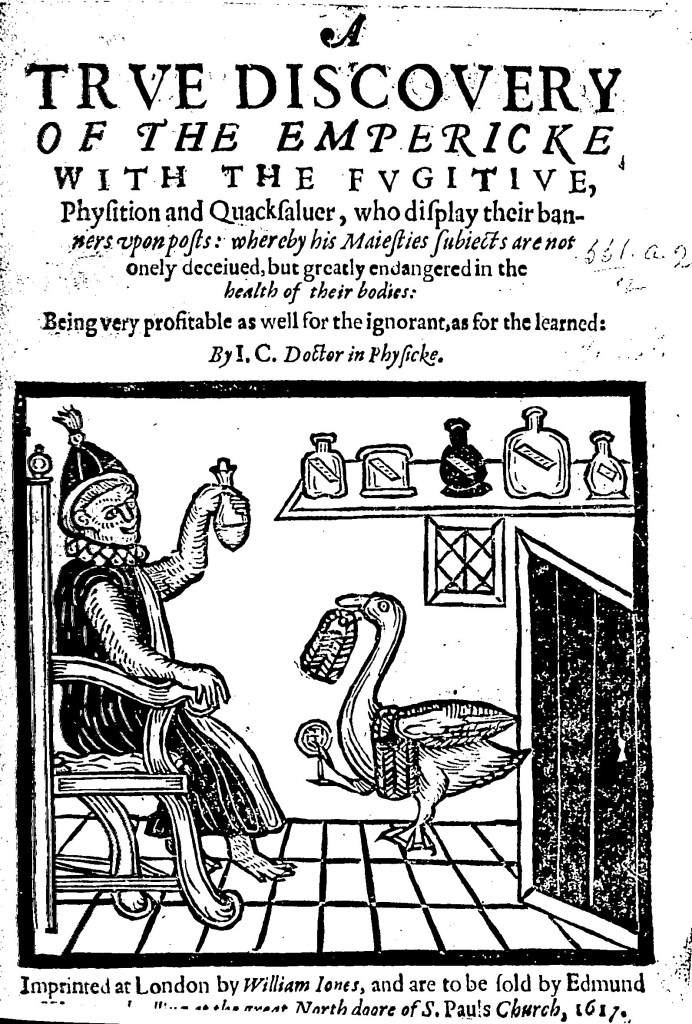
John Cotta has a minor residual fame as the author of a book on how best to identify witches, but also tried his hand at detecting poisoners. First published in 1616 as the Triall of Witch-Craft, Shewing the True and Right Method of the Discovery, with a Confutation of Erroneous Ways, Cotta’s best-known work appeared in multiple editions, including the more catchily re-titled The Infallible True and Assured Witch. A puritan ‘doctor in physick’, Cotta did not doubt the dangers of witches but disparaged unprofessional, unlearned attempts to find them, noting the necessity of consulting physicians to know the origin of an ailment. The book built upon his earlier denunciations of unlicensed healers, first published in 1612 as A Short Discoverie of the Unobserved Dangers of Severall Sorts of Ignorant and Unconsiderate Practisers of Physicke in England.[1] In later years, Cotta also tried to set himself up as a medical expert in murder by poison. After testifying in a trial in 1620 centered on the death of Sir Euseby Andrew, Cotta subsequently produced a detailed report on his efforts that provides rare insight into early forensic autopsies.
Cassie Watson has written briefly on this blog and at length elsewhere on the history of criminal poisoning and the forensic techniques used to detect such crimes from the eighteenth century on. She has excavated the development of forensic toxicology in the 1700s through to its elaboration in the ‘poison panic’ of the 1800s, when hundreds of people – and animals – fell victim to avaricious or aggrieved killers with arsenic or other toxins readily at hand.[2] A ‘poison panic’ of a different sort developed in late sixteenth and early seventeenth-century England. Poison centered in stories of attempts to assassinate Queen Elizabeth, speculations about the sudden death of King James’s eldest son Henry in 1612, reports of the trials of the Earl and Countess of Somerset for silencing Sir Thomas Overbury in 1613, and later in rumours that the Duke of Buckingham (and perhaps even Prince Charles) had hastened the death of King James.[3] These and other high profile scandals accompanied an explosion in printed accounts of men being killed by their ‘dangerous familiars’: while in fact more wives and servants were killed by husbands and masters than the reverse, popular media fanned the fears of subordinates turning on their superiors, with poison elevated as an especially insidious means of subverting the ‘natural’ order.[4] Before the chemical and other scientific developments that Cassie has traced in the eighteenth century and after, how did worried observers try to discover suspected poisoners in their midst?
For many, poisoning was akin to witchcraft, or maleficium, in being particularly hard to detect—or to defend oneself against—with any surety. Unlike Cotta, Reginald Scot famously did not believe in the existence of witchcraft, but he epitomized the fear of its all-too-real cousin:
‘Truly this poisoning art called Veneficium, of all others is most abominable, as whereby murders may be committed where no suspicion may be gathered, nor any resistance can be made. The strong cannot avoid the weak, the wise cannot prevent the foolish, the godly cannot be preserved from the hands of the wicked; children may hereby kill their parents, the servant the master, the wife her husband, so privily, so inevitably, and so incurably, that of all other it has been thought the most odious kind of murder.’[5]
So how, then, to resist this threat through detection and punishment of poisoners, and to do so without mistakenly implicating the innocent? Some people relied on divine providence to reveal secret slayings. We know that some had also begun to use forensic autopsies, though we typically have few details of these early postmortems.[6] What signs did investigators seek?
John Cotta tried to bring his medical training and authority as a licenced physician to bear in the wake of Sir Euseby Andrew’s death in 1619. In his later account, Cotta noted that he had attended the Northamptonshire gentleman twice in his last days, first being called by an attending apothecary, then by a household servant. Euseby had ailed of dropsy and scurvy, it seems, but took a turn for the worse: according to Cotta, Euseby was the first to raise suspicions of poisoning, saying he’d been especially ill since taking a broth or jelly given to him by his wife Anne’s companion, ‘Mistress Moyle’. When Cotta learned that the jelly hadn’t been prepared by a trained physician but by an unlicensed carer, he prepared new cordials for the patient. Euseby briefly seemed to recover, gaining at least enough strength to tell Cotta:
‘If I live, I will discover the strangest practice or wonder that was ever heard of in Northamptonshire; but if I die, God will revenge it, and I hope my brothers will call my wrong into question.’
A relapse followed. In a second, brief recovery, Euseby begged Cotta to take him away: ‘I am not safe’, he pleaded, ‘I am not secure in my own house. I would I were a poor shepherd that I might lie in the fields’. Euseby told his wife to dismiss Mistress Moyle, but she only pretended to humour him. He then shared with Cotta why he suspected his wife’s companion: his own doctor, Bartholomew Jaquinto, had told him that Moyle ‘was a bad woman and meant him no good’, relaying that she had put a salt into his jellies that stained the mixing basin. She had been too ‘officious’ about him, too, rising at two or three o’clock in the mornings to give him her broths and jellies. Moreover, he had overheard her say that he’d not live through the week and begin to plan for his burial. Later, nearer death, Euseby asked for his will, unsealing it and setting about to strike his wife from it. Gentlemen in the room dissuaded him, urging him to remember their long years of marriage and many children: ‘as you met in love, so part in love’. Relapsing and reviving several times more, in one of his last lucid moments he told Cotta:
‘The angels have been about me this hour and will not suffer me to die until I have made known that Mistress Moyle is the cause of my death.’
A minister standing by remonstrated: ‘Sir, I beseech you, remember yourself: you speak such things as may breed much trouble, and you know you are going out of the world. I pray you take heed what you say.’ Euseby gently answered that this was no time to lie. And with that, according to Cotta, he gasped and said no more.[7]
It was the physician, not the preacher, who seemed most affected by Euseby’s talk of angelic admonitions of evil deeds. It’s hard to shake one’s own suspicions that Cotta’s concerns emerged more from the dramatic deathbed scenes—and his longstanding dislike of unlicensed medical practitioners in general and female carers in particular—than from anything more probative. But given Euseby’s accusations, physicians did open his body for an autopsy: not trusting Jaquinto, perhaps, the family turned to John Cotta and Daniel Oxenbridge, a Northamptonshire physician just back from studies in Italy and Spain after earlier degrees at Oxford.[8] What they saw sufficed to confirm Cotta’s fears though not, it seems, to persuade Oxenbridge. Thomas Andrew, brother of the deceased, then called in one of the county coroners. They took the body to the church for an inquest and public viewing, at which time Moyle was ordered to touch the corpse to see if it would bleed – a test thought to reveal the guilt of a murderer. She passed, and was helped by another servant who said she had eaten the same jellies and broths as the deceased without harm. According to later claims, though, brother Thomas then bribed and cajoled the coroner, his jurors, and a key witness. Moyle stood trial for murder at the Northamptonshire assizes. But, ultimately, the jury acquitted her of all charges.
Thomas then brought a case to the Court of Star Chamber, charging Moyle along with widow Anne, doctors Oxenbridge and Jaquinto, a local justice of the peace, and trial jurors with having conspired to suppress the facts of his brother’s death.[9] Moyle and Anne Andrew countered by sharing their story with the Attorney General, who brought a case on their behalf against Thomas, the coroner, and John Cotta (among others) for conspiracy to falsely accuse the women of murder. Thomas could not seem to come up with a good motive for Moyle, ‘unless she thought to receive more benefit from a fast friend being a widow rather than a wife’. On the women’s behalf, the Attorney General argued that Thomas wanted to deprive Anne of the lucrative guardianship of Euseby’s twelve-year-old son and heir.[10]
Whatever came of these contending cases in Star Chamber is unknown, but it was presumably in their midst that Cotta prepared his report, whether intending it for the press or to aid in his defense. Headed ‘My opinion at the assizes in Northampton demanded in court, touching the poisoning of Sr Euseby Andrew, more fully ratified’, the document sets out Cotta’s reasons for suspicion, along with citations to published authorities on poisoning to support his case.[11]
Cotta pointed to the sudden onset of acute illness: Sir Euseby seemed to die of a sharp and swift sickness, not the long, lingering one that had previously afflicted him. New symptoms showed it to be a new disease: a blackness of the tongue, a raw throat, and much vomiting. True, he allowed, the patient had been vomiting, fainting, and experiencing stomach pain before any suspicion of poison arose. But the symptoms differed in manner thereafter. ‘If he died of a new disease, there was a new cause.’
Was the new cause poison? Cotta thought so, with his suspicions strengthened by the postmortem examination. Opening the corpse, he observed a ‘usual effect of a corroding, fretting poison, named an excoriation in the stomach, without any probable or manifest cause thereof within the body.’ And he knew it was a new excoriation as it hadn’t yet festered. As the suspected jelly had only been in Euseby’s stomach a brief time, it made sense that it left only a light mark. Here Cotta saw ‘a very great likeness between the one as the cause and the other as the effect’. Moreover, he wrote, no evidence pointed elsewhere: besides the excoriation in the stomach, he saw no other cause of the patient’s pains. The spleen was fine; the lungs were a bit withered and dry but not inflamed; the heart was a little fat; the liver was somewhat puffed and spotted. The gallbladder was very small and wasted, but otherwise, all looked much as expected.
Cotta maintained that his evidence of poison taken from without rather than bred from within concurred with signs noted by published physicians, described under the following headings:
- Signs before: stains or unusual colours in the meat, drink, or serving implements, without other manifest cause.
- Signs during: unusual taste or smell in the food or drink, without other manifest cause.
- Signs after:
- sudden sickness following fainting, purging, and pain in the stomach
- stains, spots, or swellings in the body, without any inward cause thereof
- excoriation of the guts found after decease, without any other probable or manifest cause.
Cotta’s grounds for suspicion and evidence of wrongdoing were largely the same. It wasn’t much of a case. It didn’t convince his fellow doctors and it didn’t convince a contemporary trial jury. But his report does allow us some insight into the anatomical signs and techniques used by early medico-legal experts as they navigated their own ‘poison panic’ in the absence of the chemical expertise to develop in later years. Seen in the context of Cotta’s career, the episode speaks to the venomous competition of the early modern medical marketplace.[12] The case also suggests that with suspected poisonings, as with witchcraft, doubt sometimes prevailed: faced with weak evidence, the trial jurors who held Moyle’s life in their hands were persuaded by talk of neither angels nor an autopsy.
Banner image: Master John Banister delivering an anatomical lecture, 1581, held by the University of Glasgow; image via Wikimedia Commons.
Notes:
[1] See The Major Works of John Cotta: The Short Discovery (1612) and The Trial of Witchcraft (1616), ed. Todd H.J. Pettigrew, Stephanie M. Pettigrew, and Jacques A. Bailly (Leiden, 2018).
[2] See especially Katherine D. Watson, Poisoned Lives: English Poisoners and their Victims (London, 2004), Forensic Medicine in Western Society: A History (London, 2011), and Medicine and Justice: Medico-Legal Practice in England and Wales, 1700-1914 (London, 2020). On the earlier history of forensic medicine, see Sara M. Butler, Forensic Medicine and Death Investigation in Medieval England (New York, 2015).
[3] See Alastair Bellany, esp. ‘Thinking with Poison’, in The Oxford Handbook of The Age of Shakespeare, ed. Malcolm Smuts (Oxford, 2016), 559-79; The Politics of Court Scandal in Early Modern England: News Culture and the Overbury Affair (Cambridge, 2003); Bellany and Thomas Cogswell, The Murder of King James I (New Haven, 2015). For other political uses of poison, also: K.J. Kesselring, ‘License to Kill: Assassination and the Politics of Murder in Elizabethan and Early Stuart England’, Canadian Journal of History 48 (2013), 421-40 and David Harley, ‘Political Post-mortems and Morbid Anatomy in Seventeenth-Century England’, Social History of Medicine 7.1 (1994), 1-28 (but note that clinical autopsies began in England before Theodore de Mayerne promoted the practice, as suggested here).
[4] See especially Frances Dolan, Dangerous Familiars: Representations of Domestic Crime in England, 1550-1700 (Ithaca, 1994) and Kesselring, Making Murder Public: Homicide in Early Modern England (Oxford, 2019). Poisonings certainly prompted concerns earlier, too, not least when Parliament elevated such killings to treason rather than felony, and made them punishable with death by boiling: see Kesselring, ‘A Draft of the 1531 ‘Acte for Poysoning’, English Historical Review 116 (2001), 894-99.
[5] Reginald Scot, The Discovery of Witchcraft (1584), 117. Scot suggests that the biblical passage enjoining that one must not allow a witch to live was a mistranslation of the Hebrew, which properly referred to poisoners (111).
[6] Kesselring, ‘Detecting Death Disguised’, History Today 56.4 (2006), 20-27.
[7] Summarized from Cotta’s account in his manuscript report, which later made its way to the library of Sir Charles Isham and thence to print in the nineteenth century as ‘The Poysoning of Sir Euseby Andrew. My Opinion at the Assises in Northampton demanded in Court touching the poisoning of Sr Euseby Andrew more fully ratified’, Tracts Rare and Curious…Relating to Northamptonshire, ed. John Taylor (Northampton, 1881). Jaquinto, a Neapolitan doctor, was unlicensed by the College of Physicians and incurred troubles himself, both before and after this episode. See Margaret Pelling and Frances White, ‘JAQUINTO, Bartholomew’, in Physicians and Irregular Medical Practitioners in London 1550-1640 Database (London, 2004), British History Online [accessed 3 July 2023] and Herbert Reynolds, A Short History of the Ancient Diocese of Exeter (Exeter, 1895), 234-6.
[8] Oxenbridge’s case book was later published anonymously, but unfortunately its earliest case seems to date to 1621. See General Observations and Prescription in the Practice [sic] of Physick (London, 1715) and Ida Macalpine and R.A. Hunter, ‘Daniel Oxenbridge, John Twysden, and William Harvey’, Journal of the Royal College of Physicians 4.2 (1970), 169-76. See also Margaret Pelling and Frances White, ‘OXENBRIDGE, Daniel’, in Physicians and Irregular Medical Practitioners in London 1550-1640 Database (London, 2004), British History Online [accessed 3 July 2023]. He had been practicing in Northampton for a while, but only received his MD in 1620 and fellowship in the College of Physicians a few years later.
[9] The National Archives (Kew), STAC 8/38/9.
[10] The National Archives (Kew), STAC 8/33/19. And he nearly succeeded: Diane Strange references disputes over Euseby’s heir in the Court of Wards in ‘Unwelcome Legacies: The Effects of Wardship on Widows in the English Midlands, 1616-1625’, Midland History 47.3 (2022), 245-6.
[11] Text cited in fn 7 above. He relied heavily on ancient authorities such as Galen, without reference to the more recent work of the great French surgeon Ambroise Paré, Des Venins, first published in French, then in Latin in 1582, but only translated into English in 1634.
[12] See also Charles Goodall, The Royal College of Physicians (1684), 428-37 [cited in Harley, ‘Political Post-mortems’], the fascinating account of the physicians’ response to a request from King Charles in 1632 to determine if Joseph Lane had died of poisoning, as the king was considering a request for pardon from the man convicted of the killing. The physicians carefully avoided a clear determination but also took the opportunity to call for regulation of apothecaries, empirics, and other medical practitioners.
Discover more from Legal History Miscellany
Subscribe to get the latest posts sent to your email.
 Legal History Miscellany
