Posted by Sara M. Butler, 6 August 2026.
Historians of marriage have done much to redeem the “institution” for medieval England in the past thirty years. Where once it was assumed that all marriages were loveless business arrangements, dominated by financial considerations, and imposed on daughters against their will, now, especially thanks to historians like Shannon McSheffrey, a much more complicated and nuanced understanding exists.[1] Financial security and affection were not mutually exclusive propositions; and consent was certainly a part of the process, although as Gwen Seabourne cautions, it would be foolish not to recognize that consent existed on a spectrum in which there was a broad array of choices between “wholehearted agreement and active refusal,” such as “reluctant agreement, passive acquiescence, resistance and consent.”[2]
Nonetheless, among the gentry, arrangements for marriage seem to have brought out the worst in everyone. Bills in chancery are awash with complaints from grooms promised monies or lands if they married a gentlewoman only to have those promises go unfulfilled. Far too often, the problem lay in the oral nature of the agreement: while a promise is a promise, proving that it has taken place was not easy in a court of law. This is what James Symon discovered when his father-in-law, Robert Oby, agreed that they would hold his goods in common: after three years, Symon and Oby had a falling out that led to Oby ousting Symon from the “possession and occupacion of all the said goodes”—presumably, he kicked him out of the house. Without any means to prove that an agreement existed between them, Symon had no choice but to throw himself on the chancellor’s mercy.[3]
Those reluctant to take the extra step to hire a notary to prepare a written agreement might instead rely on sureties: but as William Norreys of Burcester realized, the prospective family might see that as evidence of distrust. William discovered this after entering into negotiations with Sir John Lacy, parson of Chilton, to marry his niece, Alison. Lacy promised him a gift of 20 marks, on top of the 100s. that Alison’s father had left her for her dowry, but when Norreys suggested a suretyship, Lacy changed his mind. Accompanied by twenty-four men “araied in forme of weer [war]” and behaving “in riotous maner,” he told Norreys in no uncertain terms that he would have neither wife nor goods. Norreys claimed he barely escaped the town “unslayn.”[4]
Despite surety in the amount of 20 marks and having already paid 10 marks towards a 30-mark dowry, Simon Batell’s arrangement for marriage between his daughter Alice and George Cecil still fell through: purportedly Cecil married another woman. His failure to return the first installment of Batell’s money suggests that it may have been a ruse all along.[5]
Coercing Marriage
Nor were the gentry above using the courts as a form of coercion if they thought it might force through a marriage. When Henry Vavasour V took Edmund Mauleverer to court over breach of promise, he was determined to see his daughter Joan married. In his complaint to the chancellor (c. 1467-72), he explained that the marriage between Joan and Mauleverer’s son Robert was Mauleverer’s idea in the first place. They were supposed to have been married before the previous Easter, at which point Vavasour had paid Mauleverer the first installment towards the 240-mark dowry that he had promised would come with Jane. Since then, Mauleverer and his son had “urthely [utterly] denyth [denies] and refewse to ye grette hurthe” of Vavasour (and presumably his daughter) to go through with the wedding. And so Vavasour turned to the chancellor for assistance.[6] Without Mauleverer’s side of the story, it is hard to discern his strategy. The son of a Vavasour himself, Mauleverer was chancing a rift in the family line by rebuffing Vavasour’s daughter. Was it worth the risk to negotiate for a higher dowry? Vavasour had three other daughters still to marry off, implying that he could only afford to carve off so much of the patrimony. While the surviving bill includes no final judgment, we know that Robert Mauleverer and Joan Vavasour did go on to marry, suggesting that Vavasour’s strategy—to use the courts as a battering ram, compelling an unwanted marriage— may have been a sound one.
Margaret Elys, a widow, hoped to pursue the same strategy with respect to her reluctant groom. In spite of their contract, John Melyonek, former Master of the Chapel Royal (1483-85), said that he “in no wyse wolde acomplisshe the seid mariage,” leaving Elys few options.[7] She intended to sue Melyonek in the church courts; but before she was able to make her move, he pursued “severall accions of dette and trespas of gret somes of money” against her at the mayor and sheriff’s court in London, hoping to “ympoverysshe” her so that she would abandon any plans for a suit and “lefe hir clayme.” She petitioned the chancellor from prison, hoping he might intervene before his vexatious lawsuits led to her “fynall distruction.”[8]
The Woman’s Side of the Story (?)
Margaret’s petition presents one of the few female voices in the corpus of cases relating to breach of promise among the chancery bills. Most were written by men (usually the “jilted” father) and they speak of their own duress and hardship (think Vavasour’s “grette hurthe”). Walter Lemster’s bill, even though it was written by a man, worked to convey just how traumatizing the experience of being “left at the altar” might be for some of these women.
Lemster[9] was a Cambridgeshire physician with an exclusive clientele (among others, William Gray, bishop of Ely; Elizabeth Talbot, Duchess of Norfolk, also eventually Lemster’s executrix; and King Henry VII).[10] Through marriage to Katherine, widow of Lewis Brampston, he also became a stepfather to Lucy Brampston (whom he somewhat confusingly refers to as his “doughter in lawe” in the surviving documentation—family relationships were rarely expressed as precisely as we would like in the medieval era).[11] In his petition to the chancellor, he tells us that in May of 1469, Master Richard Narborough,[12] doctor of civil law and presumably a recent graduate of Cambridge University, entered into an engagement with Lucy to marry. We don’t know entirely how the two became acquainted. W.M. Palmer notes that Narborough was a “fellow don” with Lemster at the university.[13] However a 1462 lease agreement between Lucy’s father and a Thomas Narborough suggests that the relationship might go further back in time.[14]
Narborough’s plan was to study at the University of Padua, renowned for its law faculty, for two years, then return home, at which point, he and Lucy would be married. In the meanwhile, Lucy would remain at home with her family who would continue to pay for her expenses, although Narborough pledged to reimburse them upon his return.
Two years went by; Narborough did not return. Eventually it was ten years before he returned, during which time, Lemster paid for messengers to travel across Europe (specifically to Padua, Louvain, Bruges, and Ghent) to find Narborough, all to no avail— “to the full grete hurt and hevyness” of both Lemster and his stepdaughter. Hearing of Narborough’s arrival back in England, Lemster came to meet him in London, to remind him of his obligation to Lucy, and to ask him to pay ten years’ worth of upkeep for Lucy and her maidservant, as previously agreed. Narborough refused both to solemnize the marriage and to pay the invoice; so Lemster turned to the chancellor, whose court he was familiar with from previous (presumably successful) lawsuits for debt.[15]
Once again, the chancellor’s decision in the matter has not survived; however, we know that Lemster was successful. In September of 1481, he had a certificate drawn up at chancery to begin the process of recovering outstanding debts: the amount owing is listed as £200.[16] A writ for recovery was endorsed by London’s sheriffs a month later: they remark that Narborough was taken for imprisonment after an inquisition determined that he held no lands, tenements, goods, or chattels: that is, he had no way to pay his debt except with his body.[17]
Lemster never recovered his money; nor did Narborough marry Lucy. We discover from Lemster’s will, dated to 1487, that Narborough broke out of Ludgate prison and had not been heard from since. Lemster died with a lawsuit for 300 marks pending in Exchequer against John Tate and John Swan, formerly sheriffs of London, responsible for allowing Narborough to escape. At the time of Lemster’s death, Lucy was still presumably unmarried as he continues to refer to her as “Lucie Brampston.”[18]
What is most moving about this story, however, is the “schedule” (invoice) that Lemster attaches to his chancery petition, in which he discusses the emotional trauma inflicted upon Lucy by ten years’ of waiting for her fiancé to return.
In primis for bedde and boorde for lucy & hir mayden by the space of x yer’ by his agrement & special desire paying by ye weke iij s iiij d for them twayne—cxxx mark
Item for hir arayment yerely delyvered to hir to by gownys kirtells smokkis etc—xx li.
Item for arayment of hir servande yerely delyvered xiij s iiij d—x marks
Item for necessary exspensis made uppon hir in tyme of hir sore & gret sekenes causid thrugh his vnkyndenes & changeablenes ful hard to escape with lyiffe as al the cuntrey knowith wel and as yit apperith on hir for evir sith she hath ben sekele thrugh sorowe & pensyffenes whiche she toke for his newfangles—xiij li xiij s iiij d
Item for diverse exspensis made ovir see to seke hym at loven at Bruges at gavntt & at Paddua sumtyme by ye Archedecan of Northfolke & by Maystir Edmunde Wryght doctor of lawe & diverse other marchandis at many tymes to my gret trowble & charge as it apperith more at large by billys thereof made— xij li xvj s
Item for my costis at many diverse tymes in comyng from cambrige to london & ther abiding & sekyng hym to speke with hym for ye same causion sumtyme a monythe & sumtyme mor & sumtyme leesse during ye tyme & space of x yer to my gret hurt losse & trowble—xl li
Item for necessary costis & chargs doon & made at this last tyme yn the mayr of london is covrt & the shirreff etc and yn condytyng ye seyd lucy from cambrige to london at his special desir to speke with hym ther abidyng & taryng for remedy of hir gret wrong by the space of iij wekys—xlviij s x d
Item for myn interest & grevous trowble in al the tyme & space of the said x yer whiche as god knowyth yef y myght a chosen y wolde not a suffrid for the wynyng of ccc li & mor y remit to your noble wisedome etc.
First, for bed and board for Lucy and her maid by the space of 10 years by his agreement and special desire, paying by the week 3s. 4d. for them both—130 marks
Item, for her arrayment, yearly delivered to her two gowns, kirtles [outer garment worn over a smock], smocks, etc.— £20
Item, for arrayment of her servant, yearly delivered 13s. 4d.—10 marks
Item, for necessary expenses made upon her [at the] time of her sore and great sickness, caused through his unkindness and fickleness, [which is] full hard to avoid in this life, as all the country knows well [what happened to her], and as it impacts her, for ever since she has been sick through sorrow and pensiveness, which she experienced because of his change of heart—£13 13s. 4d.
Item, for diverse expenses made overseas to seek him at Louvain, at Bruges, at Ghent, and at Padua, at times by the Archdeacon of Norfolk and by Master Edmund Wright, doctor of law, and diverse other merchants at many times, to my great trouble and charge, as it appears more at large by bills thereof made—£12 16s.
Item, for my costs at many, diverse times in coming from Cambridge to London and there waiting and seeking him to speak with him for the same cause, sometimes a month, sometimes more, sometimes less, during the time and space of ten years, to my great hurt, loss, and trouble—£40
Item, for necessary costs and charges done and made at this last time in the mayor of London’s court and the sheriff, etc. and in conducting the said Lucy from Cambridge to London at his special desire to speak with her, there waiting and tarrying for remedy of her great wrong by the space of three weeks—48s. 10d.
Item, for my interest and grievous trouble in all the time and space of the said ten years, which, as God knows, if I might have chosen, I would not have suffered for the winning of £300 and more, I remit to your noble wisdom, etc.
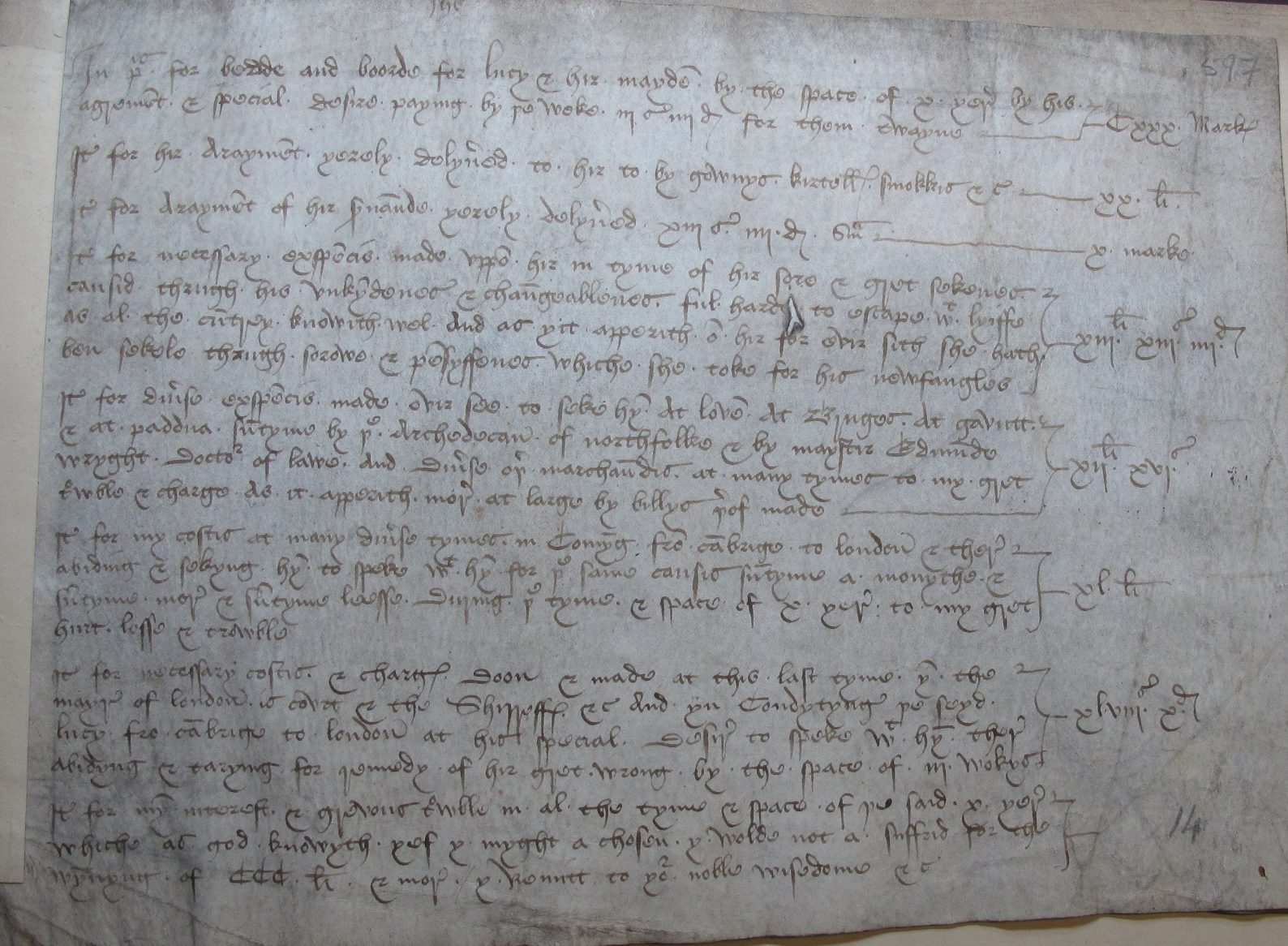
As is standard in most chancery petitions, Lemster’s invoice stresses his “gret hurt losse & trowble.” But it is Lucy’s “sore & gret sekenes causid thrugh his vnkyndenes & changeablenes” that takes center stage. Lemster’s sympathy for his stepdaughter makes it clear just why he was so persistent at court: Lucy waited ten years for him to return, during which time, she was the talk of the town, and her emotional health deteriorated, and Lemster wanted Narborough to pay for it. Apparently, the chancellor agreed, although it is significant that he more than halved the damages awarded: from the £470 requested, the chancellor awarded £200. Narborough never paid Lemster the money he owed: but Lemster made sure that Lucy was well provided for anyway. In his will, Lemster bequeathed to Lucy a total of 300 marks and the furniture from two bedrooms (presumably her own and her maidservant’s).
Endnotes:
[1] Shannon McSheffrey, “‘I will never have none against my father’s will’: Consent and the Making of Marriage in the Late Medieval Diocese of London,” in Women, Marriage, and Family in Medieval Christendom: Essays in Memory of Michael M. Sheehan, C.S.B., ed. Joel T. Rosenthal and Constance M. Rousseau (Kalamazoo,1998), 153-74.
[2] Gwen Seabourne, Imprisoning Medieval Women: The Non-judicial Confinement and Abduction of Women in England, c.1170-1509 (Farnham, 2011), 152.
[3] The National Archives, Kew, Surrey (hereafter, TNA) C[hancery] 1/60/100 (Symon v. Oby, 1475-85).
[4] TNA C 1/45/143 (Norreys v. Lacy, 1433-43, or 1467-72).
[5] TNA C 1/188/4 (Battell v. Cecill, 1493-1500).
[6] TNA C 1/44/148 (Vavasour v. Malleverer, 1467-72).
[7] A royal commission was granted to Melyonek authorizing him to “bring back all such singing men and children, being expert in the said science of music as he can find.” British Library Harleian Manuscript 433, ed. Rosemary Horrox and P. W Hammond (Ann Arbor, 1979), vol. 2, 163.
[8] TNA C 1/199/64 (Elys v. The Mayor of London, 1493-1500).
[9] Also Lempster, Leinster, and Lymster.
[10] John Venn and J.A. Venn, Alumni Cantabrigienses: A Biographical List of all Known Students, Graduates and Holders of Office at the University of Cambridge from the Earliest Times to 1900 (Cambridge, 1922), vol. 1, pt. 3, 74; ‘Henry VII: November 1485, Part 2’, in Parliament Rolls of Medieval England, ed. Chris Given-Wilson, Paul Brand, Seymour Phillips, Mark Ormrod, Geoffrey Martin, Anne Curry, Rosemary Horrox (Woodbridge, 2005), British History Online, https://www.british-history.ac.uk/no-series/parliament-rolls-medieval/november-1485-pt-2
[11] An arbitration in a dispute with the university concerning dilapidations of the Angel Inn, owned by Walter and his wife, notes that she is widow of Ludovic (elsewhere, Lewis) Bramston (also Brampston). Corpus Christi College Archives, GBR/0268/CCCC09/06/1B (1471).
[12] Also, Norborough, Norboro, Narbourgh, and Narburgh. Perhaps a reference to Knaresborough in Yorkshire?
[13] W.M. Palmer, Cambridgeshire Doctors in the Olden Time 1466-1827 (Cambridge, 1911), 226.
[14] Corpus Christi College Archives GBR/0268/CCCC09/09/32 (1462).
[15] TNA C 1/61/584 (Lemster v. Narbourgh, 1480-1483). See also: TNA C 1/60/75 (Lemster v. Mark, 1475-85) and C 1/60/73 (Lemster v. Estefeld, 1475-85)
[16] TNA C 241/258/2 (18 Sept. 1481).
[17] TNA C 131/80/1 (16 Oct. 1481).
[18] TNA PROB 11/8/40 (29 May 1487).
Discover more from Legal History Miscellany
Subscribe to get the latest posts sent to your email.

