By Cassie Watson; posted 18 September 2026.
In a previous post I suggested that criminal justice historians could pursue a valuable research project focused solely on records created by the Court of Great Sessions of Chester. I returned to this theme in the presentation I gave at the recent Legal Records Jamboree, held at The National Archives in June 2026: the document I chose for my 5-minute presentation was created by that court in the late 1780s. Reviewing the notes I took several years ago revealed a case that I had not previously noticed but that touches upon another of my research interests: the history of assault. Moreover, I discovered an annotated calendar of prisoners that suggested a possible mini research project on conviction rates and sentencing decisions. The most recent academic study of the county is ten years old,[1] but Cheshire provides a potentially suitable comparator to work done by Peter King and Richard Ward,[2] and more recently, by Bob Shoemaker.[3]
The Records
The numerous records archived within the broad series CHES – Records of the courts of the Palatinate of Chester, including the Welsh county of Flintshire – include at least 22 sub-series covering a wide range of legal issues from the mid-thirteenth century through to about 1851. That fact alone makes it pretty unique in relation to records that legal and crime historians tend to find especially useful, indictments and depositions, because the latter do not survive in such an unbroken series for much of England and because of the unique cross-border nature of the region. In the eighteenth and early nineteenth century, therefore, crimes committed in Cheshire could be tried in one of three different courts: the Welsh Court of Great Sessions; the English assizes; or their equivalent court in the Palatinate.
The series CHES 24 includes the records of each session of what by then was known as the Court of Great Sessions of Chester. It still comprised both Cheshire and Flintshire, but a lot of Flintshire records are also at the National Library of Wales in Aberystwyth, and the nature of the overlap is not entirely clear. The series consists of 854 bundles and files dating from 1329 to 1830 when the court was abolished and Cheshire and Wales were integrated into the English national assize system. The files themselves appear very much like the Welsh records: each court session (there were two per year, in spring and summer) was pinned together in date order and comprised of indictments, depositions, examinations, inquisitions, writs, recognisances, and calendars of prisoners. At Kew these bundles are in boxes; in Aberystwyth readers receive bundles without boxes.
Sentencing
In the bundle that covers the session of the court that met in August 1787, the calendar of prisoners and the way it has been annotated provides a great deal of interesting and useful information, particularly in relation to sentencing. Many of those convicted were reprieved — but to what? Release? Those sentenced to transportation can be followed up in Australian records. This reveals, for example, that Mary Bather was indeed transported, departing with the Second Fleet in November 1789. However, she died one month into the voyage.[4] Did the two and a half years she spent in prison in Cheshire weaken her to the point that she was unable to survive a sea voyage of seven months? Or, as seems more likely, did the infamously poor conditions cause her death?[5] What happened to John Orme, William Lowe, Thomas Gibson, John Cummins and James Hodgkinson, none of whom appear (luckily for them, no doubt) to have been transported?
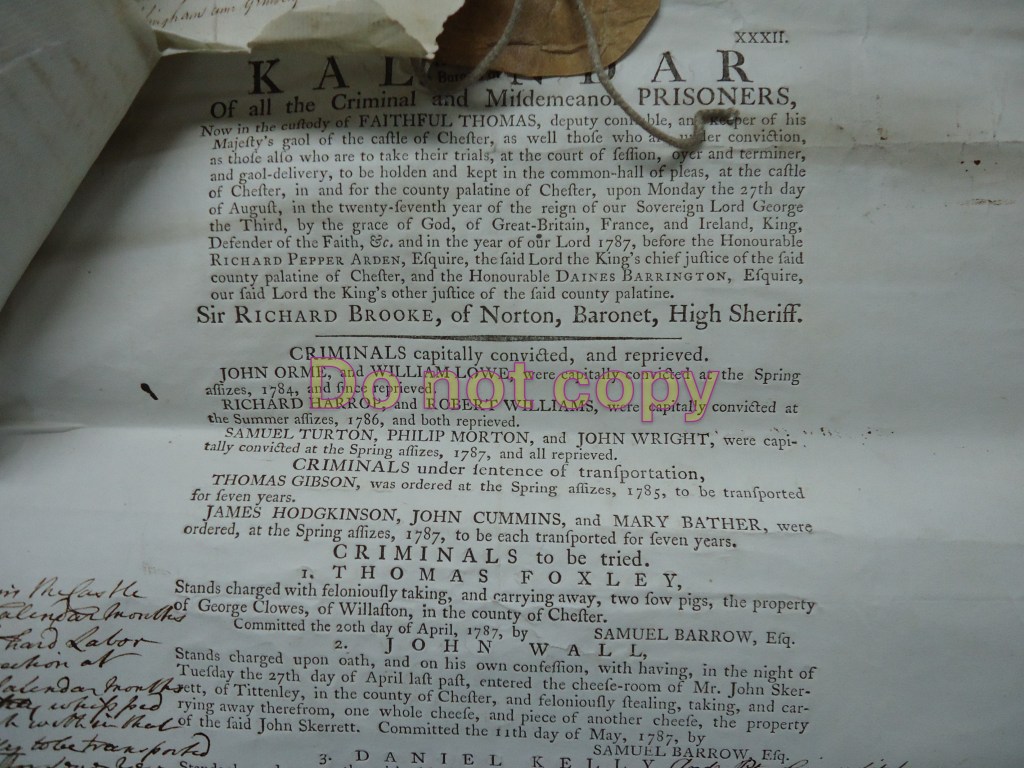
The use of whipping (not shown in the image but imposed on thieves on top of a short gaol sentence) is interesting, as is the range of items stolen. John Wall, one of the men prosecuted in August 1787, had pilfered some cheese. In early September the Chester Courant reported that Wall, who had a wife and five children, was reprieved from transportation and instead ordered to be imprisoned for six months in the house of correction at Middlewich. This followed the intervention of an unnamed lady, who had petitioned the judge for leniency.[6] This is the sort of detail that the Old Bailey website allows us to compile for London, and it would be highly desirable to be able to do so for other parts of the country. The hiatus caused by the American Revolution might explain the fate of individuals convicted during the 1770s and 1780s, but Cheshire records will reveal the local solution to a national problem.
A Falling Out Between Friends
Of even greater interest is the range of serious crimes of interpersonal violence that were prosecuted in this court. Sexual offences, homicide and infanticide have been well explored over the past 40 years, but there are far fewer studies of non-lethal violence. The Cheshire court records offer scope for studying assault in the eighteenth century, as it is similarly possible to do — but more easily, due to the existence of a database — using Welsh records.
Some of the depositions preserved in the summer 1787 court bundle relate to a man memorably named Prussia Salmon. He was prosecuted by the Reverend John Smith of Nantwich, whom he had assaulted in late June 1787; as a consequence, Smith had lost three teeth from his lower jaw. The depositions of the four witnesses were taken on 25 August 1787 by Samuel Barrow (named on the calendar as the magistrate who committed John Wall for trial), a mere two days before the sessions opened. Among the witnesses was a local surgeon, William Wrench of Nantwich, who seems to have served as a dentist too.
The victim, Mr Smith, lost a tooth in the assault (it was retrieved from the street and a boy returned it to his wife over a week later!)[7] and two others were loosened; he wanted Wrench to save them, but this proved impossible. While Wrench related the facts dispassionately, he added a little sting in the tail at the end, noting “that for some time before the said 27th day of June some of the said Mr Smith’s teeth were loose owing to a scorbutick complaint in his gums.”[8]
Other witnesses deposed that the two men had come out of the Griffin Inn with some other gentlemen, but then Salmon struck Smith in the face with his fist, grabbed his cane from him and hit him again with it. The victim told one woman that “the said Prussia Salmon owed him ill will for doing his duty by telling him of his faults.”[9] Recognizances taken in early July show that the pair were bound to keep the peace against one another and that Salmon would be prosecuted. The indictment is endorsed to show that a true bill was found against him, but he is not on the list of ‘criminals’ tried in August 1787; the Minute Books in CHES 35 may reveal the outcome, though it seems likely that the prosecution was dropped.
Two years later Prussia Salmon was listed in a Chester newspaper as having paid the Cheshire game duty of 2 guineas,[10] and he seems to have paid it annually until at least 1809,[11] so I imagine his assault on a friend and neighbour didn’t do him much harm. He married in 1800,[12] so was presumably relatively young at the time of the incident. I do wonder what faults the Reverend Smith pointed out to Salmon, but feel certain that a hasty temper was one of them.
Images
Main image: A ‘dentiste’ extracting the tooth of a large well dressed gentleman. Coloured mezzotint by J. Wilson after himself, 1773. Wellcome Collection, public domain.
Chester Mainprize August 1787, calendar of prisoners 27 August 1787. The National Archives, Kew, CHES 24/174 piece 4 (reproduced by permission; image not to be copied).
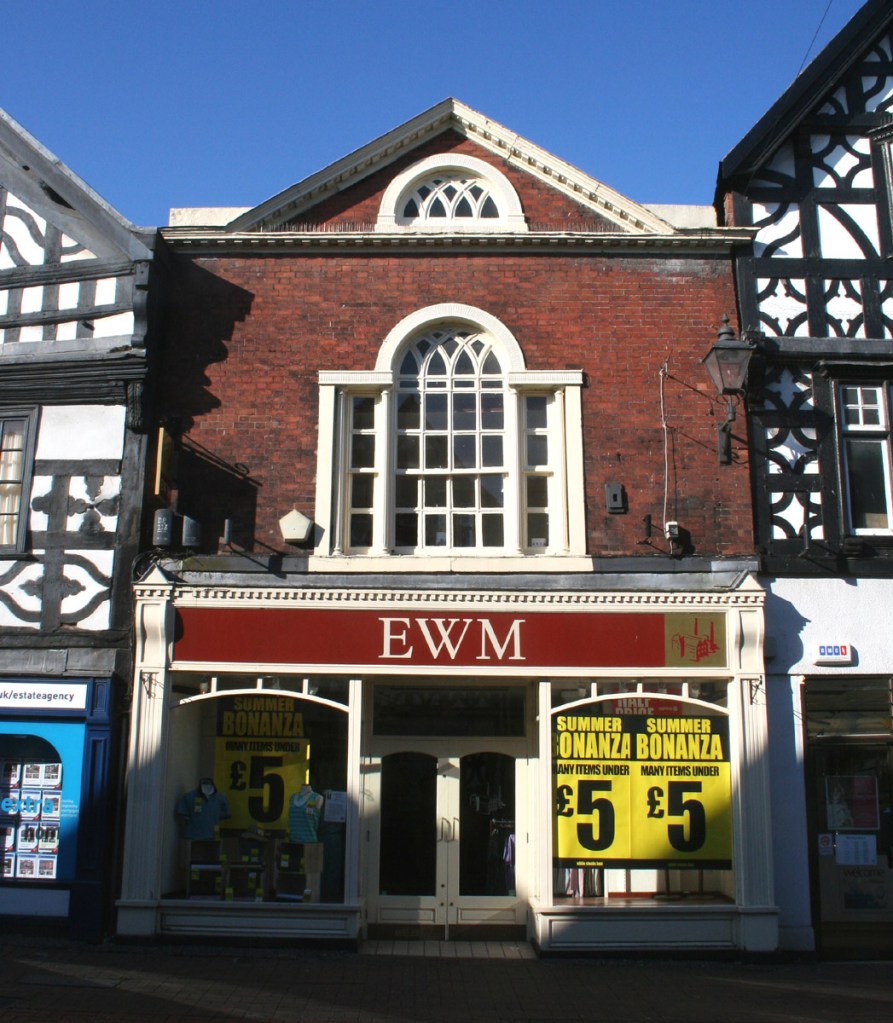
20 High Street, Nantwich, Cheshire, August 2007. Wikimedia Commons, public domain.
References
[1] Garthine Walker, Crime, Gender and Social Order in Early Modern England (Cambridge: CUP, 2003); James Sharpe and J. R. Dickinson, “Coroners’ Inquests in an English County, 1600–1800: A Preliminary Survey,” Northern History 48 (2011): 253-269; James Sharpe and J. R. Dickinson, “Homicide in Eighteenth-Century Cheshire”, Social History 41 (2016): 192-209; J. A. Sharpe and J. R. Dickinson, “Revisiting the ‘Violence We Have Lost’: Homicide in Seventeenth-Century Cheshire,” English Historical Review 131 (2016): 293-323; John Walliss, “Crime and Justice in Georgian Cheshire: The Chester Court of Great Sessions, 1760–1830,” Journal on European History of Law 6 (2015): 38-55.
[2] Peter King and Richard Ward, “Rethinking the Bloody Code in Eighteenth-Century Britain: Capital Punishment at the Centre and on the Periphery,” Past and Present 228 (2015): 159-205.
[3] Robert Shoemaker, “Sparing the Noose: Death Sentences and the Pardoning of Old Bailey Convicts, 1763–1868,” in Cultural Histories of Law, Media and Emotion: Public Justice, ed. Katie Barclay and Amy Milka (Abingdon: Routledge, 2024), 237-258.
[4] Convict Records of Australia, https://convictrecords.com.au/convicts/mary-bather-83780. Bather embarked on the largest ship of the Second Fleet, the Neptune. In total 1,084 convicts set sail, and the fleet arrived in New South Wales in June 1790. See https://convictrecords.com.au/ships/neptune-scarborough-and-surprize, accessed 18 September 2026.
[5] Emma Christopher, A Merciless Place: The Long Story of Britain’s Convict Disaster in Africa (Oxford: OUP, 2010), 344-346. Wikipedia offers a summary of the high mortality rates experienced by the Second Fleet.
[6] Chester Courant, 4 September 1787, 3.
[7] The National Archives, Kew (hereafter TNA), CHES 24/174/4, Chester Great Sessions Gaol Files, 27 Geo III Autumn, 1786-1787. Indictment and depositions against Prussia Salmon for assaulting Rev John Smith on 27 June 27 Geo III; deposition of Thomas Bowker the younger.
[8] Ibid., deposition of William Wrench.
[9] Ibid., deposition of Mary Fenna.
[10] Chester Chronicle, 11 September 1789, 1. This was a mandatory tax and license introduced in 1785 that people had to purchase if they wanted to legally hunt, kill, or sell game animals. Prussia Salmon lived at Heathside, near Nantwich.
[11] Chester Chronicle, 6 October 1809, 4. The cost had risen to 3 guineas.
[12] Prussia Salmon, described as a gentleman, married Mary Walker on 20 August 1800 but she died soon after and was buried on 28 November 1800. He remarried in 1803, to widow Elizabeth Cowap, and died around 1810. See Ancestry.com, England, Cheshire Bishop’s Transcripts, 1576-1933; Parish Register, Wybunbury, St. Chad, 1779-1812.
Discover more from Legal History Miscellany
Subscribe to get the latest posts sent to your email.

