Posted by Krista J. Kesselring, 10 October 2026.
This month’s post tells the stories of not one but two sham-plots in Elizabethan England, in which unscrupulously enterprising people tried to use the law—and government fears and fearmongering of Catholic conspiracies—to their own ends. A dip into the Court of Star Chamber’s archive and related papers shows that anti-popery had become not just a central force in Elizabethan politics but also a resource for the deceitful and devious, long before the infamous ‘Popish Plot’ of the late seventeenth century.[1] It also suggests tensions between a desire for exemplary, admonitory judicial proceedings and the perils of publicity as Elizabethan authorities fond of invoking dangerous plots struggled to construct and contain a truth conducive to their own ends in a nascent ‘public sphere’ of printed political news.
In 1600, Attorney General Edward Coke launched a case in Star Chamber against the wife of Richard Fowler, identified by her maiden name as Mary Boughton. According to the lengthy charge, Mary and her brother Henry, her lover Captain William Eynes, and her lover’s comrade-in-arms, Leonard Gascoigne, had concocted an elaborate plot to have Richard charged with treason and killed by law. In Coke’s narration, Mary’s ‘loose and infamous life’ and her ‘faithless and contemptuous carriage and behaviour’ had broken her marriage. Mary had tried to get a formal separation from Richard via the church courts but the bishop of London ordered the couple to reconcile. She had then tried to make Richard believe that she was pregnant with another man’s child, but still, he persisted. According to the charge, Mary’s ‘rooted malice’ for her husband then led her to adopt more creative methods to rid herself of Richard. She worked with her brother and her lover along with his brother-in-arms, Gascoigne, to contrive a sham plot in which Richard – who had spent time on the continent – was supposedly corresponding with French Catholics and English Catholic fugitives abroad to take down the queen and her Protestant regime. Using a scrivener who could write in the French style, they counterfeited a letter from a fictional French plotter that implicated Richard in a nefarious plot to kill the queen and bring ‘perfect happiness to the Catholic Church’. They had the letter packaged up with powder meant to look like poison, a crucifix, and an Agnus Dei (a Catholic devotional object). They then had another, unidentified co-conspirator hide the package in his own lodgings, where the incriminating package would be ‘discovered’ by Gascoigne in company with an unwitting, honest dupe who would bring it to the attention of the authorities. The co-conspirator also courted suspicions that he was in fact the notorious master-spy Hugh Owen, a Welsh Catholic in the employ of the Spanish and desperately sought by the queen’s agents.[2]
The plan ran into a few bumps, but did result in Richard Fowler’s detention in the Tower on suspicions of treason. Quite how Coke and the authorities eventually came to believe Richard innocent isn’t clear, but they finally released him and began to build their case against Mary and her co-conspirators. The proceedings produced heaps of depositions (which include details of Eynes’s and Gascoigne’s service with English forces in the Netherlands and on Sir Walter Raleigh’s El Dorado expedition that might be of interest to historians of Elizabethan adventurers.) Mary protested her innocence, asserting that ‘if she be not herein innocent and guiltless, she neither desireth favour in this court nor salvation in the world to come’.[3] She also described Richard’s years of abuse and alleged that he, in fact, had tried to kill her. But in the end, Coke had enough evidence to take his case to the Court of Star Chamber, alleging not a treasonous popish plot but that a woman’s ‘shameless passions’ had lain behind an elaborate sham conspiracy to take a man’s life by law.
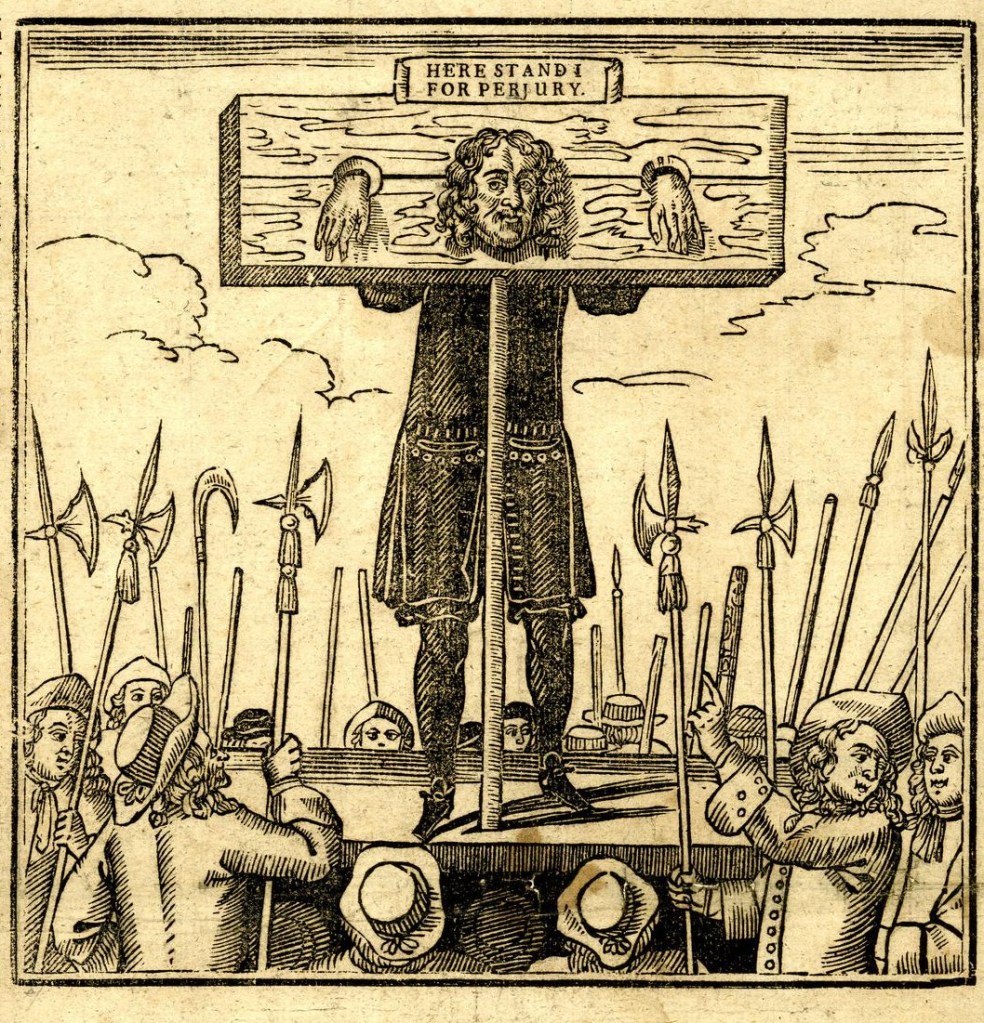
Though we know the outcome of relatively few Star Chamber cases given the loss of the court’s order and decree books, a copy of the decree in this case survives in Lord Keeper Egerton’s papers – a document Lucy Clarke has previously discussed.[4] Contemporary letter-writers also commented on the salacious proceedings. John Chamberlain reported that Mary was condemned to be whipped at Bridewell. Mary’s brother may only have facilitated Mary’s trysts with her lover and not have been an active participant in the conspiracy to take Richard’s life but he would be fined and imprisoned as a bawd until he could find sureties for his future good behaviour. Mary’s ‘mignon’, Captain Eynes, was to be pilloried and imprisoned. Gascoigne would face the harshest punishment, being ridden through London with his face to an ass’s tail, pilloried at both Westminster and Cheapside, branded on the face, and imprisoned for life. Chamberlain noted Lord Keeper Egerton’s comparison of Mary with both Helen of Troy and a whore: Egerton denounced her as ‘the cause of all the evil, carrying the right picture of a courtesan in her countenance’ with a ‘frontem meretriciam (as he called it)’—a harlot’s brow, a phrase that might denote impudent, meretricious deceit or perhaps here have been meant literally as a snide comment on Mary’s appearance.[5] Letter-writer Philip Gawdy offered a similar report, adding that Mary had swooned upon learning her fate—in his telling, she was to be ‘well whipped’ and repeatedly so. Referring to the popular and compendious historical account of England’s past, distant and near, Gawdy enthused that the Fowler story was ‘worthy to be put in Holinshed’s Chronicle’.[6]
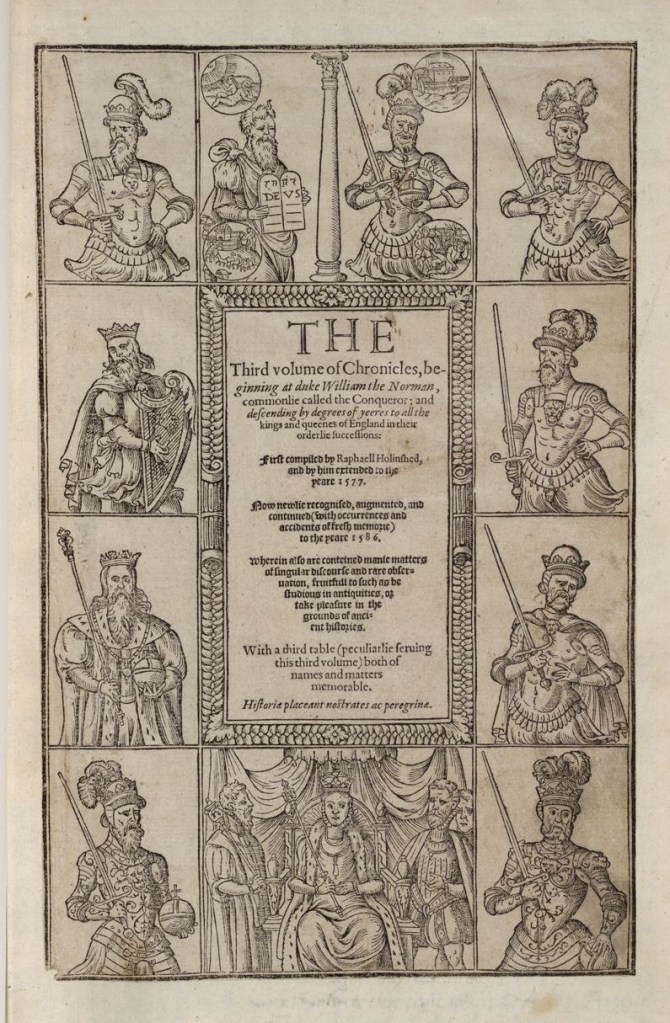
Holinshed’s Chronicles certainly included admonitory reports on the regime’s prosecutions of real Catholic conspirators, along with a few true crime stories of the deadly results of domestic discord. But would the authorities welcome a telling of the Fowler case? It was indeed remarkable, though also troubling in its inventive use of the law and of contemporary fears of popish plots to pernicious private ends. Moreover, it was not unprecedented: only a few years previously, Thomas Lovelace had also counterfeited letters and a sham Catholic plot, to have two kinsmen arrested and, he hoped, killed by law to open his path to a much-desired inheritance. And that story had been fully detailed in Holinshed’s opus—though not for long.
The first printing of the 1587 edition of the work known as Holinshed’s Chronicles included a lengthy report and commentary on the Lovelace affair. For ‘several respects well worthy the remembrance’, the compilers narrated Thomas Lovelace’s legal battles with his cousin Leonard and the growth of his ‘cankered and inveterate hatred’. In 1586, Thomas decided to have both Leonard and his brother Richard killed, crafting a narrative of treachery built upon the fact that their other brother (unhelpfully, also called Thomas) had gone to Rome and avowed himself a Catholic. Lovelace counterfeited a letter from Catholic Thomas that set out ‘most dangerous treasons against Her Majesty’s most gracious person’. He arranged with a ‘lewd fellow’ to sneak the letter into Leonard’s study, to be discovered by the authorities in due course. But when Leonard came back early, the man fled, dropped the papers in the mud, and then left them in a pub. There, a ‘wayfaring man’, thinking them to be wastepaper, took them to the outhouse. Reading a few lines while about his business, the unnamed wayfarer spotted their ‘dangerous intentions of most weighty importance’ and knew enough to take them to Lord Cobham, one of the queen’s privy councillors. William Cecil, the queen’s chief councillor, immediately investigated—and with some craft and care. After a preliminary interrogation of Richard, Cecil came to suspect Thomas Lovelace’s ill doing. Noting distinctive elements in the letter’s orthography, he called Lovelace in and had him write another letter. Spotting the common elements, he sent Lovelace to the Tower and liberated the two brothers from all suspicion. Thomas Lovelace soon confessed, so the trial in Star Chamber was a straightforward if dramatic affair.[7]
The Chronicles’ account continued with a transcription of the now missing court record. Thomas’s own offence was not treason – and thus not to be tried at common law – but it was a conspiracy of a particularly vile sort, well-suited to a conciliar court charged with policing abuses of justice.[8] As such, the judges in Star Chamber ordered the full panoply of punishments: Thomas would be carted about Westminster palace on horseback with his face to the horse’s tail; pilloried in Westminster, with one ear cut off; pilloried on a market day in Cheapside, wearing a paper describing his offences; then carried into his home county of Kent to be pilloried at the next assize session, with his other ear then cut off. He’d also be pilloried on a market day in Canterbury and on another in Rochester. The judges ordered that in each of Thomas’s five times on pillories, their description of his offence and its penalty was to be openly read and published.[9] Many people must have learned of Lovelace’s cunning through these ‘exemplary’ public punishments.
Many more might have learned of it through the account in Holinshed’s Chronicles. Its author emphasized as one lesson of the affair ‘how necessary it is to the good estate of governments, that justice be duly delivered: which in this case was in so due and honourable manner performed, upon the hearing of the cause before the lords in the Star Chamber, as that the posterity to come may from thence fetch a right fruitful precedent, to take heed of such odious practices’. But that might not have been the lesson all readers would have taken from the story.
In the event, this account was one that the privy councillors demanded be censored from the Chronicles. The 1587 edition was, famously, ‘castrated’ at the call of the councillors, with several passages cut or trimmed.[10] In subsequent printings, the Lovelace affair took up only a perfunctory paragraph summarizing the punishments, with little description of the offence and none of its investigation or trial.
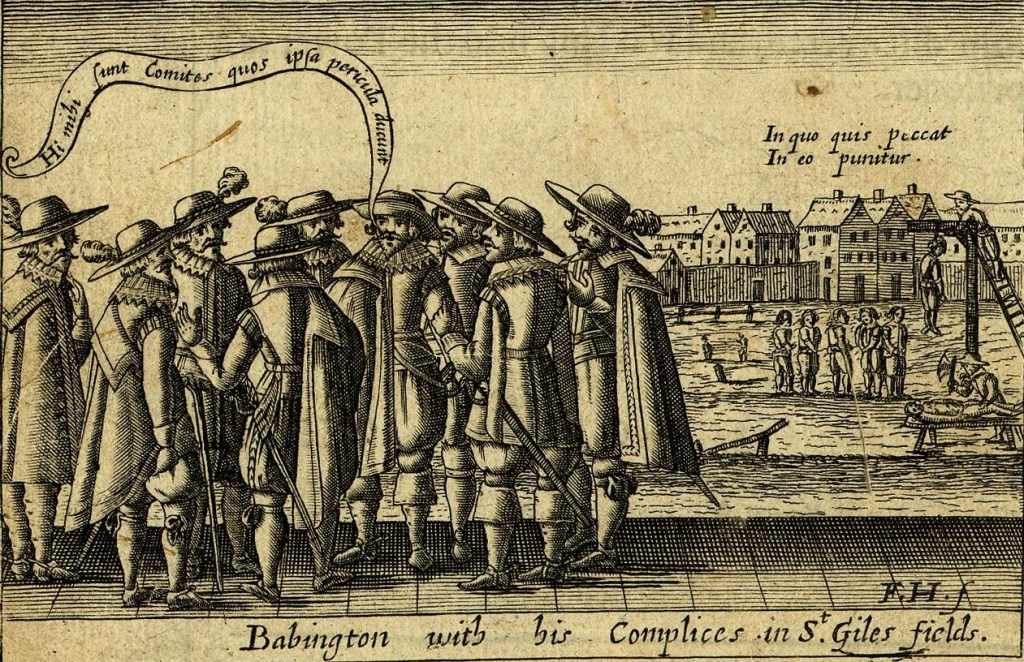
Why did this account draw the attention of the censors? Cyndia Susan Clegg notes that several of the passages excised from Holinshed’s Chronicles related in some way to biases or failings in the exercise of justice. She speculates that the excisions arose from councillors’ sensitivities in the aftermath of the contentious trials of the Babington plotters and of Mary, Queen of Scots. The new edition of the Chronicles came out just months after the gruesome, graphic public executions of Anthony Babington and his co-conspirators and even as the privy councillors were pushing for sentence on the Scottish queen to be carried out. In the Lovelace account, Clegg suggests, councillors might not have welcomed the detailing of their intelligence networks and their craft in catching out criminals. And given suggestions that the correspondence used in evidence against the Scottish queen and her Catholic supporters had been counterfeited, councillors might not have welcomed extended discussion of false letters, either.[11] Moreover, the chronicler’s commentary on the Lovelace affair might well have been read as a critique: his reference to the due delivery of justice ‘in this case’ might be read as such. So, too, his comment on ‘how profitable it is to those countries and commonwealths, where the councillors do rather seek with sharpness of judgement to discern and discover the qualities and causes, before they apply the prince’s displeasure or the heavy burden of laws to the first appearance of any suggestions’.[12] The implication, of course, is that councillors might not always have the requisite sharpness of judgement to save the innocent from the snares of their foes—and that ‘justice’ might not always be just.
Whether or not Mary Fowler and her co-conspirators drew their inspiration directly from Thomas Lovelace is impossible to say, but evidently the government’s much publicized punishments of Catholic plotters and promotion of conspiratorial polemic offered resources for the maliciously minded to draw upon.[13] So, too, did criminal law and the processes of ‘justice’. Stories of such misuses of law may well have led to others, while also undermining confidence in the veracity of government narratives. That the plots and sham-plots came not only from the religiously and politically engaged but also from people pursuing their own more personal, private interests might also give us pause when looking back.
More generally, the Fowler and Lovelace stories suggest that while our own era sometimes seems uniquely troubled by deepfakes, deception, and the politicized manipulation of fears of some ‘other’ or another in media both old and new, elements of these problems are shared across the centuries. Given recent reports of plans to resume public executions in a part of the world where they’d long since between abolished, one might also highlight a lesson learned by Elizabethan authorities: ‘exemplary’ punishments can have effects other than those intended, and all the more so when publicity is amplified through the media.
Images:
Cover image: ‘Parry not able to kill the queen’, from George Carleton, A Thankfull Remembrance of Gods Mercy (London, 1627), © The Trustees of the British Museum. Shared under a Creative Commons Attribution-NonCommercial-ShareAlike 4.0 International (CC BY-NC-SA 4.0) licence.
Titus Oates in the pillory, from a 1685 woodcut, © The Trustees of the British Museum. Shared under a Creative Commons Attribution-NonCommercial-ShareAlike 4.0 International (CC BY-NC-SA 4.0) licence.
Title page of Raphael Holinshed, et al., Chronicles (1587), vol. 3, courtesy the Folger Shakespeare Library.
’Babington with his complices’, from George Carleton, A Thankfull Remembrance of Gods Mercy (London, 1627), © The Trustees of the British Museum. Shared under a Creative Commons Attribution-NonCommercial-ShareAlike 4.0 International (CC BY-NC-SA 4.0) licence.
Notes:
[1] On the later Popish Plot, see, e.g., Andrea McKenzie, Conspiracy Culture in Stuart England: The Mysterious Death of Sir Edmund Berry Godfrey (Woodbridge, 2022) and Victor Stater, Hoax: The Popish Plot That Never Was (New Haven, 2022).
[2] Coke’s information, or bill, is in The National Archives (TNA), STAC 5/A43/8, AG v Boughton. On Owen, see, e.g., Jonathan Roche, ‘Elizabethan Catholic Intelligencers, Spain, and the Armada of 1597’, History 108.391 (2023), 244-61.
[3] The depositions are spread across several files: in addition to TNA, STAC 5/A43/8 (source of the quotation), see also STAC 5/A55/2; STAC 5/A55/3; STAC 5/A10/4; STAC 5/A25/33; STAC 5/A45/13; STAC 5/A45/28; STAC 5/A46/29; STAC 5/A28/2. It’s a story that I hope someone will fully excavate at some point.
[4] Huntington Library, EL MS 2690; a transcription by Thomas Garden Barnes can be found here; Dr. Lucy Clarke has also discussed the decree and what it suggests for understandings of credibility and evidence in a post on her blog, ‘liar, liar, portmaneau’s on fire?: an involved case of forgery’ [6 June 2023; accessed 10 October 2026].
[5] John Chamberlain to Dudley Carleton, 13 June 1600, TNA, SP 12/275, f. 6.
[6] Letters of Philip Gawdy, ed. I.H. Jeayes (London, 1906), p. 99. Gawdy also reported that Henry Boughton was later knifed by ‘a little boy, my Lord of Canterbury’s page’, in the same week that Captain Eynes knifed and killed another prisoner in the Fleet prison, for which he was subsequently hanged (p. 121).
[7] See Cyndia Susan Clegg, ed., The Peaceable and Prosperous Regiment of the Blessed Queen Elizabeth: A Facsimile from Holinshed’s “Chronicles” (1587), (San Marino, CA, 2005), pp. 514-6 (in Holinshed’s pagination, pp.1556-8.)
[8] On the distinctive use of Star Chamber to police abuses of justice and the court’s role in developing the law of conspiracy, see K.J. Kesselring, ‘Conspiracy, Crime, and the Court of Star Chamber’, Law and History Review 43.4 (2025), 693-715.
[9] Clegg, ed., Peaceable and Prosperous Regiment, 514-6. Presumably as the case was brought ore tenus, upon confession, no bill or other proceedings survive in the archive of Star Chamber pleadings, and all the court’s order and decree books have disappeared.
[10] Susan Cyndia Clegg, ‘Censorship’, in The Oxford Handbook of Holinshed’s “Chronicles”, ed. Paulina Kewes, Ian W. Archer, and Felicity Heal (Oxford, 2013), pp. 43-59.
[11] Cyndia Susan Clegg, Press Censorship in Elizabethan England (Cambridge, 1997), pp. 149-51.
[12] Clegg, ed., Peaceable and Prosperous Regiment, p. 515. Emphasis added.
[13] For the ‘pitch-making’, propaganda, and plot talk deployed by a clique at the centre of the Elizabethan regime to influence public sentiment in the post-Reformation context, see especially Peter Lake, Bad Queen Bess? Libels, Secret Histories, and the Politics of Publicity in the Reign of Queen Elizabeth I (Oxford, 2016). On the semi-official role of Holinshed’s Chronicles in the government’s publicity campaign specifically, see pp. 300-2, where Lake characterizes the excisions as ‘not so much official censorship, at least as we might understand that term, but rather some desperate last-minute fine-tuning, as elements in the regime sought to adjust the final tone of the volume in relation to the political circumstances created by Mary’s execution’.
Discover more from Legal History Miscellany
Subscribe to get the latest posts sent to your email.

