Guest post by Sebastian Sobecki, 24 October 2026.
Anyone who spent even a moderate amount of time studying medieval England’s central courts or the country’s vast administrative machine knows just how convoluted and intricate premodern institutional history can be. Changing institutions, expansive jurisdictions, shifting processes, and a mountain of surviving records captured in three languages – all this amounts to knowledge that can overwhelm student and scholar alike. Turning a decision at court into action elsewhere meant that clerks had to translate instructions into documents, with officers authorising them under different seals, to be passed between institutions. Medieval English governance remains a challenging subject, even more so because there exists no single publication or resource to gather all its facets in one place. But such a tool could not only explain how each institution worked but how it connected with other institutions, what processes and documents it produced, which clerks generated them at any given moment, and where we can locate them now.
That is why I decided to create an interactive map, The Governance of England, 1377–1471, that captured the entire picture, right down to individual clerks and their output. The map grew out of Communities of Practice: Scripts, Scribes, and the Production of Literature in London, 1377–1471, my research project at the University of Toronto, funded by the Social Sciences and Humanities Research Council of Canada (SSHRC). Now available on the Communities of Practice website, the map invites scholars, students, and anyone curious about medieval government to explore the offices, courts, and jurisdictions through which England was governed from Richard II to Edward IV. Follow those exchanges and you see royal and central authority resting on the everyday work of writing, checking, sealing, and preserving documents. These are the very practices through which Communities of Practice approaches the relationship between government service and literary production.
I wanted a single navigable aid that would bring to life Westminster’s bureaucratic machine while letting readers trace records back to their sources. The same impulse to make medieval England’s legal system accessible lay behind The Cambridge Companion to Medieval English Law and Literature, which I edited with Candace Barrington in 2019. That volume set out to introduce legal contexts to readers working across disciplinary boundaries, especially those without training in legal history. The map likewise helps students of history, law, and literature place an office or procedure within the governance of late medieval England.
The map rests on a growing bibliography of scholarship on medieval England’s clerks and institutions – from Thomas Frederick Tout, Pierre Chaplais, and Alfred Lawson Brown to Sir John Baker and many others. Readers can open the bibliography directly from the map, and every item of information inside it is credited to its scholarly sources, unless, in the case of some lists of clerks or officers, it was not practical to do so without changing the layout of the list itself.
The larger project of Communities of Practice asks how London’s multilingual bureaucracy shaped late medieval literature. Created in collaboration with Alexandra Gillespie’s Old Books New Science Lab, it brings manuscript study together with linguistic, literary-historical, and computational methods to examine the scribal practices that government clerks shared. The map, however, makes their working world easier to picture. It shows where clerks worked, what their offices did, and how documents travelled between them.
How to read the map
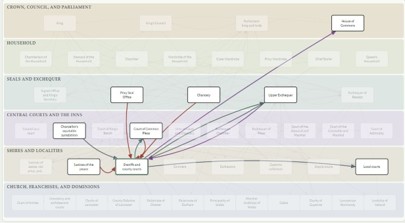
The map’s boxes stand for offices, courts, and jurisdictions, stacked in bands that run from Crown, council, and parliament down to shires, localities, and ecclesiastical jurisdictions (see Fig. 1). Coloured arrows distinguish warrants, petitions, accounting, appointments, appeals, and other relationships. Each arrow points from the body issuing an instruction, sending a petition, or rendering an account towards its recipient. Select any box or arrow to learn more. The map also takes in the Inns of Court and Chancery and the administrations of Normandy and Gascony, setting English institutions within a wider world of legal training and overseas government. Office entries list staff by function and rank, and names in bold identify those in office in the year selected on the timeline. Click a name to open that person’s entry and move from an institution to the people who actually did its work.
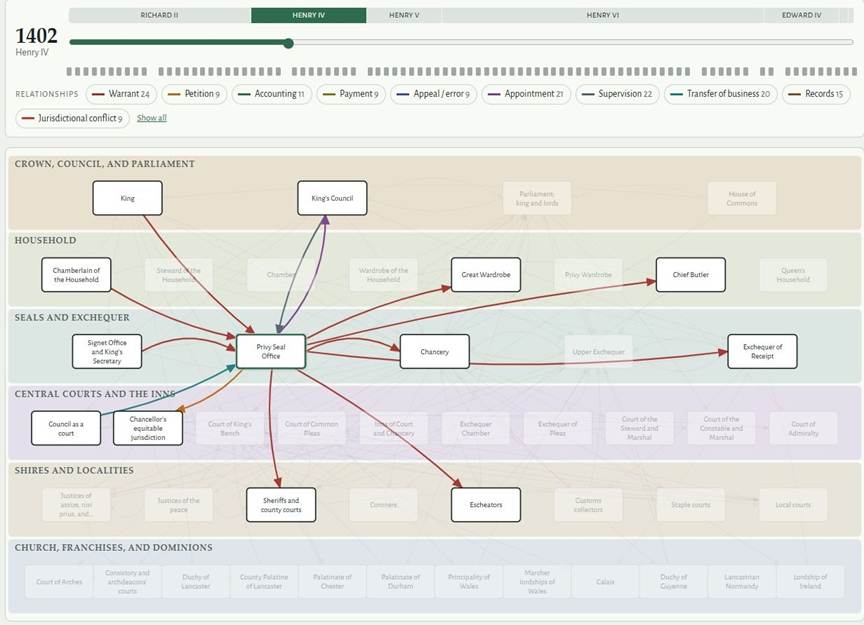
The year slider also connects institutional history with individual careers. Select a year at the top of the map (see Fig. 2), and each office’s entry shows the clerks active in that year in bold, while descriptions of later events appear in grey. In the ‘Clerks’ view (the button on the top right), you can select the current timeline year, allowing you to search across offices for all clerks recorded as active in any given year.

The Privy Seal and Chancery at work
Let’s take the example of a royal grant under Henry IV. An instruction might travel from the king’s Signet office to the Privy Seal and then on to Chancery, where letters patent were sealed and enrolled. Payment could be authorised by a privy-seal warrant to the Exchequer of Receipt. Follow this route and the offices stop being just a list of names. Instead, they become stages in a process. Relationship filters let readers isolate particular connections, such as warrants or payments.
The Privy Seal was a busy junction between the king, his Council, and the other offices. Its clerks might receive a signet letter, an endorsed petition presented through the chamberlain, a Council order, or simply an oral command. From these they prepared a privy-seal writ or bill addressed to the chancellor, the treasurer, or another officer. If you select the Privy Seal, for instance, its incoming and outgoing routes appear together (see Fig. 3). They also reveal business that went well beyond grants, including diplomatic correspondence and the paperwork of military service.
A military agreement shows this interdependence especially clearly. The Privy Seal office prepared an indenture in two copies: one for the captain, under the privy seal, and the captain’s sealed counterpart for the office’s own files. The agreement could then generate warrants to the Exchequer for wages and to Chancery for protections. One undertaking, several documents – each sent to the institution responsible for a different part of the job.
Chancery, too, had several moving parts. The chancellor kept the great seal, the keeper of the Rolls looked after the records, cursitors prepared the original writs that began legal proceedings, and the Hanaper handled fees and the release of sealed letters. Selecting Chancery lets readers explore these roles alongside the production of charters, letters patent, commissions, and writs. A warrant arriving from the Privy Seal was only the beginning: it entered a further round of drafting, followed by formal copying, sealing, and, finally, enrolment. That last stage includes the quintessentially English administrative practice of keeping duplicate and sometimes even triplicate copies of records. The map keeps this administrative work distinct from the chancellor’s developing equitable jurisdiction, through which petitioners sought remedies that ordinary common-law procedure could not supply.
These relationships were flexible enough to allow several routes through the system. Chancery also acted on warrants from the king, the Council, and other officers, while Privy Seal clerks served the Council and sometimes worked across office boundaries. The map records two Chancery warrants of 1402 in Thomas Hoccleve’s hand. Thus, the celebrated poet and Privy Seal clerk turns up in another institution’s business. Details like these explain both the formal division of responsibilities and the personal connections that made those divisions work.
Courts and local government
Selecting a court opens an account of its officers, functions, procedures, and links to records associated with that court. King’s Bench can be explored through its criminal business, supervision of other courts, and review of errors in judgments. Links between Common Pleas, King’s Bench, and parliament show the routes by which judgments could be challenged. Other connections expose the friction between royal and ecclesiastical courts, helping readers ask where a dispute might go.
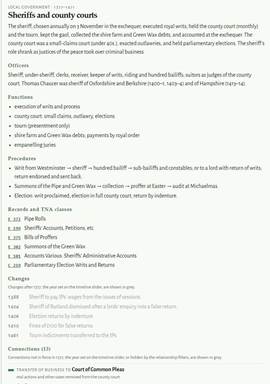
The shrieval system offers another way in. Select “Sheriffs and county courts” to see how the sheriff tied local administration to Westminster. Executing writs, empanelling juries, keeping the gaol, accounting for revenues, running parliamentary elections – all these functions relied on sheriffs. The entry follows a writ through the sheriff and local bailiffs and explains the sheriff’s accounting obligations (see Fig. 4).
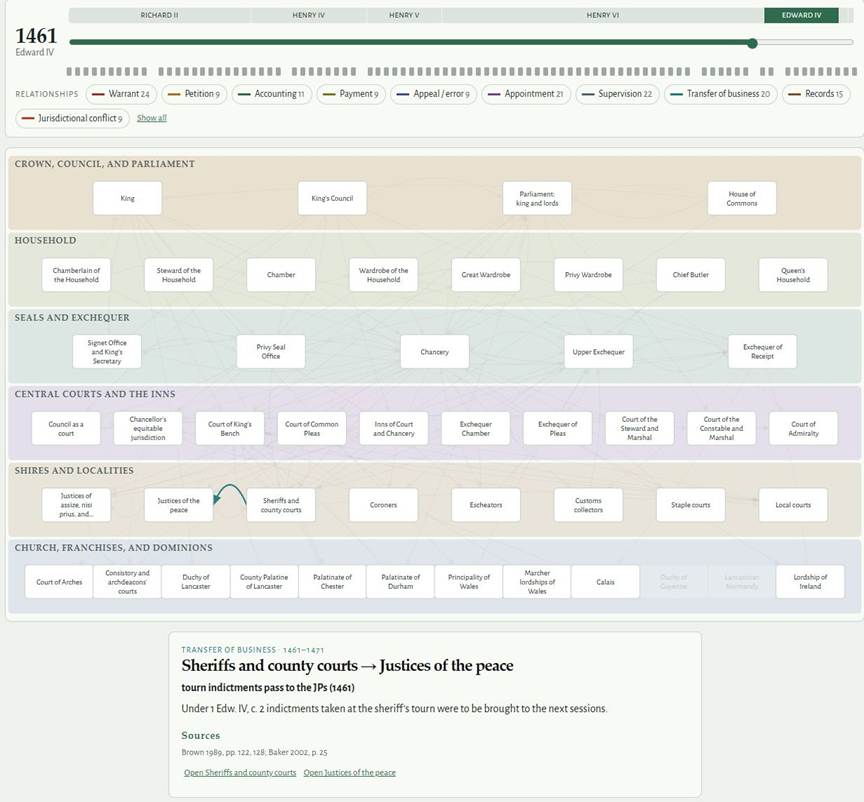
The year slider and reign selections give all this a chronology. Marks beneath the slider flag recorded changes. Take the transfer of indictments from the sheriff’s tourn to justices of the peace in 1461: select that year on the map’s slider to see the distribution of local criminal business shift (see Fig. 5).
Clerks and literary networks
Entries supply references to scholarship and record series at The National Archives, with links to its Discovery catalogue. Labels flag inference and anything still needing verification, so uncertainties stay visible. Open the “Clerks” button to reach “Clerks and Officers,” which currently gathers 398 individuals but is likely to grow. Search by name, manuscript, or TNA reference, filter by office group or identified hand, and tick “Active in” to limit results to the year selected on the map’s timeline. Results can be sorted by surname or first date. The “Hand” tag marks an identified hand: select the person’s name to read the handwriting description and see the identified documents (see Fig. 6).
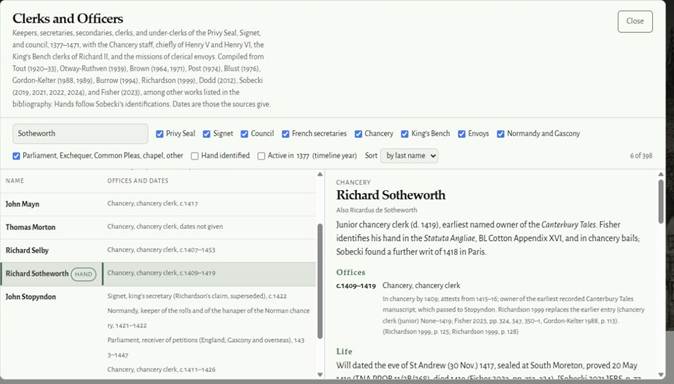
These linked biographies are built for prosopography, allowing readers to study people through their shared relationships and careers. Connections between clerks and other individuals let readers follow colleagues, patrons, executors, and book recipients from one office to another. Gathering evidence scattered through the scholarship can reveal unrecognised networks and suggest leads for further work.
The overseas entries make these movements especially tangible. John Stopyndon served as keeper of the rolls and hanaper of the Norman Chancery before holding both offices in England. Richard Caudray’s work for Henry V in France, for the Council, and in diplomatic negotiations likewise spans several administrative settings. Read such careers alongside the map’s institutional routes and you see the same people carrying writing practices and expertise between offices and across the Channel.
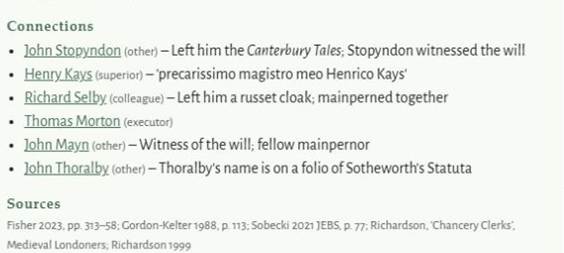
The literary links are especially revealing. Richard Sotheworth’s entry records that he owned Chaucer’s Canterbury Tales and bequeathed it to fellow Chancery clerk John Stopyndon (see Fig. 7). Thomas Hoccleve’s profile connects his poetry and manuscript work with his Privy Seal colleagues, whereas Richard Caudray’s entry brings together his administrative career, book associations, and my argument that he wrote The Libelle of Englyshe Polycye. Moving from one life to the next, readers can explore where literary interests and institutional ties met. After all, we know that clerks were readers too.
The continuing work of the map
I built the map using the Claude AI engine. Tools like this can organise a large body of scholarship, suggest network connections, and create interactive resources at a scale and speed hard to match by hand. But they are useful only if every suggestion goes back to the evidence. This map is designed primarily as a research and teaching tool that must be used alongside published scholarship. In other words, a possible connection is both a research question and a likely find that requires vetting. The sources and uncertainties underlying this map, just as those driving other publications, must stay open to scrutiny.
My hope is that readers will use the map to ask sharper questions about medieval institutions and their documents, and to explore the wider research of Communities of Practice into Westminster clerks and their handwriting. The map is a work in progress: I warmly welcome corrections, further scholarship, or relevant archival material that could be incorporated into it.
Author bio: Sebastian Sobecki is Professor of Later Medieval English Literature at the University of Toronto, with a cross-appointment in the Centre for Medieval Studies. His research explores law, literature, manuscripts, and palaeography. He leads Communities of Practice, an SSHRC-funded project investigating London’s multilingual bureaucracy and its role in medieval literary production.
Discover more from Legal History Miscellany
Subscribe to get the latest posts sent to your email.

