Guest post by Anna K. Davis and Ashley Jordan, 23 November 2026.
On 2 October 1309, Margaret wife of William Calbot appeared before justices William of Ormesby and William Inge at Norwich Castle where she had been imprisoned for killing her two daughters, Agnes (aged two) and Matilda (four). The jurors who came to deliver their verdict were in agreement: She had killed her children, but because Margaret was not in her right mind at the time, she deserved a royal pardon. Margaret, they said, had struck and killed her daughters with a staff while Agnes was in her crib and Matilda was sitting by the fireplace. She then ran—not to flee the scene, but to call her neighbors—whom she brought to her home as witnesses to what she had done. Margaret, the jury argued, had been insane for a long time both before and after the event. As evidence of her state of mind, they cited her desire to kill her husband, William, as well as other unnamed senseless acts. Accordingly, the jury recommended her for a pardon; the justices ordered her returned to prison to await the king’s grace.[1]
Almost 720 years later and a continent away, the courts put another woman, Lindsay Clancy, on trial for the murder of her three young children: Cora (aged five), Dawson (three), and Callan (eight months). On 3 September 2026, the jury in the Commonwealth v. Lindsay Clancy trial deadlocked. Eleven of the twelve jurors voted for Lindsay Clancy’s acquittal, while one juror held out for a conviction. With the jury unable to reach a unanimous decision, Judge William Sullivan ruled a mistrial. His decision angered both those who believed Clancy to be guilty of murder, as well as those who believed she should not be held accountable due to her alleged struggles with mental health, specifically her history with undiagnosed bipolar disorder and postpartum psychosis.[2] The high-profile trial has brought maternal mental health into public discourse as those following the case wonder what might cause a mother to kill her young children, while others have used the trial to bring attention to the sometimes-complicated and fraught relationship between mental health and recent motherhood. What can we learn by examining these two cases—separated by over 700 years—together?
Medieval Infanticide in Historiography
Since the feminist turn of the 1970s, scholars have grappled with the issue of infanticide (the killing of a child under one year of age), as it is seen as one of the few felonies in history associated almost entirely with women. Medieval justice systems took infanticide seriously as a form of homicide but also as something for which the perpetrator could be deemed deserving of mercy. While surviving pardons for women accused of infanticide often cited desperation, insanity, or other extenuating circumstances, few historians raise the possibility that these mothers may have been suffering from postpartum psychiatric disorders or similar illnesses. For example, Barbara Hanawalt, in a 1974 article on the peasant family and crime, briefly mentions the possibility of “manic-depressive episodes” as cause for familial murder, but does not interrogate the issue further.[3] In her 2021 article on a 1481 French pardon issued to Marie Ribou for drowning her newborn daughter, Sara McDougall mentions how Marie explained that she had become “overcome by melancholy and rage at being deceived [by the father of her child].” Marie “could not think how she could manage to raise her daughter, and was so greatly tempted by the devil” that she threw her infant girl into the river.[4] However, McDougall does not explore Marie’s mental state and its potential impact on her successful request for a pardon in any depth.
This blog post uses Margaret Calbot’s trial record as a case study to explore how maternal mental health might have been viewed by medieval communities. We are not the first historians to uncover the record of Margaret’s trial. Her case is mentioned at least five times in Hanawalt’s work and may be remembered by some readers as the case in which the mother “killed her two-year-old daughter with a knife and forced her four-year-old to sit in the flames of the hearth” (though, as the record—included below—shows, Agnes was killed with a staff and Matilda was found dead by the fireplace).[5] Initially, Hanawalt described Margaret’s homicides as an example of “sadistic violence,” resulting from her insanity.[6] However, six years later, Hanawalt revised her interpretation to note that Margaret could have been suffering from “severe depression,” which we agree is more plausible.[7] The jury’s verdict and recommendation also supports this reading: Why else would they recommend for pardon a woman who killed two young children?
The Jury’s Verdict
The jury’s reaction to Margaret’s behavior is best understood in context of cases of maternal filicide, the killing of children over a year old, a topic discussed far less frequently than infanticide. As Sara Butler has noted, medieval English juries were more likely to argue that a mother had been insane when she was accused of filicide when compared to similar child murders committed by fathers, perhaps because jurors could only imagine a woman committing such an act because of insanity.[8] The acquittal and pardon rates for filicidal mothers found in Butler’s study indicate that what might look today like a killing attributable to maternal mental health was—at least sometimes—recognizable to medieval English society.
Margaret’s jury verdict should be read as a decision by her community that she would be accepted back by her neighbors, despite her actions, on account of her struggles with mental health. Medieval juries were self-informing; their partiality was not a “bug” but a feature. While modern U.S. jurors are forbidden from conducting independent inquiry or consulting with others outside of the court, medieval English jurors were selected for their ability to do both. The jury list for Margaret’s case has not survived, making it impossible to determine if her jury was made up of local men who knew her. However, the plea roll provides details of Agnes and Matilda’s locations at the time of their deaths, which seems too specific not to have come from the witnesses called to the scene.
The jury’s inclusion of shocking, specific details in the account of Margaret’s court appearance may read today as evidence of the crimes’ inexcusability, but we argue that these details were in fact a crucial part of their strategy for excusing Margaret’s actions. The deaths of Margaret’s children were not just a Calbot family tragedy, but one that affected their entire community. In identifying Margaret as being worthy of a pardon, jurors were advocating her return, while acknowledging what she had done, instead of expelling her from the community. If the jury found her guilty and did not push for a pardon, Margaret would likely have been hanged for the homicides. However, both justices and crown seemingly agreed with the jurors: after Margaret was returned to prison, on 22 January 1310, the king commanded the sheriff of Norwich to release her from prison.[9] Her pardon has not been located, but the order to release her from jail indicates it was likely to happen.
Similar to Margaret’s jury, Lindsey Clancy’s community (family, friends, coworkers) testified to her long history of mental illness, reputation as a good mother, and to numerous incidents that may have provoked a mental health crisis.[10] In this case, the community’s informed opinion of Clancy is separate from the jury’s. Although a modern jury may use witness testimony to determine if the burden of proof is met by prosecutors, verdicts of the jury are not decided as members of the accused’s community, who will face the consequences of allowing the defendant to return. But “the court of public opinion” still matters, just as it did in medieval English trials. In the medieval process, the jury filled the role. Today, this “court” plays a crucial social role in criminal trials, although not a judicial one. Clancy’s trial was broadcast live on multiple platforms, encouraging the imagined “court of public opinion” to encompass a national and even international audience. The enormous level of media coverage and public discourse generated by the trial suggests that the topic of maternal mental health is relevant to society but due to strict juror regulations on interacting with outside media, these broader discussions were meant to be irrelevant to the twelve jurors deliberating on Clancy’s trial. On 4 September, Judge Sullivan received a note from the jury that read, “It is with a heavy heart that we report we are unable to come to a unanimous decision and will not be able to.”[11] The holdout jury member refused to align his or her vote with the majority, resulting in a hung jury. While medieval English records present a verdict as unanimous, we do not know what discussions occurred to reach a consensus. However, medieval juries had different motivations than modern ones and were more inclined to act in the best interests of their community. In Margaret’s case, this meant advocating for her to receive a pardon.
Communal Grief and Lingering Questions
Margaret’s trial record still raises more questions than it answers. Where was William, the children’s father, while the homicides were being carried out? The plea rolls clearly indicate that he was still alive, but they consistently describe the house as belonging to Margaret, implying that he did not live there, nor was he seemingly among the neighbors called to the scene. Perhaps William moved out because of Margaret’s alleged threats against his life, or was otherwise occupied away from home with work or military service? But then why didn’t he take steps to protect his children? And why didn’t the community, who also seem to have known about Margaret’s struggles with mental health, step in as well to prevent this tragedy from occurring? These questions remain unanswered not only in Margaret’s case but also in Lindsay Clancy’s. Like Margaret, Lindsey Clancy was alleged to have suffered from a documented and well-known long-term mental illness, both before and after the deaths of her children. Why didn’t her husband or her community intervene to help? Perhaps it is in part because of a sense of guilt that both women were deemed worthy of clemency by many in their respective communities, who recognized their own failure to help a struggling mother and her children.
Lindsay’s example prompts us to ask: Was Margaret suffering from postpartum psychosis or a related illness? Postpartum psychosis is a rare psychiatric disorder in which childbirth triggers episodes of mania, depression, and delusions. In severe cases, these symptoms can lead a parent to kill either themselves or their child. Symptoms usually appear within two weeks of birth but can develop up to one year after. Despite its severity, and the danger it poses, postpartum psychosis is still poorly understood. Although it is known that underlying mental issues can exacerbate symptoms, the cause of postpartum psychosis remains a mystery.[12]
Margaret may have been experiencing a postpartum psychiatric disorder. Agnes was said to be two years old, and while most instances of postpartum psychosis occur within a year of birth, research on the impact of childbirth on the body and mind in subsequent years is severely underdeveloped, and related mental illnesses could linger beyond the one-year cutoff. Margaret also may have recently suffered a miscarriage, stillbirth, or recent death of an infant not mentioned in the record. It is not our intention to provide a diagnosis, but rather to use the topic of maternal mental illness to explore Margaret’s case and suggest that the history of postpartum mental health in the Middle Ages is worth exploring. [13] Additionally, Margaret’s case proposes that medieval people thought the condition was worthy of mercy.
That the jury advocated pardoning Margaret, rather than declaring her guilty without exculpatory evidence, implies an understanding and supportive community dealing with a recognizable circumstance. Medieval society is often perceived as more misogynistic and patriarchal than ours today. Yet, an all-male jury took pity on Margaret in spite of her actions. Margaret’s story should draw our attention, as both historians and people who still grapple with these complex issues, to the possibility that while medieval people may not have used the same vocabulary, they may have shared similar experiences.
***
The Record: The National Archives, JUST 3/48, m. 6 (Norf., 1309).
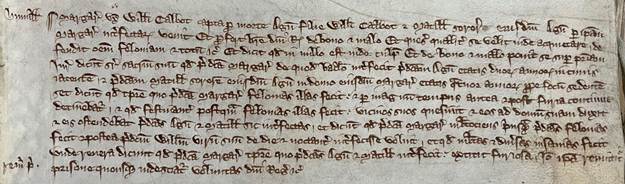
Margareta uxor Willelmi Calbot capta pro morte Agnetis filie Willelmi Calbot et Matildis sororis euisdem Agnetis per ipsam Margaretam interfectarumvenit Et profert breve domini Regis de bono et malo Et quaesivit qualiter se velit inde acquietare defendit omnem feloniam et totum etc Et dicit quod in nullo est inde culpabilis Et de bono et malo ponit se super patriam Juratores dicunt super sacramentum suum quod predicta Margareta de quodam baculo interfecit predictam Agnetam etatis duorum annorum in cunis iacentem et predictam Matildam sororem euisdam Agnetis in domo euisdam Margaretae etatis quatuor annorum prope focum sedentem set dicunt quod tempore quo predictam Margaretam felonias illas fecit et per magnum tempus antea et post furia continue detinebatur et quod festinantur postquam felonias illas fecit vicinos suos quesiuit et eos ad domum suam dixit et eis ostendebat predictas Agnetam et Matilldam sic interfectas et dicunt quod predictam Margaretam multotiens prius quam predictas felonias fecit Postea predictum Willelmum virum suum de die et noctanter interfecisse voluit et quod multas et diversas insanias fecit unde revera dicunt quod predictam Margaretam tempore quo predictas Agnetam et Matildam interfecit extitit furiosa Ideo ipsam remittitur prisone quousquam inde sciatur voluntas domini Regis etc
[Margin: Humill; remittitur prisone]
Translation: Margaret wife of William Calbot, taken for the death of Agnes daughter of William Calbot and Matilda sister of the same Agnes killed by the same Margaret, comes. She produces her writ of the Lord King of bono et malo. And when she is asked how she wished to acquit herself, she denied all all felony and the like, etc. And she says that she is in no way guilty. And for good and ill she puts herself upon the county. The jurors say upon their oath that the said Margaret with a certain staff killed the said Agnes, aged two years, lying in a cradle, and the said Matilda, sister of the said Agnes, in the house of the said Margaret, aged four years, sitting near the hearth, but they say that at the time when the said Margaret committed those felonies, and for a long time before and after, she was continually detained by fury. And that after she committed those felonies she hurried [and] sought her neighbors and called them to come to her house and she showed them the said Agnes and Matilda thus killed. And they say that the said Margaret many times before she committed the said felonies and afterwards, she wished to kill her said husband William by day and by night and that she did other many and diverse insane things, which they say truly that the said Margaret, at the time she killed the said Agnes and Matilda, she was insane. Therefore, she is remitted to prison [until] the will of the King is known, etc.
[Margin: Humbleyard; returned to prison]
Author bios:
Anna K. Davis is a PhD student at The Ohio State University studying criminal and violent women in medieval England. She received her MA from Western Michigan University in 2024 with her thesis “Female Criminal Agency in Early Fourteenth-Century Norfolk,” which is when she first examined Margaret’s case in detail.
Ashley Jordan is a PhD student at The Ohio State University. She studies law and society in the late antique and early medieval period, with a focus on citizenship and the unfree.
Images:
Main image: Early 14th century illumination depicting Rebecca after giving birth to Esau and Jacob. Oxford, Bodleian Library, MS. Douce 211 f. 27v, © Bodleian Libraries, University of Oxford. Shared under a Creative Commons Attribution-NonCommercial-ShareAlike 4.0 International (CC BY-NC-SA 4.0) license.
TNA JUST 3/48, m. 6 (Norf., 1309). Photo by Anna K. Davis, with thanks to The National Archives.
[1] The National Archives, Justices Itinerant (JUST) 3/48 m. 6.
[2] Diagnoses testified to by psychologist Dr. Paul Zeizel. Micheal Casey, “Psychologist testifies Lindsey Clancy was not responsible in killing of her 3 children,” Associated Press, August 20, 2026.
[3] Barbara Hanawalt Westman, “The Peasant Family and Crime in Fourteenth-Century England,” Journal of British Studies 13, no. 2 (1974): 11–12.
[4] Sara McDougall, “Singlewomen and Illicit Pregnancy in Late Medieval France: The Case of Marie Ribou (1481),” French Historical Studies 44, no. 4 (2021): 552.
[5] Barbara A. Hanawalt, “The Female Felon in Fourteenth-Century England,” in Women in Medieval Society, ed. Susan Mosher Stuard (Philadelphia, 1976), 131. Margaret’s case is also mentioned in Hanawalt, Crime in East Anglia in the Fourteenth Century: Norfolk Gaol Delivery Rolls, 1307–1316 (Norwich, 1976), 35; “Women Before the Law: Females as Felons and Prey in Fourteenth-Century England,” in Women and the Law: A Social Historical Perspective, vol. 1, ed. D. Kelly Weisberg (Cambridge, MA, 1982), 177; and “The Peasant Family and Crime in Fourteenth-Century England,” 11–12.
[6] Hanawalt, “The Female Felon,” 131.
[7] Hanawalt, “Women Before the Law,” 177.
[8] Sara M. Butler, “A Case of Indifference? Child Murder in Later Medieval England,” Journal of Women’s History 19, no. 4 (2007), 71–2, 76.
[9] Calendar of Close Rolls, Edward II: Volume 1, 1307–1313, ed. H.C. Maxwell Lyte (London, 1892), 190.
[10] “1 year later, Duxbury community gathers to mourn 3 slain children,” NBC Boston 10, January 25, 2024; Susannah Sudborough, “‘I Hope the Family Knows We’re All behind Them’: South Shore Gathers for Vigil after Duxbury Tragedy,” The Boston Globe, January 27, 2023.
[11] Carmel Wroth, et al., “With Jury Deadlocked, Judge Declares a Mistrial in Lindsay Clancy’s Murder Case,” NPR, September 4, 2026.
[12] Ramanpreet Toor, et al., “Postpartum Psychosis: A Preventable Psychiatric Emergency,” Focus 22, no. 1 (2024): 44–52.
[13] The topic of historical precursors to postpartum psychosis, especially its relationship with the rise of the asylum, has been explored by scholars such as Roger Smith, “Defining Murder and Madness: An Introduction to Medicolegal Belief in the Case of Mary Ann Brough, 1854,” Knowledge and Society: Studies in the Sociology of Culture Past and Present 4 (1983): 173–225; Ania Wilczynski, “Mad or Bad?: Child-Killers, Gender and the Courts,” The British Journal of Criminology 37, no. 3 (1997): 419–36; and Hilary Marland, Dangerous Motherhood: Insanity and Childbirth in Victorian Britain (Palgrave MacMillian, 2004). Thanks to Katherine Watson for directing us to these modern examples. Dianne Berg also mentions postpartum depression and psychosis at the end of her “Monstrous Un-Making: Maternal Infanticide and Female Agency in Early Modern England,” in Medieval and Early Modern Murder: Legal, Literary and Historical Contexts, ed. Larissa Tracy (Boydell & Brewer, 2018), 433.
Discover more from Legal History Miscellany
Subscribe to get the latest posts sent to your email.

