Posted by Krista J. Kesselring, 17 July 2026.
Juries remain iconic in understandings of rights and liberties, even as their forms and uses have changed over time—and may yet change again in England and Wales, quite dramatically, though the incoming prime minister is understood to have reservations about the plans to curb their use set out under the outgoing prime minister, Keir Starmer.[1] The Courts and Tribunals bill now before the U.K. Parliament proposes to reduce a backlog in cases and ‘modernize’ judicial processes by restricting the availability of jury trial for many criminal defendants in England and Wales. The proposal has prompted much concern, of various sorts. Some opponents of the bill fear that barring jury trials will increase bias or at least perceptions of it, heightening distrust and suspicion if not active miscarriages of justice. Others acknowledge that jury trial can be imperfect but point to the lack of evidence that infringing this ancient, long-tested right to be tried by a jury of one’s peers will work to achieve the stated purpose of making the courts more ‘efficient’. Proposals to restrict jury trials bring conservatives and progressives together in a variety of ways to defend this ‘lynchpin of a fair society’ (in the words of Andy Burnham).[2]
How and when did the criminal trial jury come to be so closely associated with fundamental rights and freedoms? The late Lois Schwoerer used the term ‘jury ideology’ to refer to the celebratory view of the jury as a bulwark that protected subjects and their liberties from arbitrary and lawless government, as well as false or mistaken accusations more generally, and suggested that it emerged most clearly articulated in the late seventeenth century.[3] Several factors influenced its development, but this post focuses on the role of the trial jury’s older sibling, often overlooked perhaps because it is now defunct in much of the common law world: the grand jury. ‘Grand’ referred to its size, compared to the petty or ‘petit’ jury of twelve who tried the case; the grand jury was a larger group of typically twenty-four men that both made accusations based on their own local knowledge and filtered accusations made by others to decide which ones would go to trial as indictments. When a bill of accusation came before the courts, a grand jury decided whether the evidence warranted a trial, deeming it a billa vera (true bill) or else discarding it with an ignoramus (we do not know).[4] The part played by this prosecutorial filter in the emergence of jury ideology appears more clearly when viewed in conjunction with the notorious early modern Court of Star Chamber, both in its life and in its afterlife. Star Chamber served as a foil for the jury as institution and as ideology. In Star Chamber, unlike the regular common law courts, cases began and ended without the indictments of grand juries or verdicts of petty juries. In the court’s heyday, moreover, its judges tried to frustrate the ‘corruption’ (or independence) of both grand and petty juries—as well as the former’s other sibling, the coroners’ juries—through fines and shaming punishments.[5] Then, after its abolition in 1641, Star Chamber became a spectre that enhanced the standing of both grand and petty juries as ‘pillars of English liberty’, guaranteed by Magna Carta.
Part One: The Early Development of Jury Ideology
That juries would come to be counted among the ‘ancient and sacred’ protections afforded by Magna Carta was neither an inevitable nor straightforward journey, but seems to have taken shape in the late Elizabethan and early Stuart contests between common law and other jurisdictions. Professor John Baker suggests that the jury’s link with the Great Charter’s due process provisions and talk of ‘trial by peers’ developed only in the late sixteenth century as Magna Carta itself started to be re-invented as a bulwark of liberties by writers such as Edward Coke, in the midst of post-Reformation jurisdictional and constitutional conflicts.[6] Proponents of the common law contested the powers of the ecclesiastical courts of High Commission to impose the ex officio oath—an oath to tell the truth no matter what was asked of its takers, effectively forcing them to become their own accusers and thus bypassing the usual modes of accusation at common law. Moreover, as Adam Forsyth has deftly shown, the critiques went beyond oaths alone: they emerged first in response to ecclesiastical courts’ orders to arrest excommunicates without ‘due & legal accusation or presentment’.[7] In time, the critiques first honed against the ecclesiastical courts of High Commission grew to include the Court of Star Chamber and transmuted into a fervid attachment to juries as a necessary protection against unjust prosecutions.
Queen Elizabeth’s chief minister, William Cecil, lord Burghley, reportedly asserted in 1588 that
‘it was the liberty of the subject of England, more than of all other nations, that he should not be molested or imprisoned without indictment: other nations have an accusation, but that is verbal and at the promotion of a party, whereas this is by the presentment of his neighbours and peers upon their oath and should be of record. This liberty was purchased to the subjects of England with the blood of many people, noble and ignoble, and was the cause of the Barons’ War, and it is the noblest accusation that may be’.[8]
Ironically, perhaps, Burghley is said to have made the statement during a hearing in Star Chamber—in a case against two London sheriffs who arrested, imprisoned, and whipped two women without indictment or due process of any sort.[9] A direct if thin line linked his words and the writings of later champions of the jury as a defence against proceedings such as those for which Star Chamber became infamous.
Burghley’s purported speech became more widely known after being quoted in the habeas hearing for William Owner and Richard Maunsell in King’s Bench in 1607, a case focused on the power of the church courts to imprison without indictments at common law. As defence counsel, Nicholas Fuller continued his earlier attacks on High Commission and its ex officio oaths. Reports of the hearing circulated not just in manuscript but also in a covertly printed tract, conveying Fuller’s arguments that such oaths violated the laws and liberties that were the ‘high inheritance of the realm’. The Great Charter provided that none shall be arrested or imprisoned without ‘due process of law’. To force a man to accuse himself in a criminal case violated the laws of God and of England: accusations without the biblically mandated two witnesses to support them had to go before a jury of indifferent persons, a kind of trial ‘so behoveful for the subjects as it may prevent much wrong and oppression from high authority’.[10] Fuller himself, as well as the puritan printer who published his arguments against the ecclesiastical jurisdiction and procedures, soon stood accused in Star Chamber in turn.[11]
Law-minded concerns that focused on the ecclesiastical courts expanded to include Star Chamber’s processes. In a 1603 case, a man brought into Star Chamber for his opposition to the prayer book cited Magna Carta in his challenge that he should be tried only ‘by judgement of his peers or by the law of the land’.[12] Writing in 1621, William Hudson defended the court from criticisms even as he allowed that its ore tenus oral proceedings on oath might sometimes be a ‘dangerous excess’ and an ‘exuberancy of prerogative’. [13] But it was John Lilburne who most effectively linked Star Chamber and its procedures with the widely despised practices of the ecclesiastical courts of High Commission. Detained in 1637 by order of Star Chamber for dispersing unlicensed books, Lilburne famously ended up being whipped through the streets for his refusal to swear the oath tendered to him in his examination, what he called an ‘inquisition-oath’, an ‘oath of inquiry, and of the same nature of the High Commission Oath, which I knew to be unlawful’—he knew it to be unlawful, ‘as Mr. Nicholas Fuller in his Argument doth prove’.[14]
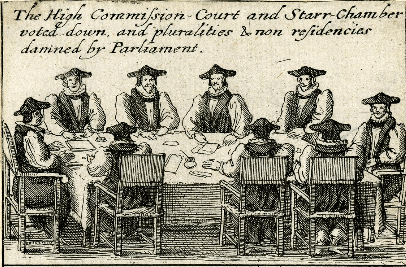
Lilburne’s published accounts of his treatment at the hands of Star Chamber—first printed abroad, then in London when the Long Parliament met—influenced later jurisprudence on the right to remain silent and to avoid self-incrimination.[15] His accounts also did much to channel a depiction of the court to later generations that set it up as a foil for the jury. In the meantime, the ideology of the jury developed in the contests that led to the court’s closure and in the years immediately following. In 1640 and 1641, parliament received dozens of petitions from or on behalf of people imprisoned by both Star Chamber and High Commission. The Commons ordered investigations into the individual cases as well as the ‘excesses’ of Star Chamber itself. The ‘excesses’ alleged by petitioners ranged widely, including the kinds of charges, the nature of the proceedings, the types of punishments imposed, and the ends to which they were put. Lilburne and others imprisoned by Star Chamber and High Commission were freed.[16] In 1641, parliament decided to abolish both courts. The bill to close Star Chamber invoked Magna Carta and insisted that the ordinary course of justice and common law of the land must triumph. It maintained that both the Great Charter and laws enacted under Edward III had established that ‘none shall be taken by petition or suggestion made to the King or to his Council, unless it be by indictment or presentment of good and lawful people of the same neighbourhood where such deeds be done’. And, of course, no one would be condemned ‘but by lawful judgment of his peers’.[17]
The linking of ‘due process’ and the jury—both grand and petty—continued apace in the years of civil war and republican rule that followed. Among the legal reformers active in this era, some argued for the abolition of the jury itself: the longstanding difficulties in finding fit men of sufficient understanding and integrity exercised some, and it seems that some members of parliament thought that juries might no longer be needed in the new republican age.[18] But advocates such as John Lilburne and others in the Leveller movement that cohered around him became ever more explicit and voluble in the jury’s defence.[19] In the Hue and Cry After the Fundamental Laws and Liberties of England, for example, Lilburne described those fundamental laws as jewels and juries as pearls—and insisted that no man could be taken by petition made either to king or parliament unless it be by writ original at the common law or upon an indictment by good and lawful men.[20] And he cited, again and again, the ‘excellent law that abolished the Star Chamber’ as affirming the necessity of indictment by a jury of peers.[21] Lilburne and writers of the revolutionary era elevated the jury to a starring role in the ‘birthright’ or ‘inheritance’ of laws that protected the liberties of the freeborn English.[22]

Part Two: Star Chamber’s Spectre
Star Chamber’s part in the development of jury ideology continued after the court’s demise. A blog post that traced the defences of the jury, both petty and grand, through the conflicts of the Restoration era and Revolution of 1688—the history already examined by Lois Schwoerer—would quickly grow far too long. In brief, when grand juries obstructed charges against some supposed participants in the plots of the era, the figure of the ‘ignoramus juryman’ prompted much discussion in the press and a revival of interest in the role of the indictment jury.[23] When a trial jury freed the seven bishops charged by James II, grand juries refused to indict members of boisterous crowds who raucously celebrated the verdict.[24] But for present purposes we can skip to the great conflicts over seditious libel and freedom of the press in the eighteenth century, in which Star Chamber emerged as a fearsome spectre to prove the need for robustly independent juries, both grand and petty.
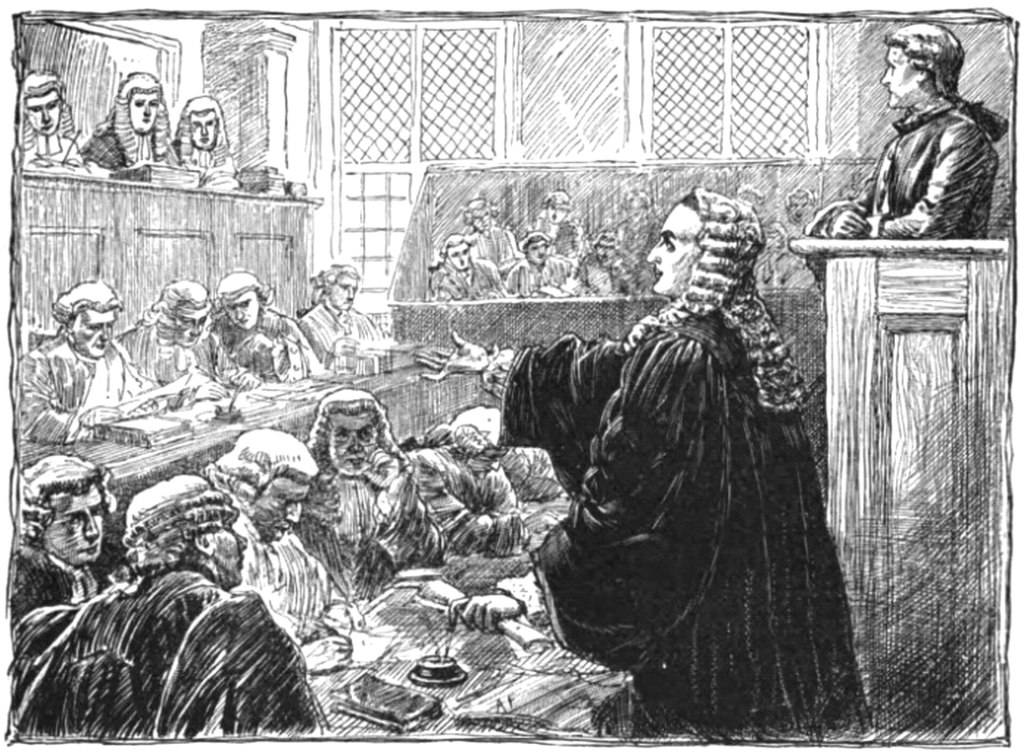
A key event in channelling lessons from the seventeenth century into the eighteenth unfolded in the colonies, with the trial of the New York publisher John Peter Zenger. In 1735, Zenger stood trial for seditious libel for criticisms of the colonial governor in his newspaper and in a pamphlet that criticized the governor’s attempt to bypass a jury in a case relating to his own interests. Twice grand juries refused to return the indictments put before them by the chief justice. Instead, the governor filed an information before the justices who in turn issued a bench warrant for Zenger’s arrest. After some delays prompted by attempts at jury packing by the governor’s men, the trial began on 4 August with the Philadelphia lawyer Andrew Hamilton conducting Zenger’s defence. He noted that Zenger did not deny having printed the works in question, but he strongly disputed their characterization as libel. And Hamilton argued that it was the jury’s job, not the judges’, to determine whether the statements constituted libel—that is, to determine the law and not just the facts of the case. He launched into a remarkable defence not just of a free press—the claims for which the Zenger trial is perhaps most famous—but also of the jury as an institution. His arguments invoked Star Chamber as a grim spectre, calling it ‘that terrible court…the most dangerous court to the liberties of the people of England that ever was known in that kingdom’. He challenged the law of seditious libel, or at least the notion that the truthfulness of the claim was no defence, by tracing it to its roots in Star Chamber jurisprudence. But he didn’t just discuss the ‘most arbitrary and destructive judgements and opinions…of that arbitrary court’; he also used its processes to laud the jury. In that awful court, the people of England were cheated out of their ‘ancient and sacred right of trials by grand and petit juries’. There, ‘instead of being lawfully accused by 24 good and lawful men of the neighbourhood and afterward tried by 12 like lawful men’, men stood trial on bare accusations. Star Chamber was ‘the soil where informations grew rankest’. Hamilton alluded to Lilburne and quoted from the Act that abolished the court while insisting that the mode of prosecuting by information when a grand jury would not find billa vera was a ‘national grievance’ and most inimical to the liberties of the people.[25] Hamilton’s arguments secured an acquittal from Zenger’s trial jury, to much public celebration.
An account of Hamilton’s arguments soon appeared in England, in multiple printings. Another would be republished decades later, at the time of John Wilkes’s encounters with the courts in the 1760s. Another newspaperman charged with seditious libel and arrested on a bench warrant, Wilkes published works that prompted a political firestorm centred on freedom of the press but encompassing ‘liberty’ and constitutional issues more broadly.[26] Star Chamber played a significant role in the texts Wilkes and his supporters published in these years. Its malign reputation helped to challenge components of the law of libel developed in its decisions. But even more so, Wilkes and his fellows emphasized its procedures and its bypassing and suppressing of juries as the key things that brought down this ‘court of inquisition’. Wilkes blasted the ‘Star-Chamber proceedings in the Court of King’s Bench’, denouncing prosecution on a writ of attachment alone and suggesting it had no precedent beyond the despised Court of Star Chamber, which he depicted as having been abolished precisely for its failure to proceed via grand jury indictments.[27] William Bollan and John Rayner offered similar accounts of the court and of juries, citing the Act that abolished Star Chamber right alongside Magna Carta itself.[28] Both Lilburne and Zenger made appearances in works on the Wilkes affair.[29] The title of one book published anonymously left no ambiguity about its argument: The Court of Star Chamber, or Seat of Oppression.[30]
In a classic essay from 1961, Thomas Garden Barnes set out to bust various ‘Star Chamber myths’. He took aim at characterizations of the court as despotic and incompatible with the common law’s protection of the rights of Englishmen.[31] But instead of just refuting the views that consolidated in eighteenth-century texts and showing them to have been ‘wrong’ (or right), we might remember that the derogatory perception of Star Chamber was not originally the product of ostensibly disinterested legal historians but of participants in political and legal conflicts for whom a malevolent Star Chamber served as a useful foil. They found it particularly useful in burnishing the mythology and ideology of the jury. And for them, a key component of that jury ideology was one that has now largely fallen by the wayside in much of the common law world: the grand jury.
Grand juries persist in the United States: until recently often dismissed as largely pointless, they are now receiving renewed appreciation for rebuffing contentious, politically motivated charges made under the current Justice Department.[32] Grand juries have long since disappeared in the U.K., in Canada, and elsewhere in the common law world, but trial juries retain a variety of useful, even necessary functions in criminal justice and in civic life more generally. While individual juries sometimes leave much to be desired, as an institution, this ancient but still vital form of association should not be blindly bled to the point of death on the altar of supposed ‘efficiencies’. In a speech selling the bill to curb juries (and touting the benefits of AI), Lord Chancellor David Lammy said he was ‘calling time on the justice system of the past’. MPs may let trial juries go down the path of their defunct companions, but perhaps they will want to hold off on last orders for a while yet.[33]
Images:
Cover image: detail from the title page of Anon., Ignoramus Vindicated…Touching the Duty, Power, and Proceedings of Juries (London, 1681).
‘Starr-Chamber voted down’, from a series of prints by Wenceslaus Hollar known as the ‘Chronicle of the Civil War’ which appeared under several titles and is here used from the British Museum’s website. © The Trustees of the British Museum. Shared under a Creative Commons Attribution-NonCommercial-ShareAlike 4.0 International (CC BY-NC-SA 4.0) licence.
Portrait of John Lilburne at the bar, below medals commemorating the jury that acquitted him, from The Triall of Lieut. Collonell J. Lilburne (London, 1649). © The Trustees of the British Museum. Shared under a Creative Commons Attribution-NonCommercial-ShareAlike 4.0 International (CC BY-NC-SA 4.0) licence.
‘The Zenger trial, as depicted by an illustrator in the 1883 book, Wall Street in History’, via Wikimedia Commons.
Notes:
My title echoes Frank Riebli’s essay, ‘The Spectre of Star Chamber: The Role of an Ancient English Tribunal in the Supreme Court’s Self-Incrimination Jurisprudence’, UC Law Constitutional Quarterly 29.4 (2002), 807-30.
[1] Mentioned briefly in Jessica Elgot and Kiran Stacey, ‘The building in-tray of challenges Andy Burnham faces upon entering No 10’, The Guardian, 10 July 2026 [accessed 16 July 2026], and in the longer but paywalled piece by Lara Spirit, ‘Andy Burnham is already running out of time to get ready for power’, The Times, 4 July 2026 [accessed 16 July 2026].
[2] As quoted in Parliament, Helen Grant on 9 July 2026: https://hansard.parliament.uk/commons/2026-07-09/debates/FC280A64-1934-4FBF-A10B-6D3A73DE2678/JuryTrials and in The Times article cited above.
[3] Lois Schwoerer, ‘Law, Liberty, and “Jury Ideology”: English Transatlantic Revolutionary Traditions’, in Revolutionary Currents: Nation Building in the Transatlantic World, ed. Michael A. Morrison and Melinda Zook (Rowman & Littlefield, 2004), 35-64.
[4] The trial jury usually takes the lion’s share of scholarly interest, but the grand jury is addressed in such foundational texts as J.S. Cockburn, A History of English Assizes, 1558-1774 (Cambridge University Press, 1972); Thomas Andrew Green, Verdict According to Conscience: Perspectives on the English Criminal Trial Jury, 1200-1800 (University of Chicago Press, 1985); and Thomas A. Green, ‘The Jury, Seditious Libel and the Criminal Law’, in Juries, Libel and Justice: The Role of English Juries in Seventeenth- and Eighteenth-Century Trials for Libel and Slander, ed. R.H. Helmholz and T.A. Green (William Andrews Clark Memorial Library, 1984), 39-91. For an examination of the grand jury’s wide variety of administrative functions, see John Morrill, The Cheshire Grand Jury, 1625-1659: A Social and Administrative Study (Leicester University Press, 1976).
[5] Not discussed here, but the subject of Charles Hamilton, ‘Star Chamber and Juries: Some Observations’, Albion 5.3 (1973), 237-42 and a forthcoming article, Kesselring, ‘The Jury, the Witch, and the Shadow of Doubt: Trying Witchcraft and Perjury in Early Modern England’, English Historical Review.
[6] J.H. Baker, The Reinvention of Magna Carta, 1216-1616 (Cambridge, 2017), esp. p. 37.
[7] Adam B. Forsyth, ‘England’s Erastus? Or, James Morice and the Law of Excommunication’, Historical Journal 69 (2026), 21-41, quote from Morice at p. 34.
[8] From the report on Maunsell’s Case (1607), which survives in several manuscript copies, quoted here from J.H. Baker’s translation and transcription in Appendix 9 of Reinvention of Magna Carta, 520. Baker notes that it isn’t clear whether the words following the colon are attributable to Burghley. Maunsell’s co-defendant in some reports, and in the printed version cited below, is named as Thomas Lad.
[9] AG v. Skynner and Catcher (1588). Some of the pleadings from this case survive in The National Archives, Kew (TNA), STAC 5/N15/10, catalogued as Neville v Catcher; the decree is in British Library, Add MS 48064, fols. 207-208d.
[10] Nicholas Fuller, The Argument of Master Nicholas Fuller, in the Case of Thomas Lad, and Richard Maunsell, his clients, Wherein it is plainely proved, that the Ecclesiastical Commissioners have no power, by virtue of their commission, to imprision, to put to the oath ex officio, or to fine any of his Maiesties subiects (London, 1607; also reprinted in 1641), quotations at pp. 3, 12.
[11] On Fuller, see Andrew Thrush, ‘Fuller, Nicholas (1544-1620), of Gray’s Inn, London and Chamberhouse, Thatcham, Berks’, The History of Parliament: The House of Commons 1604-1629, ed. Andrew Thrush and John P. Ferris, 2010: https://www.historyofparliamentonline.org/volume/1604-1629/member/fuller-nicholas-1544-1620. For the bill against the printer, see TNA, STAC 8/11/18; for the proceedings against Fuller, see STAC 8/19/7. For the case against the printer, see Mark H. Curtis, ‘William Jones: Puritan Printer and Propagandist’, The Library, 19 (1964), 38-66, esp. 58n2. For Fuller’s case and the broader conflict between the common law courts and High Commission, see David Chan Smith, Sir Edward Coke and the Reformation of the Laws (Cambridge University Press, 2014), ch. 6.
[12] W. Hudson, ‘A Treatise on the Court of Star Chamber’, in Collectanea Juridica, ed. F. Hargrave (2 vols, London, 1792), ii. 1-240, at p. 4. (Hudson noted that Lord Keeper Egerton argued that the ‘or’ in the pertinent clause of Magna Carta was disjunctive, that one needed to be tried by indictment or writ original OR by the law of the land, and insisted that what Star Chamber enforced was the law of the land. He also argued that a privy seal or subpoena ‘is in the nature of an original writ’.) For this case, see also John Hawarde, Les Reportes del Cases in Camera Stellata, ed. W.P. Baildon (London,1894), 164.
[13] Hudson, ‘Treatise’, quote at p. 128.
[14] John Lilburne, A Worke of the Beast, or a relation of the most unchristian censure executed upon John Lilburne (now prisoner in the Fleet) the 18 of April 1638 (Amsterdam, 1638), 12-13. Another version was published in England in 1641: John Lilburne, The Christian Mans Triall, Or, A True Relation of the First Apprehension and Severall Examinations of John Lilburne with his censure in Star-Chamber (London, 1641). Note, too, the contemporaneous reprinting of Fuller’s Argument.
[15] See, e.g., Riebli, ‘Spectre of Star Chamber’ for the American legacy; for England and Wales, M.R.T. MacNair, ‘The Early Development of the Privilege against Self-Incrimination’, Oxford Journal of Legal Studies 10.1 (1990), 66-84, at pp. 67, 79.
[16] Discussed in Steven Carl Dalla Lana’s MPhil thesis, “The Court of Star Chamber, 1629-1641” (University of St Andrews, 1987) and on this blog, ‘The End(s) of a Lawless Court’, 22 April 2025. On Lilburne and his campaign, see Michael Braddick, The Common Freedom of the People: John Lilburne & the English Revolution (Oxford University Press, 2018).
[17] 17 Car. 1, c. 10, Act for the Abolition of the Court of Star Chamber.
[18] Austin Woolyrich, Commonwealth to Protectorate (Clarendon Press, 1982), 294.
[19] Note that the exchange between Henry Robinson and Leveller William Walwyn focused on trial jury: Henry Robinson, Certaine Considerations, in Order to a More Speedy, Cheap, and Equally Distribution of Justice throughout the Nation (London, 1651) and William Walwin, Juries Justified: Or, A Word of Correction to Mr. Henry Robinson; for his seven objections against the trial of causes, by juries of twelve men (London, 1651).
[20] John Lilburne, An Hue and Cry After the Fundamental Lawes and Liberties of England (London, 1653), fol. 4.
[21] See, e.g., John Lilburne, The Triall, of Lieut. Collonell John Lilburne, by an extraordinary or special Commission, of oyear and terminer at the Guild-Hall of London, the 24, 25, 26. Of Octob. 1649 (London, 1649), 11.
[22] On the significance of theologically-charged ‘birthright’ language, see Paul Halliday, ‘Birthrights and the Due Course of Law’, The Oxford Handbook of English Law and Literature, 1500-1700, ed. Lorna Hutson (Oxford University Press, 2017), 587-603.
[23] See, e.g., Anon., Ignoramus vindicated in a dialogue between prejudice and indifference touching the duty, power, and proceedings of juries (London, 1681); Anon., Billa vera, or, The arraignment of ignoramus put forth out of clarity, for the use of grand inquests and other jury’s, the sworn assertors of truth and justice (London, 1681); A Letter from the Grand-Jury of Oxford to the London-Grand-Jury relating to the case of the Protestant-joyner(London, 1681).
[24] William Gibson, James II and the Trial of the Seven Bishops (Palgrave Macmillan, 2009), 132, 135-6.
[25] A Brief Narrative of the Case and Tryal of John Peter Zenger, Printer of the New-York Weekly Journal (New York, 1738), quotes at pp. 28, 31, 33, 34, 37.
[26] On the Wilkes affair, see, e.g., Peter D.G. Thomas, John Wilkes, A Friend to Liberty (Clarendon Press, 1996).
[27] John Wilkes, A letter to the Right Honourable William Lord Mansfield, Lord Chief Justice Of England, And One Of His Majesty’s Most Honourable Privy Council. Upon some late Star Chamber proceedings in the Court of King’s Bench. Against the publishers of the Extraordinary North Briton, no. IV. By the author of those papers (London, 1768).
[28] William Bollan, The freedom of speech and writing upon public affairs, considered; …The Origin, legal and assumed Jurisdiction, Severities, Subservience to arbitrary Power, and Abolition of the Court of Star-Chamber, and of Trial by Juries. With Observations on the proper Use of the Liberty of the Press, and its Abuses, particularly of late with respect to the Colonies; and a brief State of their Origin and political Nature, collected from various Acts of Princes and Parliaments (London, 1766) and John Rayner, An inquiry into the doctrine lately propagated, concerning attachments of contempt, the alteration of records, and the Court of Star-Chamber (London, 1769), esp. pp. 92-6.
[29] See Edward Vallance, ‘Reborn John? The Eighteenth-Century Afterlife of John Lilburne’, History Workshop Journal 74.1 (2012), 1-26 at p. 16. See, too, Andrew Whitehead’s images and description of a copy of The Tryal of Lieutenant Colonel John Lilburn owned by Wilkes: ‘Radical Objects: John Lilburne and John Wilkes’, History Workshop blog, 28 Sept 2012 [accessed 16 July 2026].
[30] Anon., The Court of Star Chamber, or Seat of Oppression (London, 1768).
[31] Thomas G. Barnes, ‘Star Chamber Mythology’, American Journal of Legal History 5.1 (1961), 1-11.
[32] John Gerstein, ‘Trump Triggers a Renaissance for Grand Juries’, Politico, 7 January 2026 [accessed 16 July 2026] and John E. Jones III, ‘Trump Has Unintentionally Revived the Grand Jury’s True Purpose’, The Hill, 24 January 2026 [accessed 16 July 2026]. See also, e.g., reports on Sean Dunn, so-called ‘Sandwich Guy’, charged by federal prosecutors with felony assault on a federal officer for throwing a sandwich during a protest: Robert Tait, ‘Grand Jury Declines to Indict Alleged Washington DC Sandwich Thrower’, The Guardian, 27 August 2025 [accessed 16 July 2026].
[33] David Lammy, ‘We Are Calling Time on the Justice System of the Past’, delivered 24 February 2026: https://www.gov.uk/government/speeches/we-are-calling-time-on-the-justice-system-of-the-past [accessed 16 July 2026].
Discover more from Legal History Miscellany
Subscribe to get the latest posts sent to your email.


As ever, a beautifully written post. There’s lots of food for thought here: as an historian of the medieval English legal system, my own reaction to the recent proposals to abandon the jury has been wholly negative. Despite its problems, I remain committed to the trial jury in the Canadian system of justice, and will happily draw on this piece in future discussions.
LikeLiked by 1 person
Excellent work, and timing.
LikeLiked by 1 person